
Loading, please wait...
LOT 0014
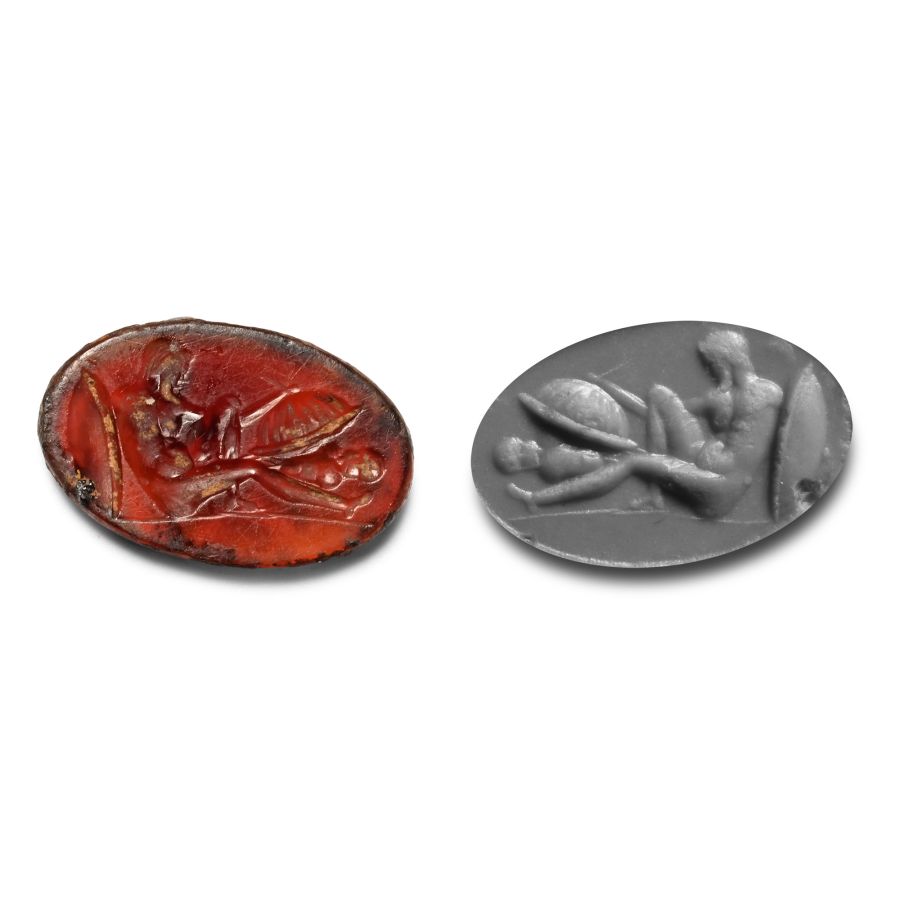
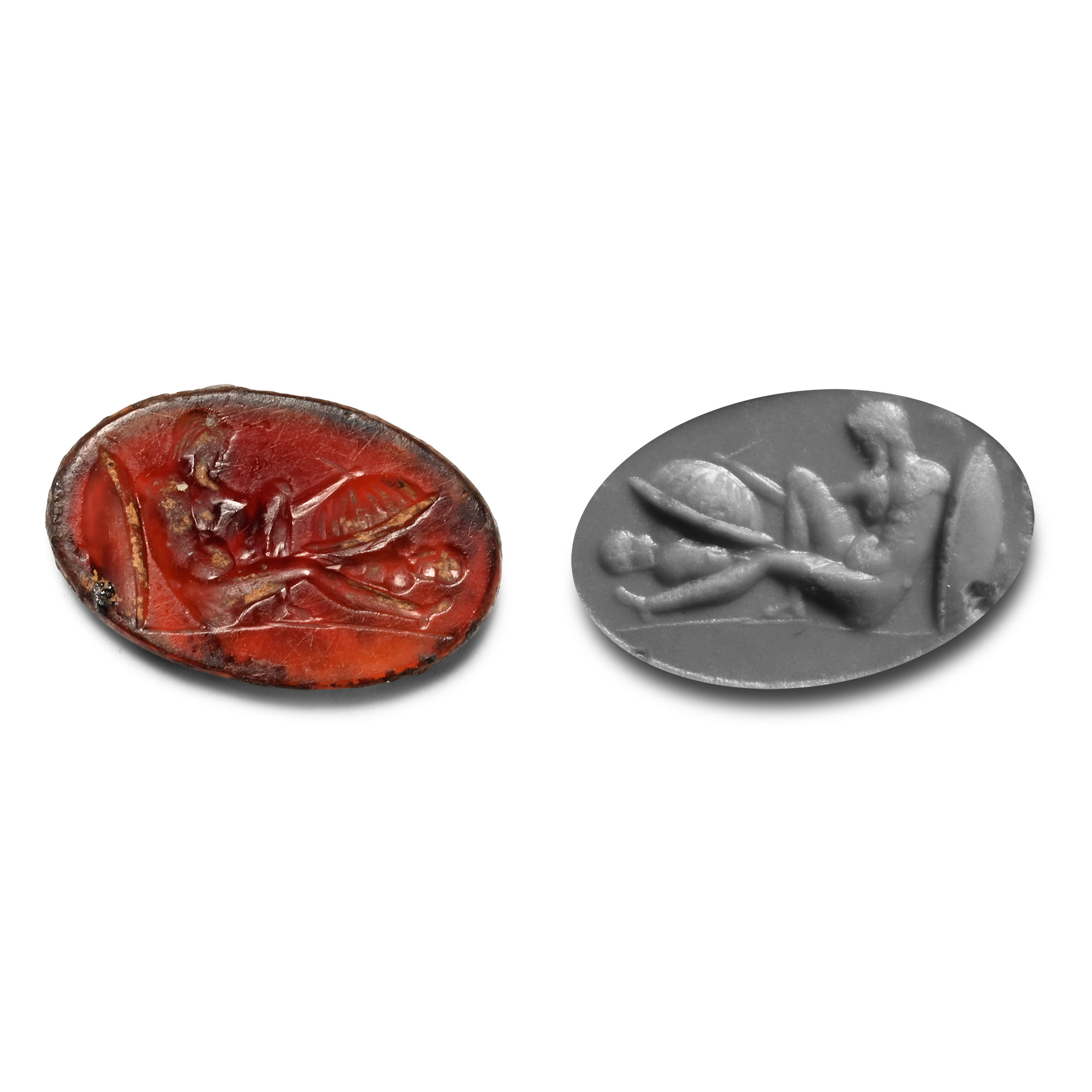
Roman Sard Gemstone of Othryades the Fallen Warrior Writing on a Shield
1ST-2ND CENTURY A.D.
1/2 in. (0.50 grams, 14 mm).
With incuse scene on a baseline depicting a nude warrior resting on a baseline with his shield propped behind his back, one leg bent and one arm extended towards the convex shield of another warrior (visible as head and trunk), with a stylus in his hand in the act of inscribing the shield; supplied with a museum-quality impression.
ProvenancePrivate English collection, formed between the late 1970s and early 1990s.
Private collection, London, UK.
TimeLine Auctions follows a vetting process to ensure the authenticity and legality of all items, reinforcing our commitment to integrity and responsible trading. Each antiquity, antique, and coin lot undergoes thorough examination by a vetting committee of at least ten external specialists, professional trade association members, scientists, and archaeologists: Our Vetting Process
AUCTIONS:
TimeLine is a leading auction house specialising in antiquities, ancient art, collectables, natural history, coins, medals, and books. Our auctions offer museums, collectors, historians, and enthusiasts the opportunity to acquire unique and historically significant pieces.
LOT 0014
Roman Sard Gemstone of Othryades the Fallen Warrior Writing on a Shield
Sold for (Inc. bp): £442
-
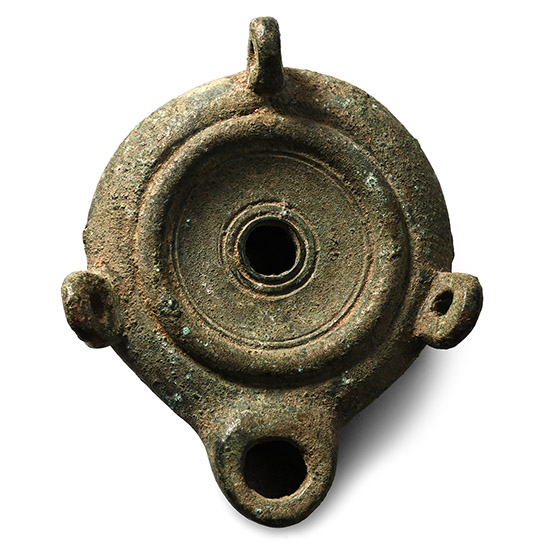
Roman Bronze Oil Lamp
3rd-5th century A.D.Estimate: £400 - 600 (‡+bp*)
Opening Bid: £200
With broad sloping shoulder and concave discus with raised circular ridge, central hole; three radiating suspension loops and stub nozzle with flat rim; base with incuse circular grooves. 106 grams, 67 mm
Ex collection Mr. K.H., Germany, Private collection, acquired in 2012. -
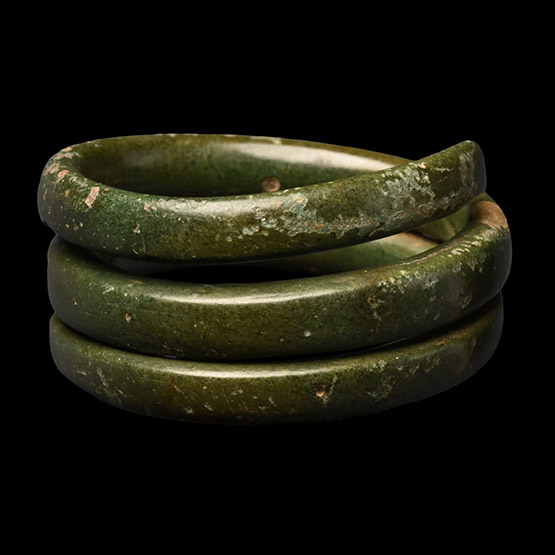
Romano-British Coiled Ring
1st century A.D.Sold for (Inc. bp): £65
Formed from a tightly coiled rectangular-section bar. 17.46 grams, 28.89 mm overall, 21.26 mm internal diameter (approximate size British V 1/2, USA 10 3/4, Europe 24.4, Japan 23)
Found near Cambridge, UK. Acquired on the UK and EU art market before 2000. From the private collection of a Surrey, UK, gentleman.
Spiral type rings have been found in the northern Provinces of the Empire, and a very similar specimen, but in silver, was found near Sitten in 1888, inside a Roman grave of Muraz la Sierre. Bronze examples came from the Germanic Limes. They continued models and typologies of Celtic fashion. -
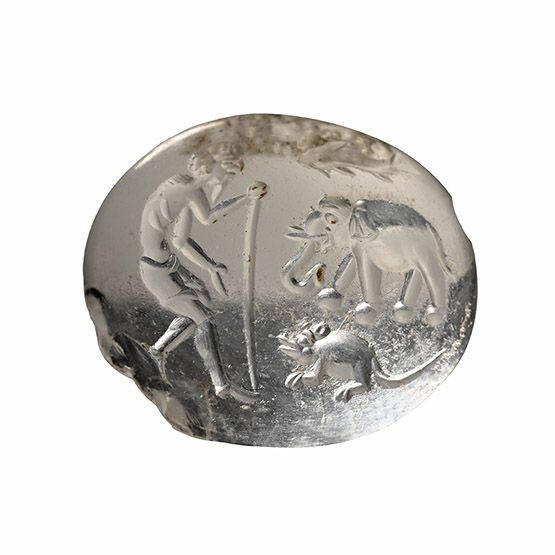
Kushan or Indo-Greek Rock Crystal Gemstone with Mature Man and Animals
1st-3rd century A.D.Sold for (Inc. bp): £3,120
Plano-convex in section with incuse image of an advancing elderly man with a staff facing three beasts: dolphin, elephant and rat; possibly Kushan workmanship; supplied with a museum-quality impression. 2.44 grams, 18 mm
Private English collection, formed between the late 1970s and early 1990s. Private collection, London, UK.
