
Loading, please wait...
_900x900.jpg "Roman Sapphire Gemstone with Crescent Moon and Star")
_200x200.jpg "Roman Sapphire Gemstone with Crescent Moon and Star")
.jpg "Roman Sapphire Gemstone with Crescent Moon and Star")
LOT 0094
Roman Sapphire Gemstone with Crescent Moon and Star
THIRD QUARTER OF 1ST CENTURY B.C.
3/8 in. (1.05 grams, 10 mm).
Cushion-shaped greenish-blue intaglio engraved with a large crescent moon and star.
ProvenanceFormerly in a private collection of an European lady, 1970s-1980s.
Private collection, UK.
This lot has been checked against the Interpol Database of stolen works of art and is accompanied by search certificate number no.13305-257800.
Cf. for the use of sapphire in Roman jewellery, Altamura, F., Tomei, N., Cerino, P., ‘Characterization and provenance of ancient gemstones: Case study of a gold-and-sapphire jewel dating from the Roman imperial period and found in a tomb in Colonna, Italy’ in Proceedings of 3rd IMEKO International Conference on Metrology for Archaeology, Lecce, Italy, October 23-25 2017, pp.312-31, figs.4-5.
FootnotesBasaltic sapphires used by the Romans came from surface deposits in northern Ethiopia, which were already known and productive in ancient times. This hypothesis is supported by comments by Pliny the Elder (23–79 A.D.) and Solinus (early 3rd century A.D.), both of whom referred to gems from Ethiopia named ‘hyacintos’, which is generally accepted in archaeology to be the ancient name of sapphire. The moon and stars have been, since the 4th century BC, symbols of the city of Byzantium and were also linked with Spartan military culture.
CONDITIONTimeLine Auctions follows a vetting process to ensure the authenticity and legality of all items, reinforcing our commitment to integrity and responsible trading. Each antiquity, antique, and coin lot undergoes thorough examination by a vetting committee of at least ten external specialists, professional trade association members, scientists, and archaeologists: Our Vetting Process
AUCTIONS:
TimeLine is a leading auction house specialising in antiquities, ancient art, collectables, natural history, coins, medals, and books. Our auctions offer museums, collectors, historians, and enthusiasts the opportunity to acquire unique and historically significant pieces.
-
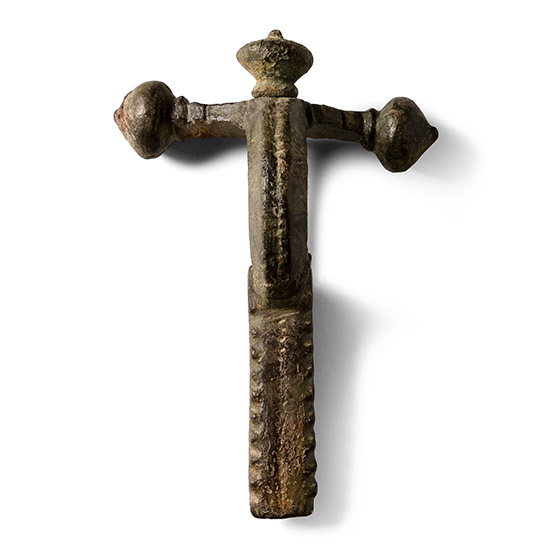
Roman Bronze Crossbow Brooch
4th century A.D.Sold for (Inc. bp): £85
With three onion-shaped knops to the crossbar, deep bow, trapezoidal foot with notched edges and longitudinal line; integral catch; hinged pin to reverse. 39 grams, 69 mm
From the private coin collection of a West London, UK, gentleman, formed since the mid 1980s. -
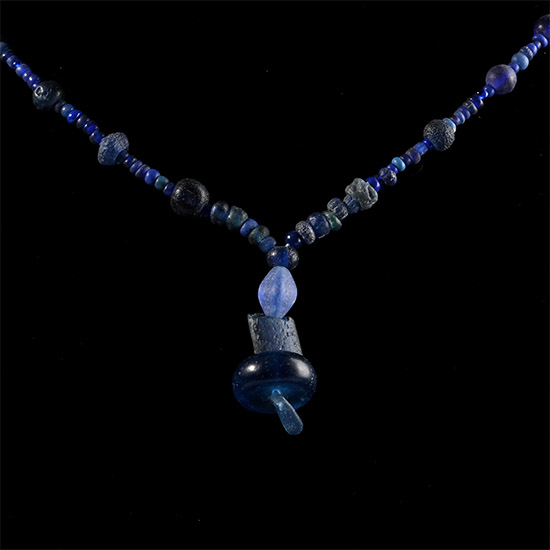
Roman Blue Glass and Other Bead Necklace String
1st-4th century A.D. and laterSold for (Inc. bp): £104
Composed of small oblate and larger spherical beads, the central feature composed of larger beads, restrung. 12 grams, 34.5 cm
Acquired in the 1990s. Ex London, UK, collection. -
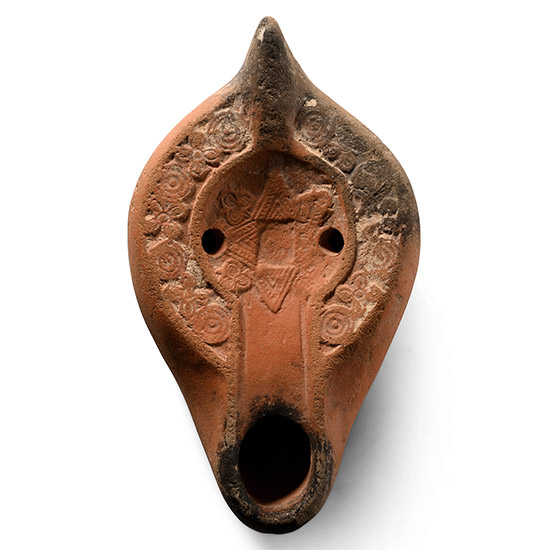
Large Late Roman Terracotta Oil Lamp with Floral Design
Circa 5th-6th century A.D.Sold for (Inc. bp): £117
Piriform body with large nozzle and a small stub handle to the rear, the edge with a band of alternating concentric circles and flowers, the discus with flowers and triangles, inked collector's number '347' on the base. 248 grams, 14.1 cm
Ex important German collection, 1960-1990.
