
Loading, please wait...
_900x900.jpg "Roman Sapphire Cameo with Bust of Serapis Later Converted to Saint John the Evangelist")
_200x200.jpg "Roman Sapphire Cameo with Bust of Serapis Later Converted to Saint John the Evangelist")
.jpg "Roman Sapphire Cameo with Bust of Serapis Later Converted to Saint John the Evangelist")
LOT 0090
Roman Sapphire Cameo with Bust of Serapis Later Converted to Saint John the Evangelist
CIRCA 2ND-3RD CENTURY A.D., REWORKED 6TH-7TH CENTURY A.D.
1 in. (5.06 grams, 23 mm).
Carved in the half-round on a sapphire crystal showing striations on the reverse, depicting the upper body of Serapis/St John with modius and pleated tunic, eagle with spread wings placed on the chest.
ProvenanceAcquired circa 1980.
Property of a Middlesex gentleman.
This lot has been checked against the Interpol Database of stolen works of art and is accompanied by search certificate number no.13351-255640.
Cf. for the style a medallion decorated with the bust of an Evangelist in Istanbul Archaeological Museum in Killerich, B., ‘The State of Early Christian Iconography in the Twenty-First Century’ in June 2015, Studies in Iconography, 36, 2015, pp.99-134, fig.6; for the kind of religious Rock Crystal engravings cf. Wamser, L., Die Welt von Byzanz - Europas Östliches Erbe, München, 2004, items 694ff.
FootnotesThis is a prime example of late antique or early medieval spolia, where a pagan motif was converted into a Christian one with minimal mental or manual adaptation into a visual fusion of Serapis and Saint John. During the Roman Empire, especially in the 2nd and 3rd centuries AD, depictions of the 'bust of the God Serapis standing on an eagle' were extremely popular. The eagle symbolised Jupiter-Serapis, as well as Roman power. When the Empire became Christian, this combination was immediately recognised as the Evangelist John, accompanied by his symbol, the eagle. The modius (kalathos) symbolised fertility and dominion over the underworld when placed on Serapis's head. However, it was often incorrectly (or deliberately) interpreted by Christian observers as an early form of a crown, halo, or priestly headdress. As sapphire is extremely difficult to work with, the modius was often left standing, emphasising the figure's imperial or divine dignity. There are documented cases of this kind. Most famous example: 'Gem of Serapis' (Cab. Méd., Paris), or the reinterpretation of depictions of Jupiter as God the Father. During the Christianisation process, pagan gods with beards and eagles (Jupiter/Serapis) were reclassified as John the Evangelist or Christ himself en masse.
CONDITIONTimeLine Auctions follows a vetting process to ensure the authenticity and legality of all items, reinforcing our commitment to integrity and responsible trading. Each antiquity, antique, and coin lot undergoes thorough examination by a vetting committee of at least ten external specialists, professional trade association members, scientists, and archaeologists: Our Vetting Process
AUCTIONS:
TimeLine is a leading auction house specialising in antiquities, ancient art, collectables, natural history, coins, medals, and books. Our auctions offer museums, collectors, historians, and enthusiasts the opportunity to acquire unique and historically significant pieces.
LOT 0090
Roman Sapphire Cameo with Bust of Serapis Later Converted to Saint John the Evangelist
Sold for (Inc. bp): £7,800
-
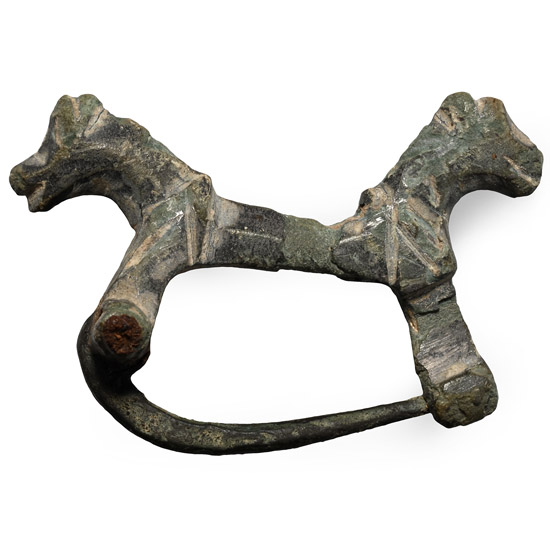
Roman Bronze Double-Horse Brooch
4th-5th century A.D.Sold for (Inc. bp): £111
Bow brooch formed as an arch with addorsed horse-heads with notched detailing, pin and catchplate below. 8.78 grams, 38 mm
From the private coin collection of a West London, UK, gentleman, formed since the mid 1980s. -
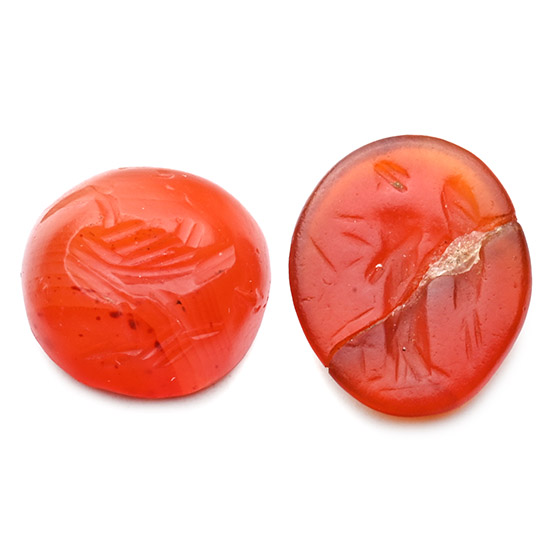
Roman Carnelian Gemstone Group
Circa 1st century B.C.Sold for (Inc. bp): £65
Ellipsoid type with two standing figures, broken; plano-convex type with a perching bird. 1 grams total, 9 mm each
Property of a European gentleman, acquired from the estate of a London collector (formed before 2000). -
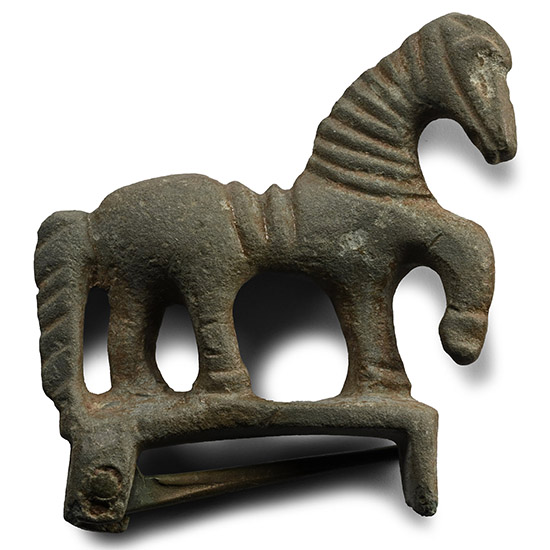
Roman Bronze Prancing Horse Brooch
2nd-3rd century A.D.Sold for (Inc. bp): £124
The horse standing on a groundline with its front leg raised and head turned to right, ribbed tail and mane, simple saddle on the back; hinged pin and remains of catchplate beneath. 17.7 grams, 37 mm
Ex German art market, 2000s. Acquired from an EU collector living in London. From the collection of Surrey, UK, gentleman. This lot is accompanied by an illustrated lot declaration signed by the Head of the Antiquities Department, Dr Raffaele D’Amato.
