
Loading, please wait...
LOT 0187
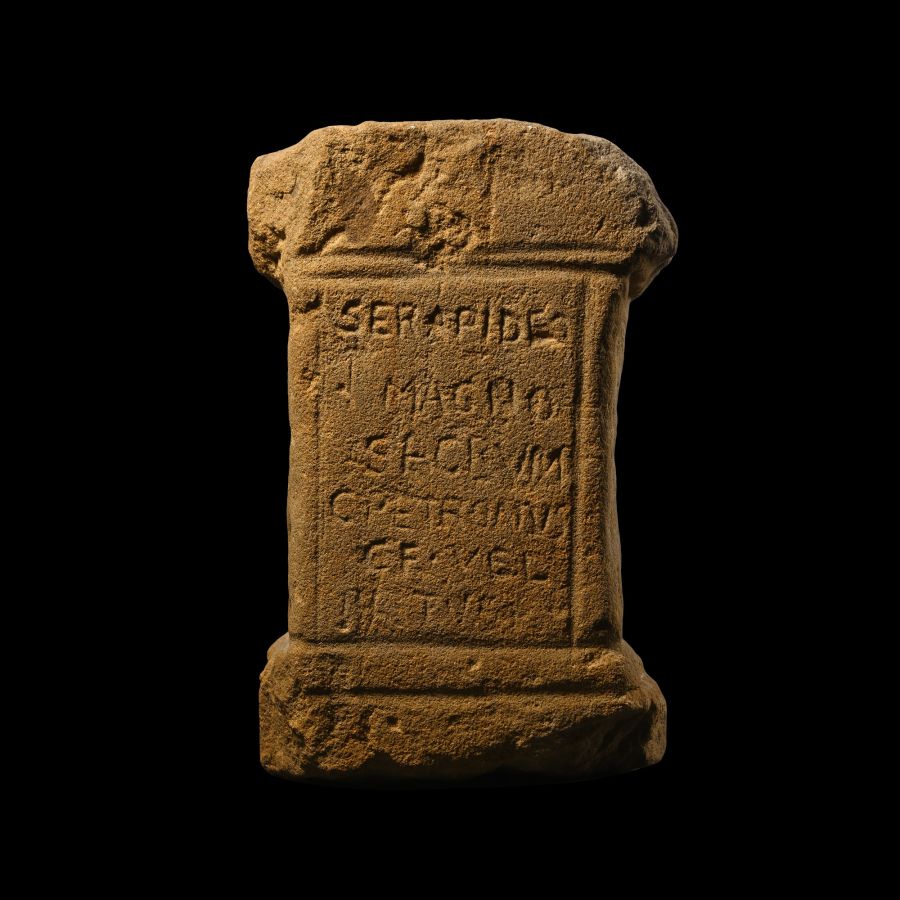
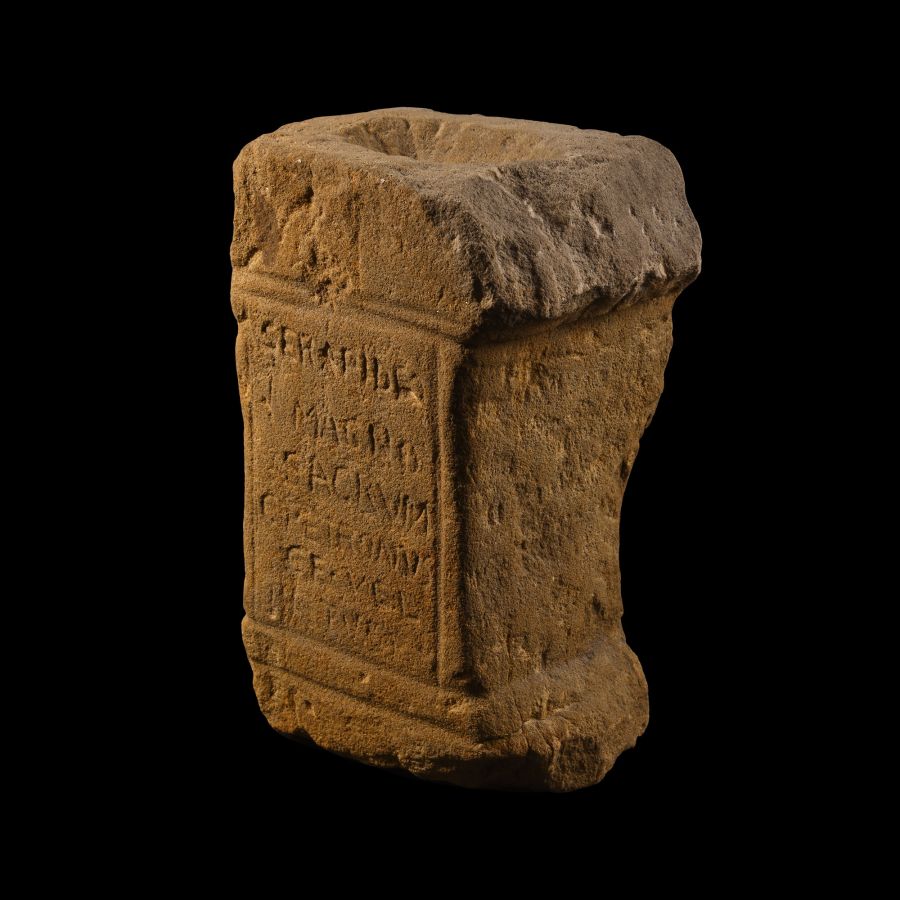
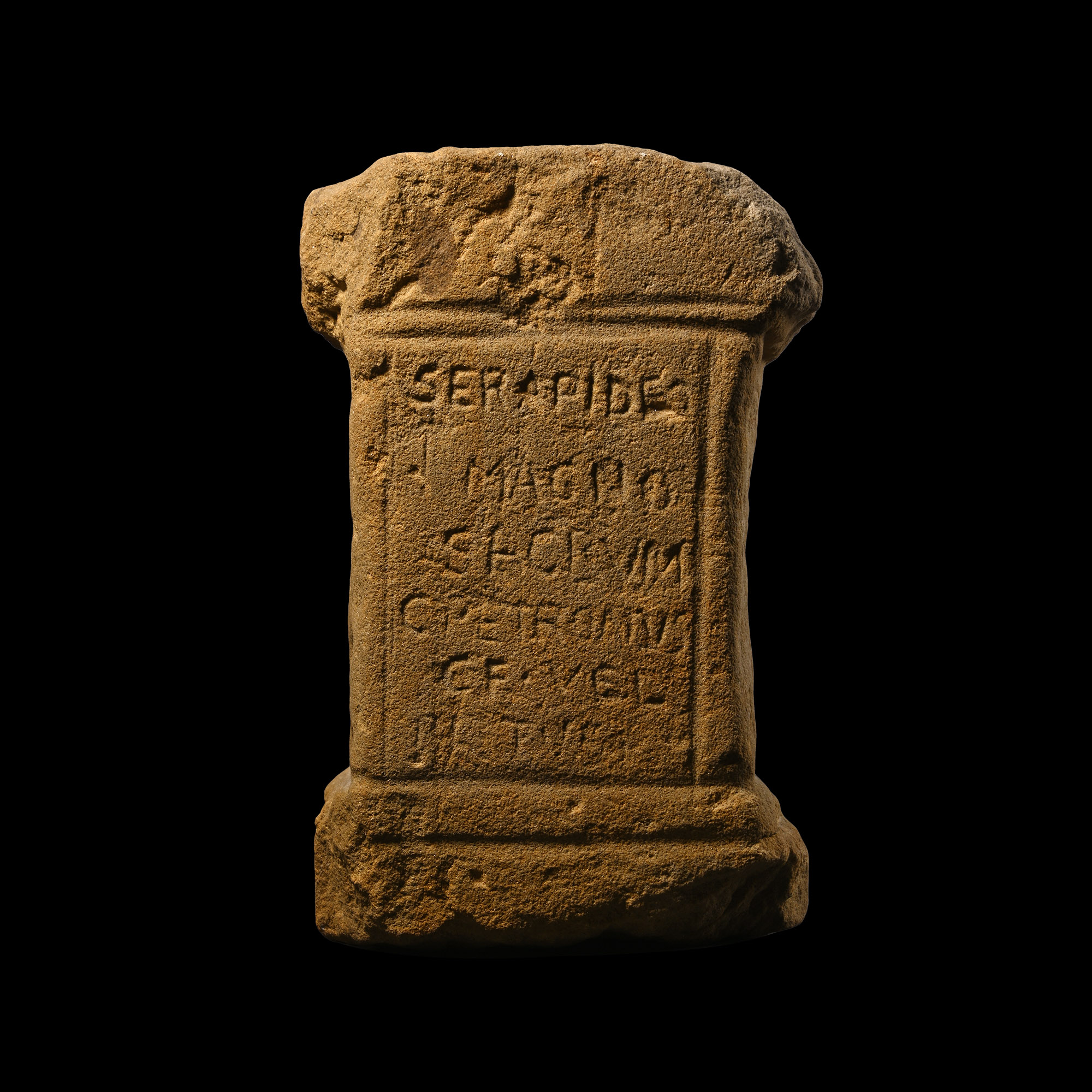
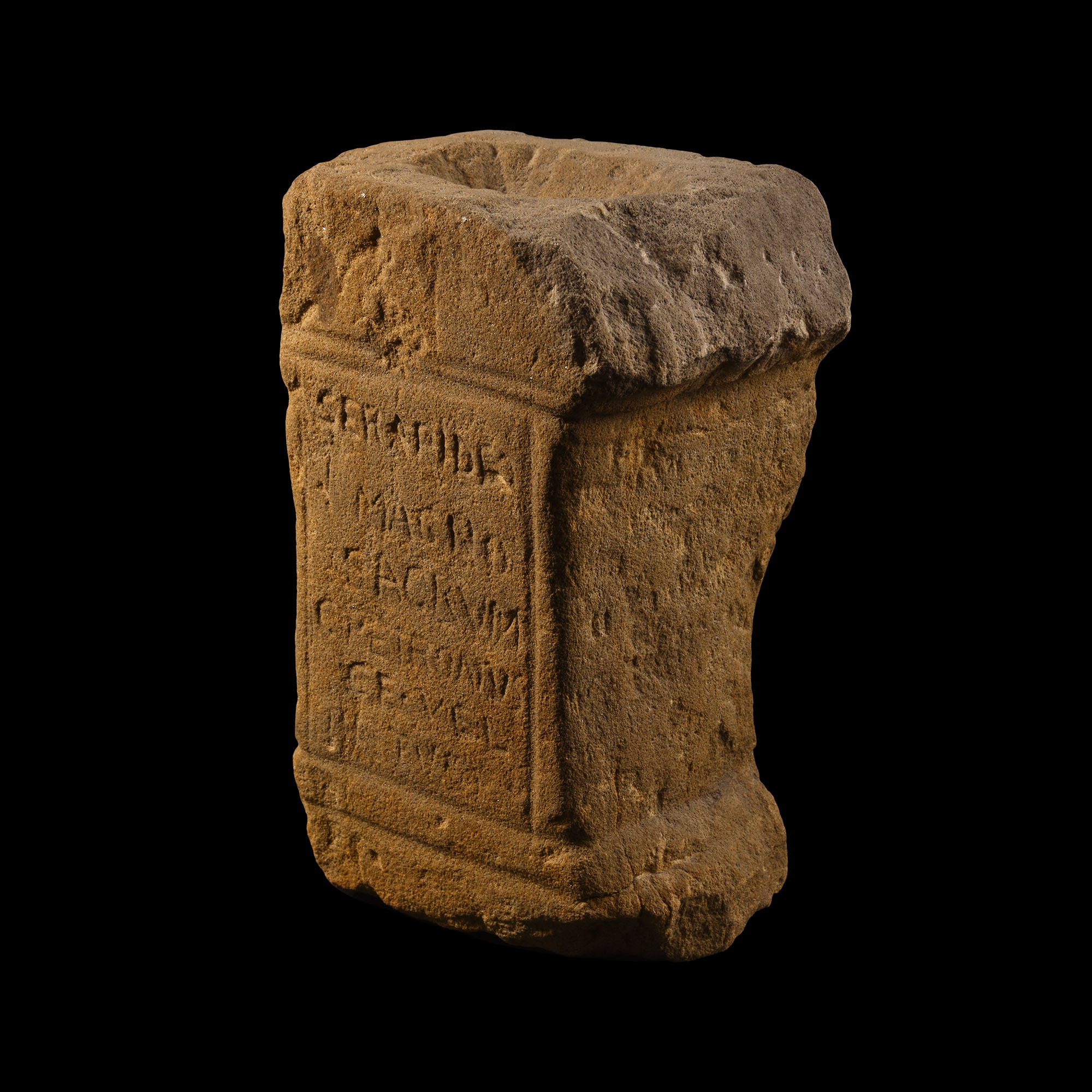
Roman Sandstone Altar for the God Serapis by Gaius Petronius Paetus
2ND CENTURY A.D.
10 1/2 in. (9.1 kg, 26.5 cm).
Rectangular in profile with stepped base and capital; dished socket to the upper face; incised rectangular panel to obverse with six lines of inscription in sans-serif capitals: 'SERAPI DEO / MAGNO / SACRVM / C. PETRONVS / C. F. VEL / PAETUS' (Sacred to the great god Serapis, G(aius) Petron(i)us Paetus, son of Gaius, (enrolled in the) tribus Velina). [No Reserve]
ProvenanceAcquired at auction in London, December 1993.
From the private collection of Peter Clayton, FCILIP, Dip, Arch, FSA, FRNS, Hemel Hempstead, Hampshire, UK; formed since the 1950s.
Accompanied by copies of Roger Tomalin's article in Britannia, in which this altar is published.
Accompanied by an old handwritten information card by Peter Clayton.
Britannia Vol.XXXI, (2000: 448-9) fig.14, plate XXIV.
FootnotesWhen the Britannia article was published in 2000, there was only one other dedication to the god Serapis known from Britain, found at York (p.448). Meanwhile, the Roman Inscriptions of Britain database records five entries. The altar was said to have been found in Yorkshire, although this is disputed. The dedicant possessed Roman citizenship, and he provides his name on this altar with all elements like praenomen, filiation, and tribus. This onomastic observation points to the end of the first century or the first half of the second century A.D.
CONDITIONTimeLine Auctions follows a vetting process to ensure the authenticity and legality of all items, reinforcing our commitment to integrity and responsible trading. Each antiquity, antique, and coin lot undergoes thorough examination by a vetting committee of at least ten external specialists, professional trade association members, scientists, and archaeologists: Our Vetting Process
AUCTIONS:
TimeLine is a leading auction house specialising in antiquities, ancient art, collectables, natural history, coins, medals, and books. Our auctions offer museums, collectors, historians, and enthusiasts the opportunity to acquire unique and historically significant pieces.
LOT 0187
Roman Sandstone Altar for the God Serapis by Gaius Petronius Paetus
Estimate £800 - 1,000€930 - 1,160 (for guidance only)$1,080 - 1,350 (for guidance only)
-
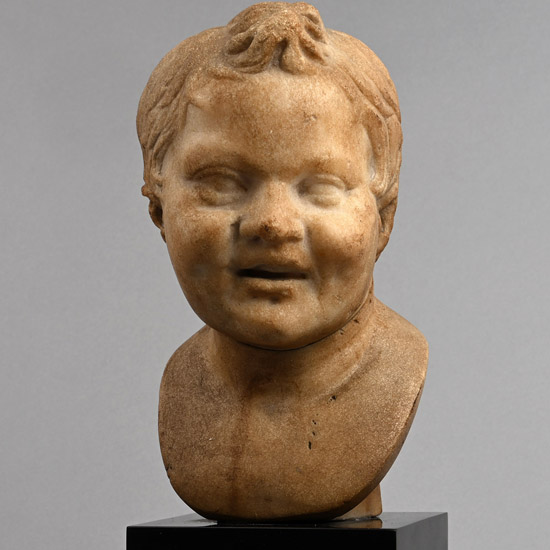
Roman Marble Head of Cupid on Georgian Pedestal
1st-2nd century A.D.Estimate: £15,000 - 20,000 (‡+bp*)
Opening Bid: £7,000
Carved in the round as a bust of a child with short hair combed into a peak, fleshy features, lips slightly parted in a smile, fitted to an 18th-century marble pedestal; mounted on a display stand with collection note 'Buste d'Enfant / Epoque Romaine / 1er Siècle'. 6.12 kg total, 30 cm including stand
Collection of B. Poindessault (1935-2014), France, acquired before October 1975. Oger & Blanchet Enchères, Paris, 2014. German private collection, Cologne. Private collection, acquired in 2015. Accompanied by an academic report by Dr Marina Mattei. Accompanied by a copy of an Art Loss Register certificate, no.S000104583. Accompanied by a copy of French passport no.167453. This lot has been checked against the Interpol Database of stolen works of art and is accompanied by search certificate no.12931-246329.
The finely sculpted head represents a young child, probably intended as Eros (Cupid). Such depictions were produced in numerous variations to illustrate the stages of childhood and the capacity of children to undertake meaningful or symbolic actions. The softly modelled features and gentle expression recall the celebrated work of Boethos, The Boy Strangling the Goose, as well as the widespread images of Eros and the Erotes found throughout Graeco-Roman sculpture and painting. In Graeco-Roman art, representations of children occupied an important and evolving role. Initially, youthful figures were portrayed as miniature adults, but from the 4th century BC onwards - particularly during the Hellenistic and Roman periods - artists began to study children’s anatomy more closely, reproducing their characteristic proportions and expressions with naturalistic sensitivity. The figure of Eros, the constant companion of Aphrodite, became the quintessential model of the child in ancient art, identifiable by his traditional attributes of wings and bow. As evidenced by numerous statuettes and wall paintings unearthed at Pompeii, scenes of childhood were among the most popular subjects for adorning the gardens and interiors of wealthy Roman villas. These figures appear in lively and varied activities - playing, working, performing, or interacting with animals such as birds, hares, and dolphins - celebrating both the charm and vitality of early life within an idealised artistic vision. -
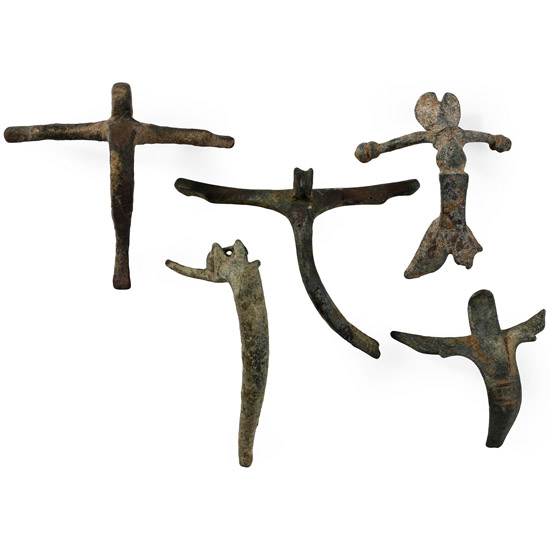
Roman Bronze Vessel Handle Group
1st-4th century A.D.Estimate: £50 - 70 (+bp*)
Opening Bid: £5
Including one with pin-lugs for a hinged lid, one with scooped thumb-pad, and other types. 175 grams total, 52-89 mm
From a UK collection formed in the 1980s. Property of an Essex, UK, gentleman. -
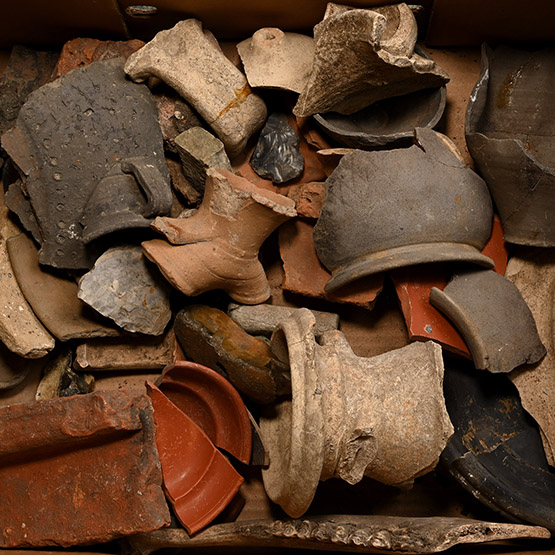
Roman and Other 'Colchester' Pottery Collection
1st-4th century A.D. and laterEstimate: £60 - 80 (+bp*)
Opening Bid: £5
Including: mortaria, cooking vessels, tableware and other types, plus stone age axe fragments and a domestic animal jaw bone with teeth. 8.4 kg total including box, 3-32 cm
Found Colchester, UK. (UK buyers only, not for export) From the collection of a late East Anglian teacher and antiquarian who retired to the Isle of Wight in Hampshire, UK. He amassed a large collection of objects between the 1960s-1980s.
