
Loading, please wait...
LOT 0957
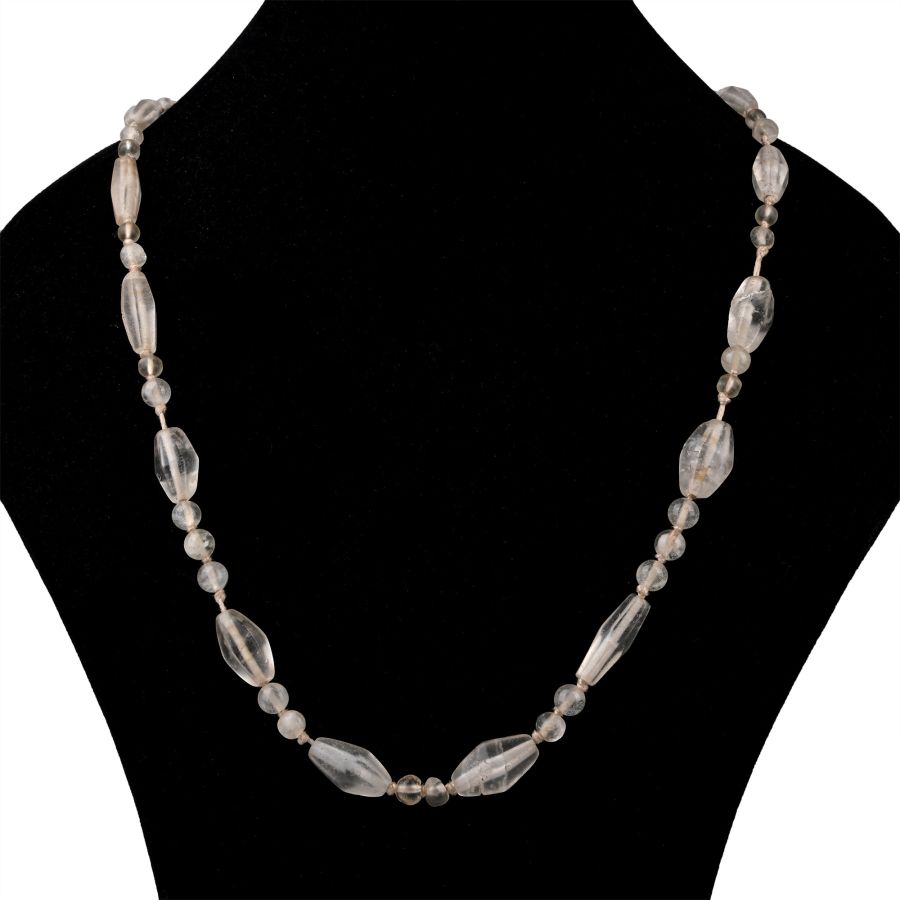
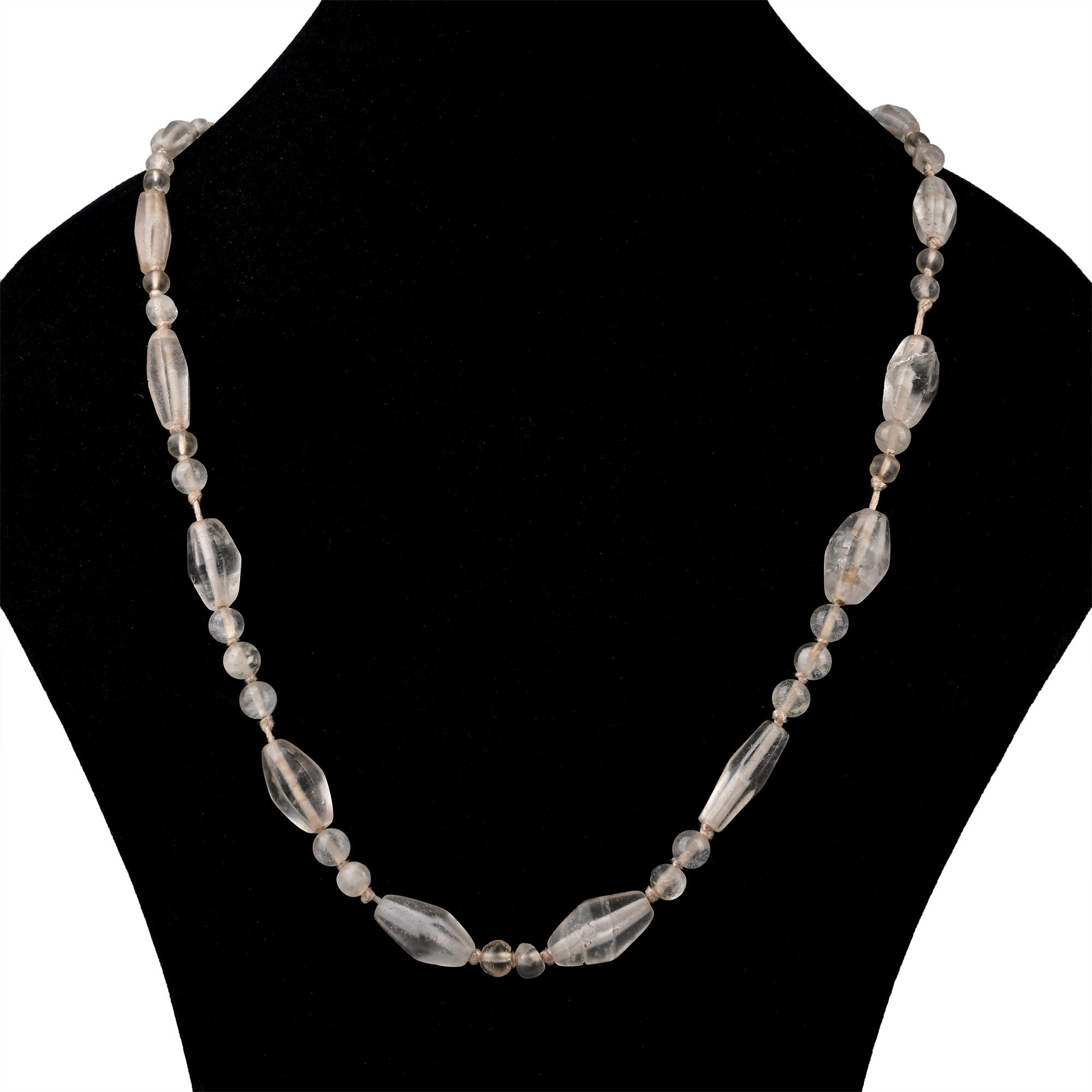
Roman Rock Crystal Necklace
4TH-6TH CENTURY A.D. AND LATER
28 3/8 in. (77 grams, 72 cm).
Long necklace composed of alternating facetted biconical and spherical beads, restrung and with an S-hook closure.
ProvenanceEx London, UK gallery, 1971-early 2000s.
Private collection, London, UK.
For similar Roman rock crystal beads, see Eger, C., Khalil, L., ‘Bead Jewellery of Late-Roman and Byzantine Time in the Province of Arabia. The Beads and Pendants of Glass, Stone, and Organic Materials from the Rock Chamber Necropolis at Khirbat Yajuz, Jordan’ in Zeitschrift fur Orient-Archäologie, 2013, Band 6, Berlin, 2013, pp.156-181, pl.1.
CONDITIONTimeLine Auctions follows a vetting process to ensure the authenticity and legality of all items, reinforcing our commitment to integrity and responsible trading. Each antiquity, antique, and coin lot undergoes thorough examination by a vetting committee of at least ten external specialists, professional trade association members, scientists, and archaeologists: Our Vetting Process
AUCTIONS:
TimeLine is a leading auction house specialising in antiquities, ancient art, collectables, natural history, coins, medals, and books. Our auctions offer museums, collectors, historians, and enthusiasts the opportunity to acquire unique and historically significant pieces.
LOT 0957
Roman Rock Crystal Necklace
Estimate £400 - 600€460 - 700 (for guidance only)$540 - 810 (for guidance only)
Opening Bid
£200 (EUR 232; USD 270) +BP*
-
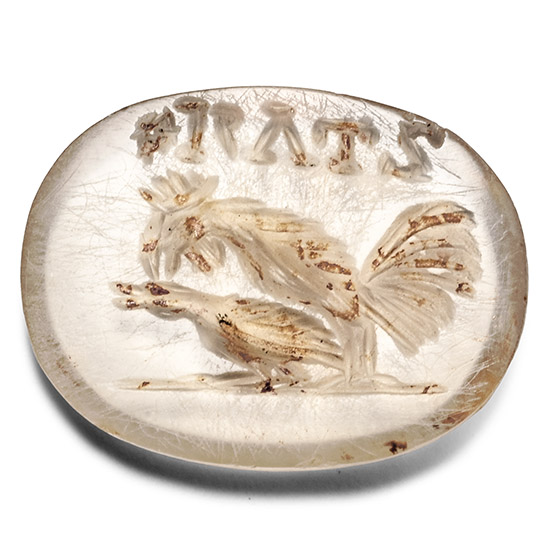
Roman Rock Crystal Gemstone of an Archigallus
Circa 1st century B.C.-1st century A.D.Estimate: £800 - 1,000 (+bp*)
Opening Bid: £250
Ellipsoid in plan with an engraved scene of a cockerel copulating with a hen, inscription above. 0.62 grams, 14 mm
Property of a European gentleman, acquired from the estate of a London collector (formed before 2000).
In ancient Rome, a cockerel, Latin gallus, was a symbol of virility and fertility. But gallus (plural galli) was also the term for a religious devotee and later for a priest of Cybele (Magna Mater). Often eunuchs, they performed ecstatic dances and rituals, sometimes even engaging in sexual acts as part of their religious practices. In Rome, the head of the Cybele priests was the archigallus, chosen by the quindecimviri sacris faciundis. Reliefs show that the archigallus was wearing luxurious and extravagant costumes and jewellery. This unique gemstone can be attributed to such an archigallus. The cult of Cybele/Magna Mater and the presence of galli also spread to Roman Britain, where it is attested, e.g. in Catterick and Corbridge. -
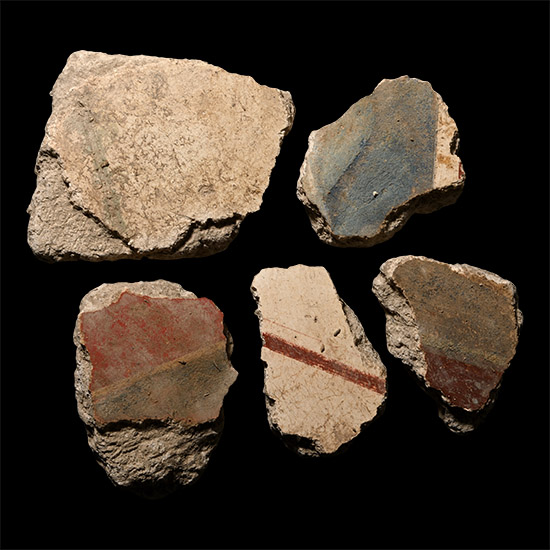
Roman Fresco Wall Plaster Collection
1st century A.D.Estimate: £50 - 70 (+bp*)
Opening Bid: £5
Fragments of wall plaster with rendered surface painted with mainly Pompeii red, pale blue and white detailing; some with an impression of timber laths to the reverse. 1.06 kg total, 9.7-15.3 cm
Acquired in the 19th century. Ex Jeger collection, Switzerland. UK gallery, early 2000s.
These small fragments, by analogy with the fragments of Pompeii, seem to belong to the second style of Roman painting - red panels representing highlight and shadow, decorated with vegetal interlaces. A red grenade fillet probably framed some panels. A fragment shows alternate blue and red colours over a cream background, maybe pertinent to a socle. -
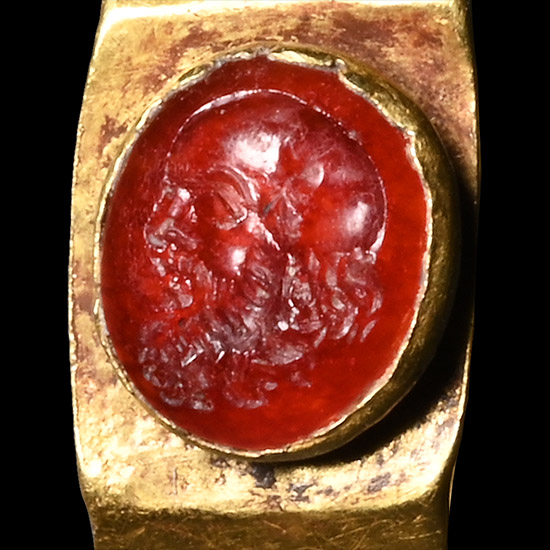
Roman Gold Ring with Gemstone of Silenus
1st-3rd century A.D.Estimate: £2,000 - 3,000 (+bp*)
Opening Bid: £1,000
Comprising a flat-section facetted hoop with a raised collet set with a red carnelian intaglio showing the profile head of Silenus; the intaglio is of the 1st century and set in a 3rd-century ring. 2.58 grams, 22.25 mm overall, 18.29 x 17.68 mm internal diameter (approximate size British P 1/2, USA 7 3/4, Europe 16.86, Japan 16)
Private collection, London. This lot has been checked against the Interpol Database of stolen works of art and is accompanied by search certificate no.13534-263674.
The ring belongs to the type VI, variant 1, of Ruseva-Slokoska classification of Roman gold rings. Polygonal-ellipsoid hoops with sectoral planes cut on the outside of the massive hoop, widening and thickening towards the shoulders, are typical of the 3rd century A.D.
