
Loading, please wait...
LOT 0125
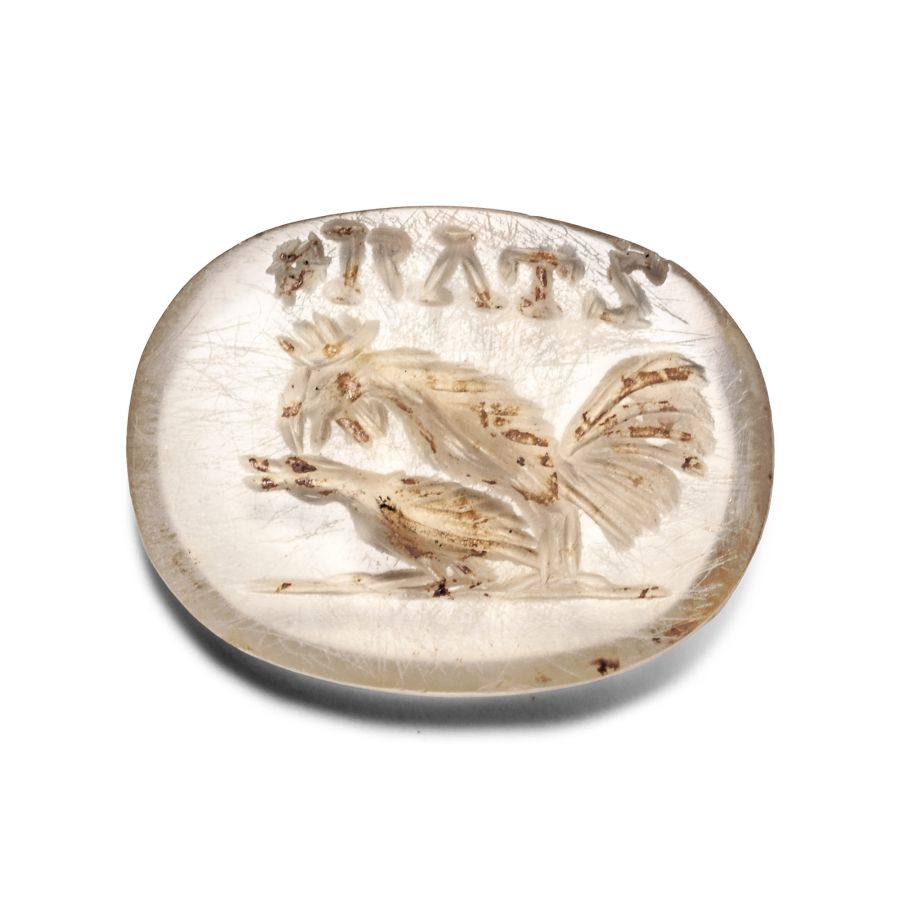
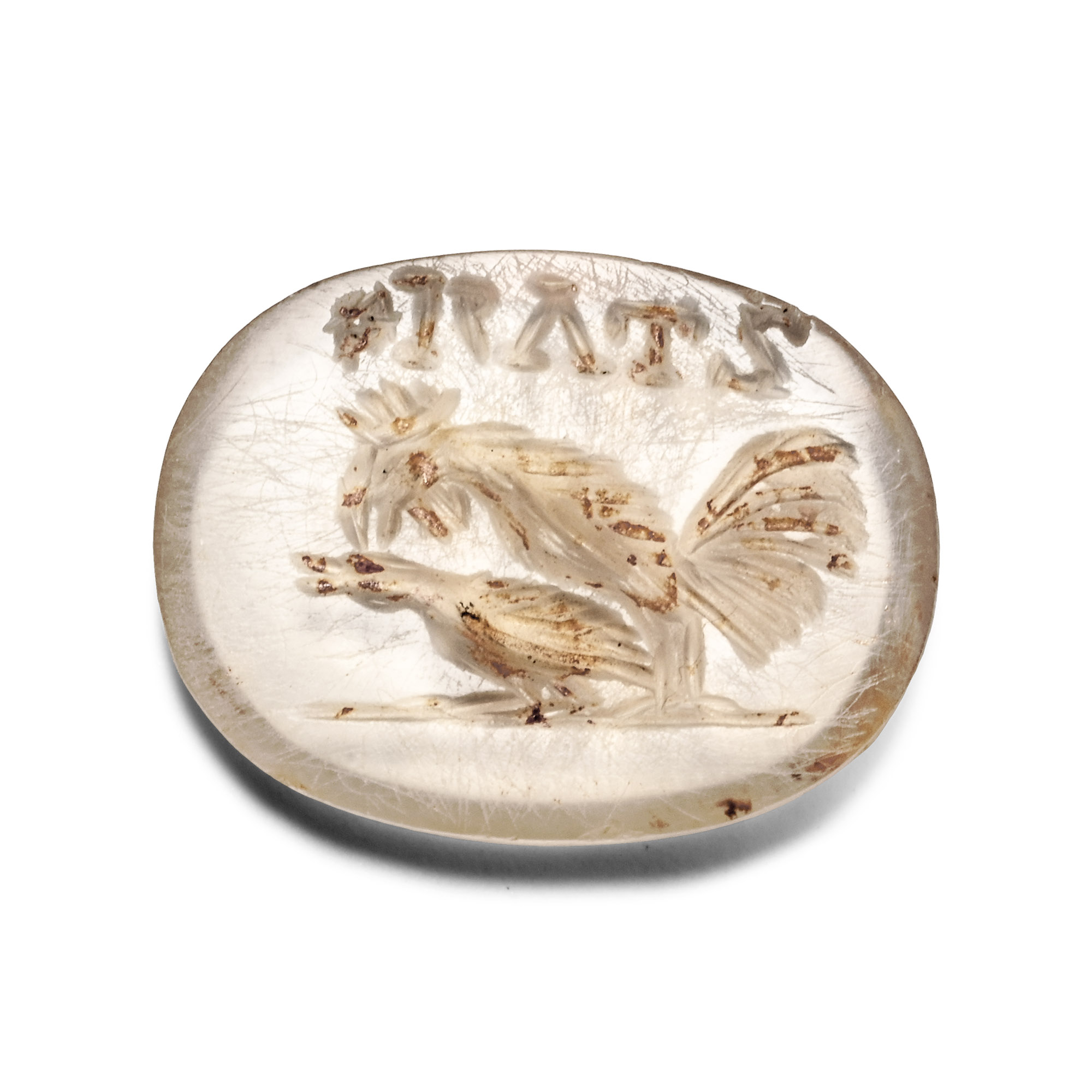
Roman Rock Crystal Gemstone of an Archigallus Priest
CIRCA 1ST CENTURY B.C.-1ST CENTURY A.D.
1/2 in. (0.62 grams, 14 mm).
Ellipsoid in plan with an engraved scene of a cockerel copulating with a hen, inscription above.
ProvenanceProperty of a European gentleman, acquired from the estate of a London collector (formed before 2000).
FootnotesIn ancient Rome, a cockerel, Latin gallus, was a symbol of virility and fertility. But gallus (plural galli) was also the term for a religious devotee and later for a priest of Cybele (Magna Mater). Often eunuchs, they performed ecstatic dances and rituals, sometimes even engaging in sexual acts as part of their religious practices. In Rome, the head of the Cybele priests was the archigallus, chosen by the quindecimviri sacris faciundis. Reliefs show that the archigallus was wearing luxurious and extravagant costumes and jewellery. This unique gemstone can be attributed to such an archigallus. The cult of Cybele/Magna Mater and the presence of galli also spread to Roman Britain, where it is attested, e.g. in Catterick and Corbridge.
CONDITIONTimeLine Auctions follows a vetting process to ensure the authenticity and legality of all items, reinforcing our commitment to integrity and responsible trading. Each antiquity, antique, and coin lot undergoes thorough examination by a vetting committee of at least ten external specialists, professional trade association members, scientists, and archaeologists: Our Vetting Process
AUCTIONS:
TimeLine is a leading auction house specialising in antiquities, ancient art, collectables, natural history, coins, medals, and books. Our auctions offer museums, collectors, historians, and enthusiasts the opportunity to acquire unique and historically significant pieces.
LOT 0125
Roman Rock Crystal Gemstone of an Archigallus Priest
Estimate £800 - 1,000€930 - 1,160 (for guidance only)$1,080 - 1,350 (for guidance only)
-
Roman Terracotta Bullae, Tesserae or Token Group
3rd century B.C.-1st century A.D.Estimate: £100 - 140 (+bp*)
Opening Bid: £5
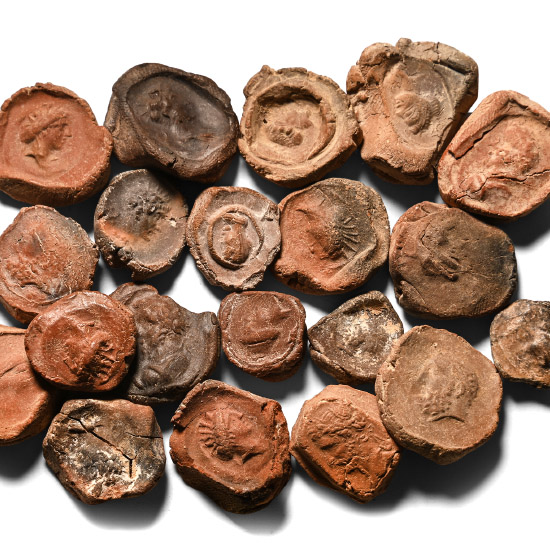
A mixed group of ceramic bullae, tesserae or theatre tokens bearing low-relief motifs, mainly consisting of profile busts of deities. 34.2 grams total, 15-23 mm
From the private collection of a European gentleman (1942-2024), formed since the 1970s.
The term 'tessera' was used in Roman times to convey the Greek term σύμβολον (token). Small tiles are known as tokens, often shaped like coins, made of metal (copper, lead, iron), clay, bone, wood, or glass, stamped as well as engraved. The tokens, however, are not exclusively coin-shaped, as the Latin term 'tessera' suggests by etymologically referring to a square or at least a four-sided shape and confirmed in several cases by material remains of the past. Tokens and tesserae seem to have been used both in Athens and Rome for the distribution of goods. According to written sources, the term token is identified with credentials of the official authorities. They have also been interpreted as tokens of identity, as entrance tickets to theatre performances, tribunals or assemblies of citizens, archival material of seal engraving, as pawns in games, Charon’s obols and even as amulets. -
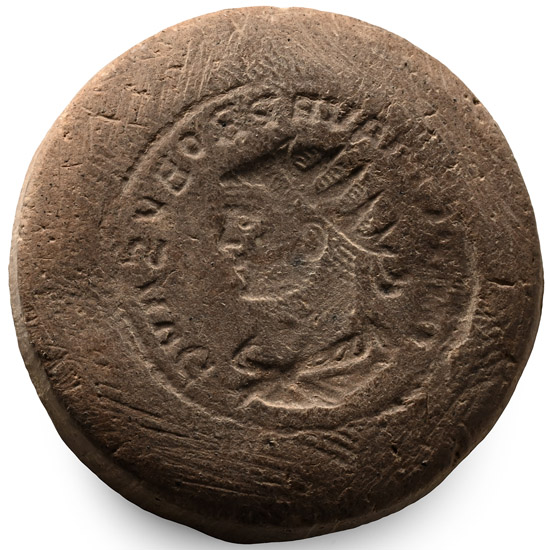
Roman Terracotta Forger's Mould for a Coin
Circa 3rd-4th century A.D.Estimate: £50 - 70 (+bp*)
Bids: 2 | Current Bid: £10
Discoid clay mould with an impressed design of a coin on each face. 4.55 grams, 28 mm
London gentleman's collection, 1970-1990s, by descent. -
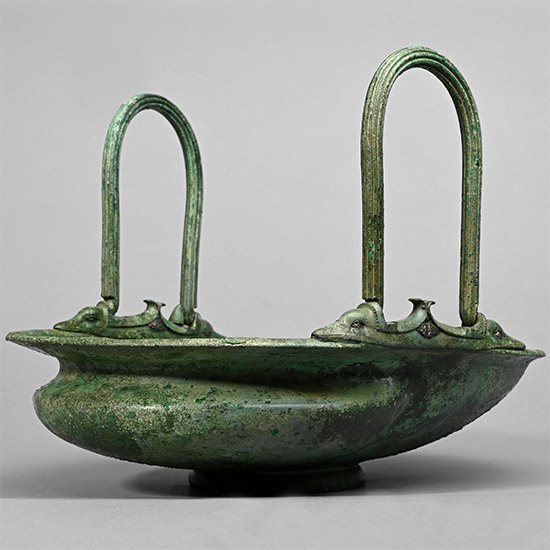
Large Roman Bronze Basket-Vase with Swinging Handles
Roman Imperial, 1st century B.C.-1st century A.D.Estimate: £12,000 - 17,000 (‡+bp*)
Opening Bid: £6,000
Ellipsoid in plan, with a low basal ring, thick convex rim, and carination towards the front, lateral hinges, the knuckles formed as addorsed duck-heads, each with silver-inlaid eyes, a scrolled panel to the rear retaining the pivot of the ribbed D-shaped handles. 1.68 kg, 28 cm
Acquired in Switzerland, 1996. Private collection, Europe. Accompanied by an academic report by Dr Raffaele D'Amato. Accompanied by a copy of an Art Loss Register certificate dated 30th April 2004. This lot has been checked against the Interpol Database of stolen works of art and is accompanied by search certificate no.12363-226688.
This vessel (lanx) was part of Roman and provincial bronze instrumentum domesticum, i.e. culinary or domestic utility ware. The form of the bowl resembles a type of helmet with carination to the front, the handles placed as hinged cheek-protectors.
