
Loading, please wait...
LOT 0704
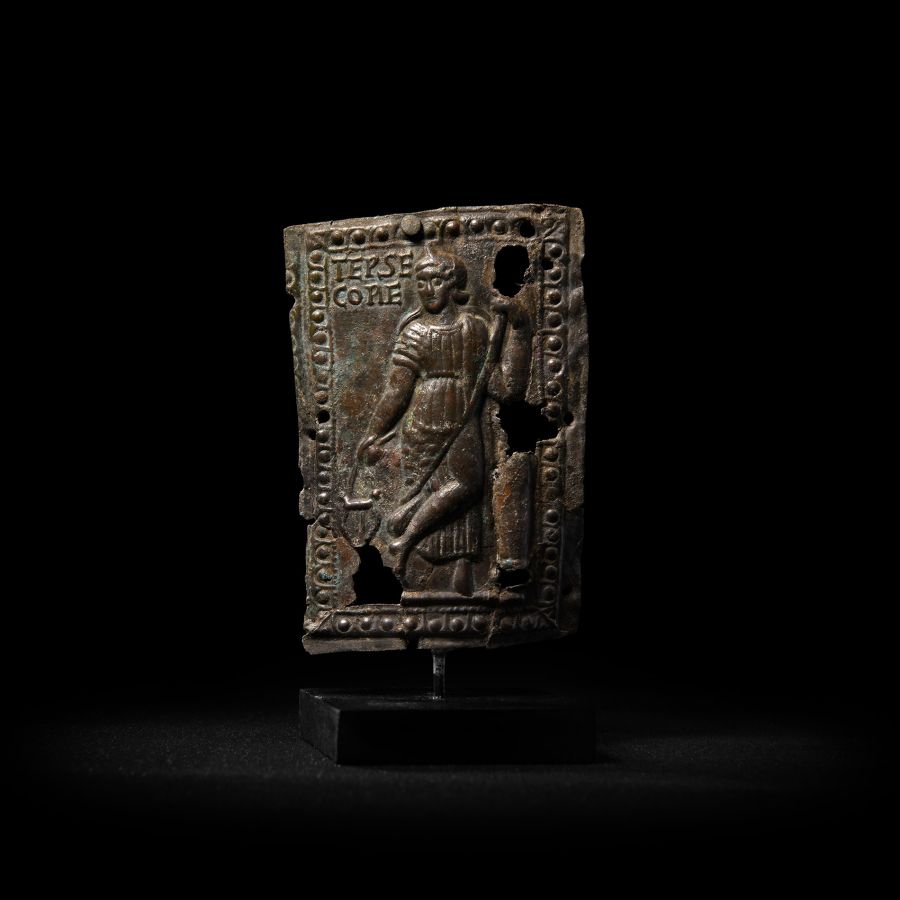
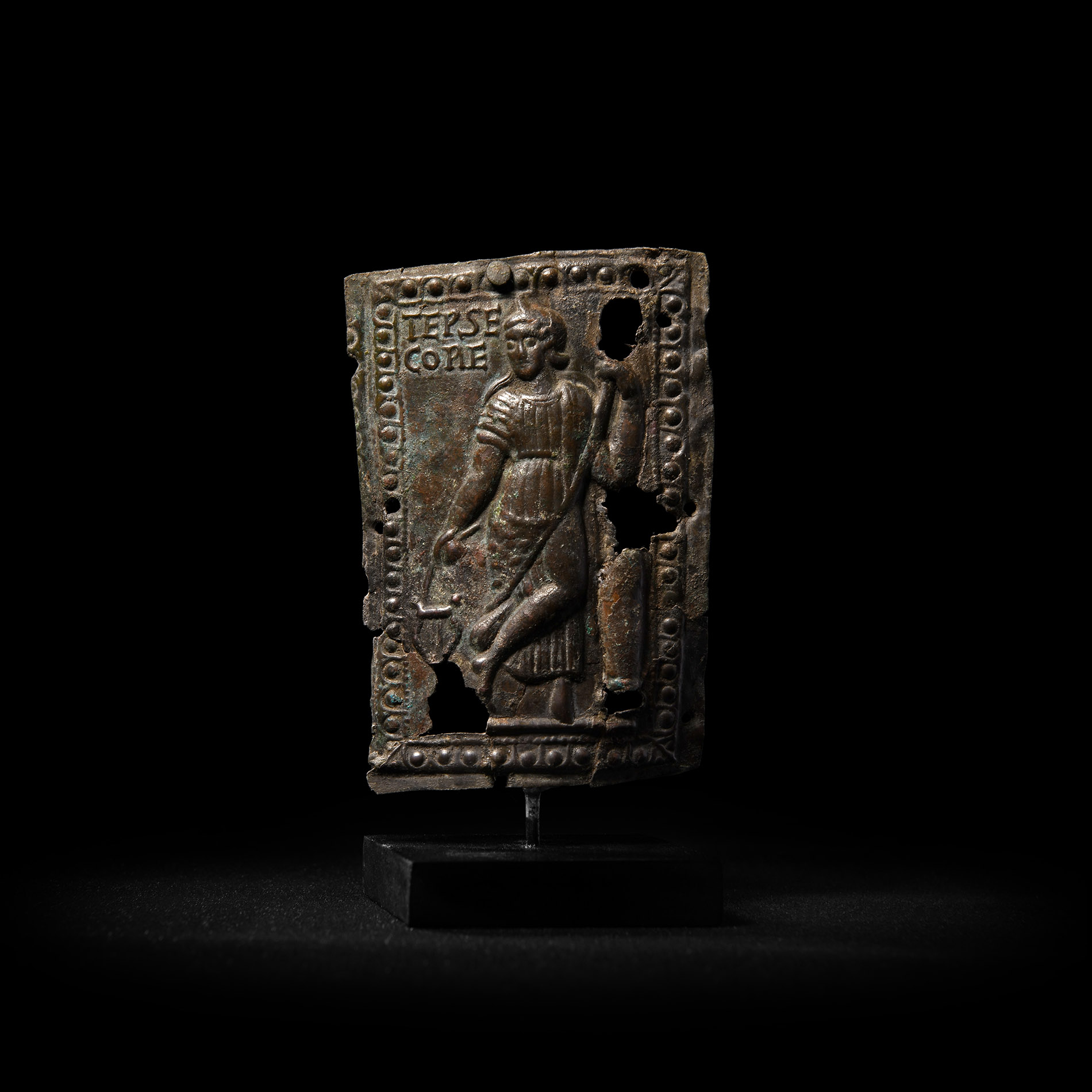
Roman Repousse Plaque with Muse Terpsichore
4TH CENTURY A.D.
4 1/8 in. (41 grams total, 10.6 cm high including stand).
A square plaque from a casket or votive panel with the embossed image of the Muse Terpsichore, dressed in a short sleeved tunica talaris, standing with the weight on the right leg, the other leg bent in front of the body, the right hand holding a lyre hanging from a strap, in the left hand a staff; inscription in late Latin beside the right part of the head reading 'TEPSECORE'; the figure framed with an embossed edge; accompanied by a custom-made display stand.
ProvenanceAcquired in the 1970s.
Ex London collection.
Cf. Humer, F., Kremer, G., Pollhammer, E., Pülz, A., AD 313 Von Carnuntum zum Christentum, Bad Voslau, 2014, nos.40, for similar plaques with divinities, especially no.642, with the Muses.
FootnotesThe plaque probably came from a casket similar to the one of Carnuntum, which represent the images of the Muses on one side and biblical scenes to the other side. These scenes were popular motifs in Late Antiquity, where caskets with Christian and mythological images were widespread, especially in Pannonia.
CONDITIONTimeLine Auctions follows a vetting process to ensure the authenticity and legality of all items, reinforcing our commitment to integrity and responsible trading. Each antiquity, antique, and coin lot undergoes thorough examination by a vetting committee of at least ten external specialists, professional trade association members, scientists, and archaeologists: Our Vetting Process
AUCTIONS:
TimeLine is a leading auction house specialising in antiquities, ancient art, collectables, natural history, coins, medals, and books. Our auctions offer museums, collectors, historians, and enthusiasts the opportunity to acquire unique and historically significant pieces.
LOT 0704
Roman Repousse Plaque with Muse Terpsichore
Estimate £700 - 900€810 - 1,040 (for guidance only)$950 - 1,220 (for guidance only)
-
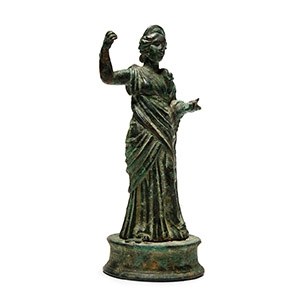
Roman Statuette of the Goddess Fortuna
1st-2nd century A.D.Estimate: £2,000 - 3,000 (+bp*)
Opening Bid: £1,000
A bronze statuette of the goddess Fortuna, modelled in the round standing on a circular plinth base, her feet emerging from beneath her floor length robes, her hair held in a chignon at the back of the head and crowned with a diadem. 205 grams total, 13 cm high including stand
Acquired London art market in early 1960s. From the private collection of the late Walter Steinberg, London, UK. This lot has been checked against the Interpol Database of stolen works of art and is accompanied by search certificate no.11633-199467.
The cult of Fortuna was associated with the round of the agricultural year, the wheel of time and the changing fortunes of the individual, both bad and good. The Rota Fortunae (wheel of fortune) is a symbol of the changeable nature of one's luck and was already a recognised idiom by the time of Cicero, writing in the 1st century B.C. -
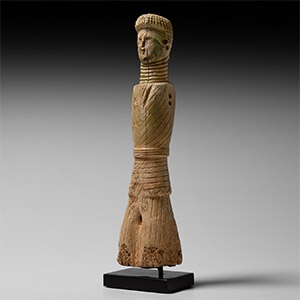
Roman Female Bone Doll
3rd-4th century A.D.Estimate: £500 - 700 (+bp*)
Opening Bid: £250
A Roman or Parthian bone figurine of a female with holes to accept pegs for separate articulated arms, hatching to the piled hairstyle, incised facial features, tiered collar, slender body with drape detailing to the bodice, belt and skirt; pierced ears to accept earrings; mounted on a custom-made stand. 214 grams total, 18 cm including stand
Fine condition.
Family collection since the 1960s. with Christie's, London, 29 April 2010, lot 373. Property of a Brussels gentleman. Accompanied by copies of the relevant Christie's catalogue pages.
The doll was made of a carved bone figure of woman with separate arms attached to the body, and pieces for the ears. All the surface shows extensive marks of working by a saw, knife or a file. The body is made from bone, and the style of the doll is typical of Roman Britain. The separate parts were attached with pins or string. On the doll are still visible the little holes for the connecting string. -
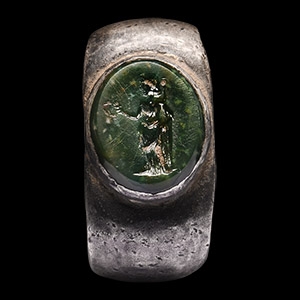
Roman Silver Ring with Goddess Gemstone
2nd-3rd century A.D. or laterSold for (Inc. bp): £390
A silver ring composed of a convex ellipsoid hoop, expanding at the shoulders to a raised oval bezel with collar, set with a green jasper intaglio gemstone engraved with the image of a goddess, carrying a staff and a laurel crown. 8.43 grams, 23.53 mm overall, 19.80 mm internal diameter (approximate size British M 1/2, USA 6 1/4, Europe 13.09, Japan 12)
Acquired in the late 1990s-2000. Property of an East London gentleman.
The ring presents similarities with the type II, variant 1 of the Ruseva-Slokoska classification. Many rings with images of divinities were found by the archaeologists as votive offerings to the divinities engraved on the bezel. It is difficult to interpret which divinity is represented in this ring, but the sceptre and the laurel crown could hint at it being Hera or Juno.
