
Loading, please wait...
_900x900.jpg "Roman Redware Fragment with Diana")
_200x200.jpg "Roman Redware Fragment with Diana")
.jpg "Roman Redware Fragment with Diana")
LOT 0674
Roman Redware Fragment with Diana
4TH-5TH CENTURY A.D.
2 1/2 in. (19.6 grams, 63 mm).
Curved ceramic fragment with high-relief image to the inner face, female in short-sleeved undergarment and outer stola draped over her head as a hood, holding a rod in her left hand and extending her right arm across her body. [No Reserve]
ProvenanceAcquired 1960s-1990s.
From the late Alison Barker collection, a retired London barrister.
TimeLine Auctions follows a vetting process to ensure the authenticity and legality of all items, reinforcing our commitment to integrity and responsible trading. Each antiquity, antique, and coin lot undergoes thorough examination by a vetting committee of at least ten external specialists, professional trade association members, scientists, and archaeologists: Our Vetting Process
AUCTIONS:
TimeLine is a leading auction house specialising in antiquities, ancient art, collectables, natural history, coins, medals, and books. Our auctions offer museums, collectors, historians, and enthusiasts the opportunity to acquire unique and historically significant pieces.
-
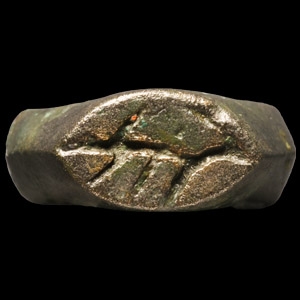
Roman Period Bronze Ring with Antelope
1st century B.C.Sold for (Inc. bp): £20
D-section hoop and tall scaphoid bezel, intaglio design of an antelope. 10.82 grams, 26.08 mm overall, 15.94 mm internal diameter (approximate size British K, USA 5 1/4, Europe 9.95, Japan 9)
Ex old English collection. London art market, pre 2000. Property of a London, UK, gentleman. -
.jpg)
Roman Banded Agate Lion Attack Gemstone
Circa 2nd century A.D.Estimate: £200 - 300 (+bp*)
Opening Bid: £100
With intaglio scene of a lion attacking an ibex; supplied with a museum-quality impression. 1.55 grams, 14 mm
From the collection of a Swiss gentleman formed in Europe from 1970-1980s; thence by descent from the family in London. -
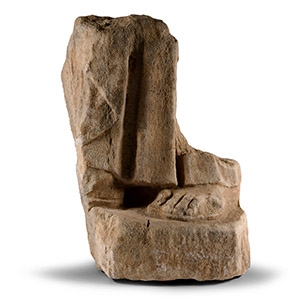
Roman Marble Statue Fragment with Feet
1st-2nd century A.D.Estimate: £1,500 - 2,000 (‡+bp*)
Opening Bid: £750
Presenting the hem of a pleated robe, the sandaled feet of the figure emerging from beneath, with semi-naturalistic anatomical detailing, resting on a plain base. 7.1 kg, 24 cm
Acquired early 1990s. Ex private American collection; thence by descent. Private collection since 1998. This lot has been checked against the Interpol Database of stolen works of art and is accompanied by search certificate no.11624-198973.
