
Loading, please wait...


LOT 0114
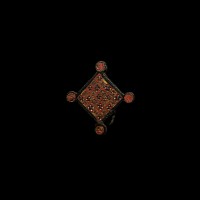
Roman Red Millefiori Plate Brooch
2ND-3RD CENTURY A.D.
1 in. (9.52 grams, 27 mm).
A lozengiform plate brooch with sub-circular lugs to each corner and shallow decorative notching along each straight edge, the lugs with a red enamel fill, the centre displaying a millefiori panel composed of square tiles alternating between red squares within a yellow border and a dark blue cross with red centre in a red border; pin lug, pin and catchplate to reverse. [No Reserve]
ProvenanceEx European collection.
Acquired in the mid 1990s.
Property of a Harrow, UK, gentleman.
Cf. Hattatt, R., A Visual Catalogue of Richard Hattatt's Ancient Brooches, Oxbow Books, 2000, fig.573, for type; cf. The British Museum's Portable Antiquities Scheme Database, record ids. SOM-1FBF61 and LVPL-4824A4, for very similar examples.
CONDITIONTimeLine Auctions follows a vetting process to ensure the authenticity and legality of all items, reinforcing our commitment to integrity and responsible trading. Each antiquity, antique, and coin lot undergoes thorough examination by a vetting committee of at least ten external specialists, professional trade association members, scientists, and archaeologists: Our Vetting Process
AUCTIONS:
TimeLine is a leading auction house specialising in antiquities, ancient art, collectables, natural history, coins, medals, and books. Our auctions offer museums, collectors, historians, and enthusiasts the opportunity to acquire unique and historically significant pieces.
-
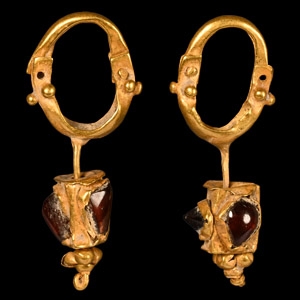
Roman Gold Earring Pair
1st-3rd century A.D.Sold for (Inc. bp): £546
A matched pair of gold earrings, each a substantial hoop with hinged closure and granule detailing, columnar sleeve with applied cells and inset carnelian cloisons, granule cluster finial. 3.45 grams total, 31 mm each
Acquired early 1990s. Ex private American collection; thence by descent. Private collection since 1998. -
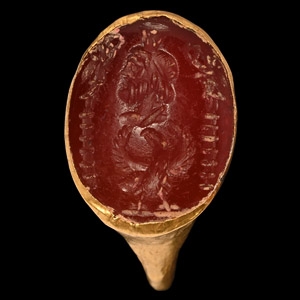
Roman Gold Ring with Serapis Gemstone
1st century A.D.Estimate: £1,500 - 2,000 (‡+bp*)
Opening Bid: £750
A hollow-formed gold finger ring with inset carnelian gemstone engraved with a profile bust of Serapis above a perching eagle flanked by fronds, possibly a marriage. 3.15 grams, 26.98 mm overall, 13.22 mm internal diameter (approximate size British D, USA 1 3/4, Europe 1.15, Japan 1)
Acquired early 1990s. Ex private American collection; thence by descent. Private Swiss collection since 1998. -
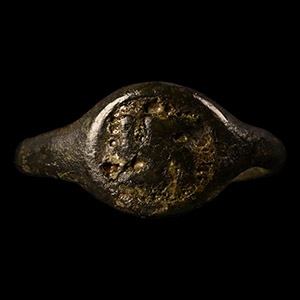
Roman Enamelled Ring with Fylfot
3rd-4th century A.D.Sold for (Inc. bp): £312
A bronze ring composed of a D-section hoop with overlapping arms, the discoid bezel displaying a fylfot with remains of an enamelled field. 2.17 grams, 22.62 mm overall, 19.94 mm internal diameter (approximate size British Q, USA 8, Europe 17.49, Japan 16)
Private collection formed since the 1940s. UK art market. Property of an Essex gentleman.
