
Loading, please wait...
LOT 0123
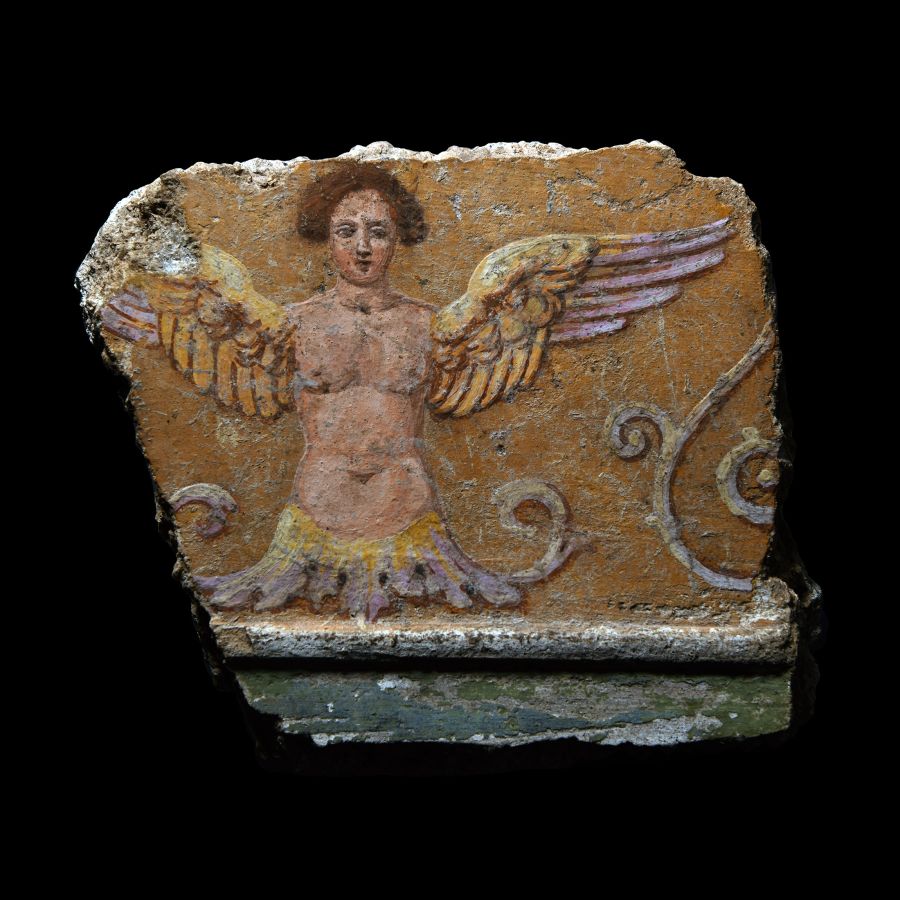
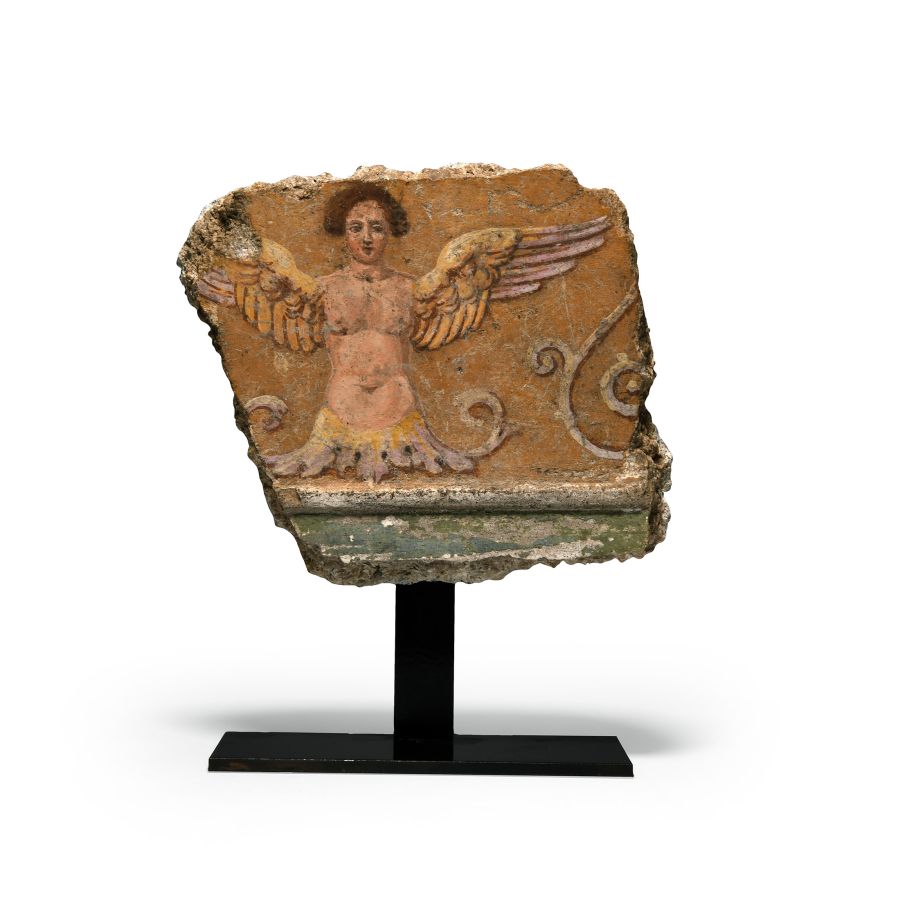
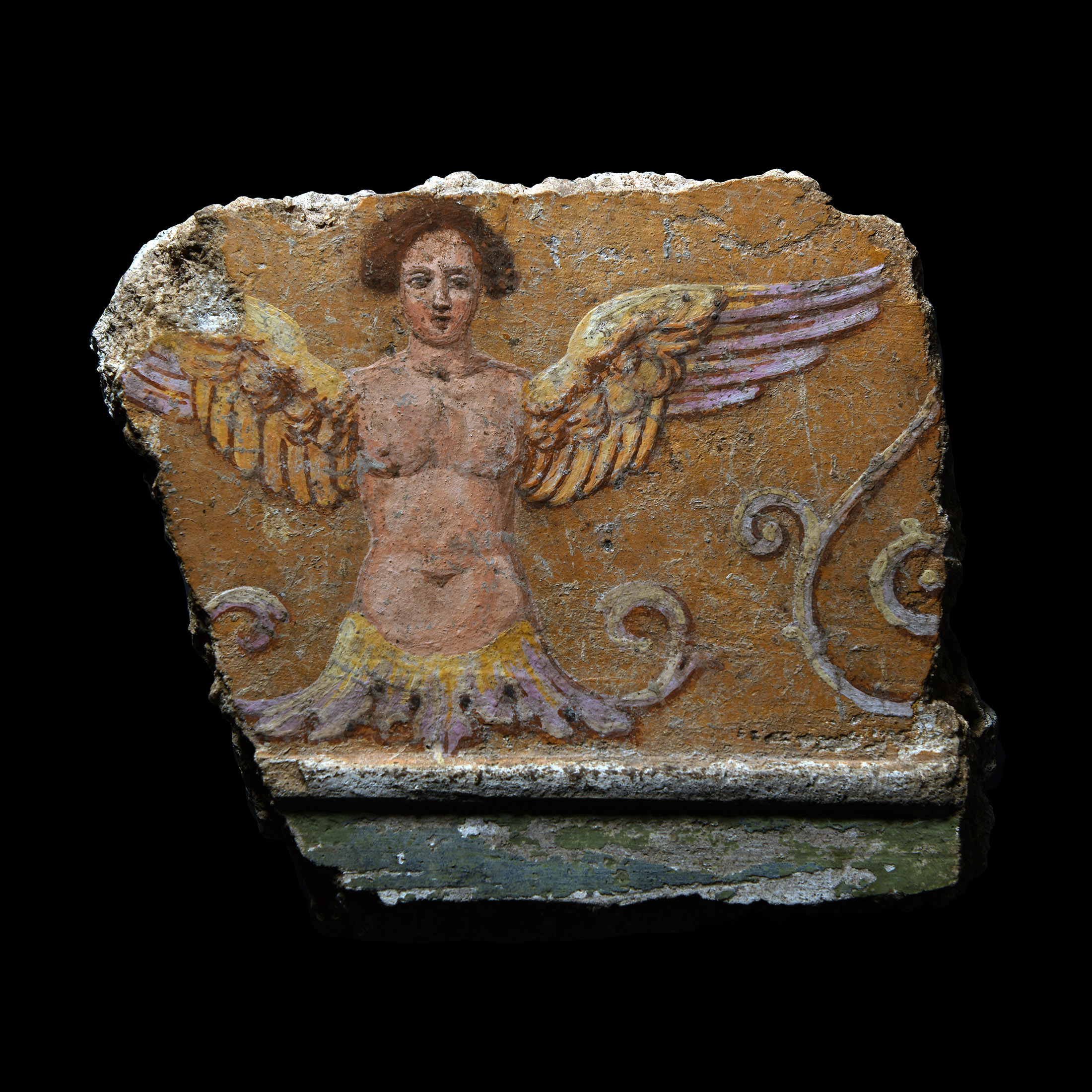
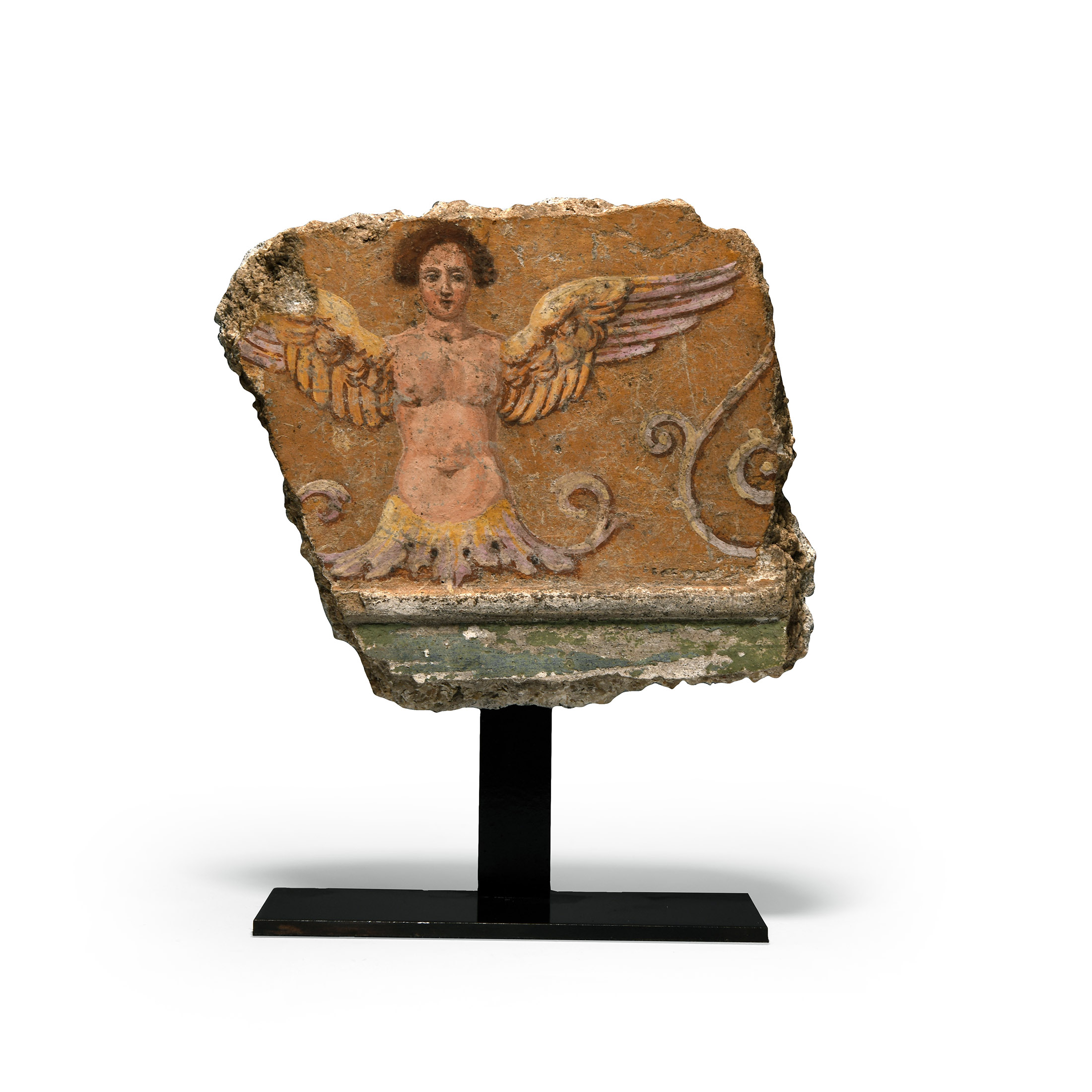
Roman Polychrome Wall Painting Fragment with Winged Siren
LATE 1ST CENTURY B.C.-EARLY 2ND CENTURY A.D.
6 1/4 in. (979 grams total, 16 cm high including stand).
Decorated with a frieze of partially preserved acanthus volutes from which emerges a figure of a winged female, possibly a siren, the body and the head of a woman with brown hair, the outstretched wings in pink and yellow; ochre background, cream-coloured line border with a green raised edge (part of the wall) below; mounted on a custom-made display stand.
ProvenanceFrom a European collection formed in the 19th century or earlier, based on the custom-made tooled leather box similar to another fragment kept in a case of similar manufacture with a label reading 'Fragment de Pompéi provenant de la vente Préat 1868' sold at Sotheby's New York, 12 December 2013, lot 84.
Mitsukoshi department store, Nihonbashi, Tokyo, by 1974.
Japanese art market, 1974-1978.
Accompanied by an academic report by Dr Raffaele D'Amato.
This lot has been checked against the Interpol Database of stolen works of art and is accompanied by search certificate number no 11828-207723.
Cf. Gullini, G., La pittura romana, Torino, 1969, pp.72ff.; Gullini, G., Problemi di pittura romana, Torino, 1972, pp.60ff.; De Franciscis, A., The Pompeian Wall paintings in the Roman Villa of Oplontis, Recklinghausen, 1975, pls.17,23; Barham, N., ‘Theorizing Image and Abstraction in Ancient Rome: the Case of the Villa Farnesina’, in Association for Art History, 2021, pp.165-185, fig.3; for the iconography of the sirens in Roman paintings see a wall painting in the British Museum accession no.1867,0508.1354 in Hinks, R.P., Catalogue of the Greek, Etruscan & Roman Paintings & Mosaics in the British Museum: Paintings, London, 1933, fig.27.
FootnotesThis painted stucco was probably part of a decorative frame. Such decorations can be seen on the famous Villa of Oplontis, where the painted walls of the Triclinium nr. 14 have been divided thrice by columns with a sphinx as ornament on the top of the pillar, decorated with acanthus scrolls and sirens beneath the sphinxes.
CONDITIONTimeLine Auctions follows a vetting process to ensure the authenticity and legality of all items, reinforcing our commitment to integrity and responsible trading. Each antiquity, antique, and coin lot undergoes thorough examination by a vetting committee of at least ten external specialists, professional trade association members, scientists, and archaeologists: Our Vetting Process
AUCTIONS:
TimeLine is a leading auction house specialising in antiquities, ancient art, collectables, natural history, coins, medals, and books. Our auctions offer museums, collectors, historians, and enthusiasts the opportunity to acquire unique and historically significant pieces.
LOT 0123
Roman Polychrome Wall Painting Fragment with Winged Siren
Sold for (Inc. bp): £20,800
-
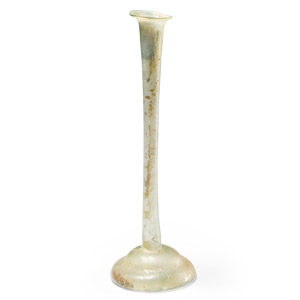
Roman Glass Candlestick Unguentarium
2nd-3rd century A.D.Sold for (Inc. bp): £143
Tall thin translucent pale green vessel with wide base and flared rim. 15 grams, 15.5 cm high
Acquired 1980-2015. Ex Abelita family collection. -
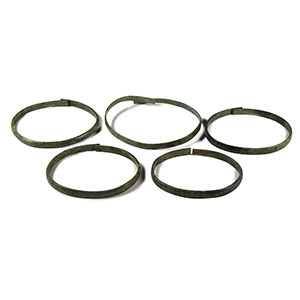
Roman Bronze Bracelet Group
1st-4th century A.D.Sold for (Inc. bp): £85
Comprising five with round-section bodies and squared terminals; the surface decorated with engraved lines and dots. 72 grams total, 63-75 mm
From the family collection of a Surrey gentleman since before 1960.
Bracelets were worn in Rome by ladies of rank, but it was considered a mark of effeminacy for civilian men to use such female ornaments (Suetonius, Caligula, 52; Nero, 30). The armillae (or psellia in Greek) were rings and bracelets worn by women in the Graeco-Roman world on both legs and arms. Homer mentions them (elikas) as being part of the hairstyle of the divine Aphrodite, thus giving an almost sacred character to these objects. There were different types, the most common consisting of a more or less thick metal wire, or a flat or cylindrical circle, like our examples. -
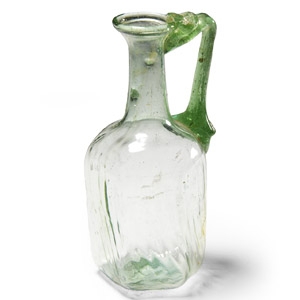
Roman Translucent Green Hexagonal Flask
3rd-4th century A.D.Sold for (Inc. bp): £546
A pale green translucent six-sided flask with trumpet-shaped neck and everted rim, applied strap handle. 52.3 grams, 12 cm high
Acquired 1980-2015. Ex Abelita family collection.
