
Loading, please wait...
LOT 0780
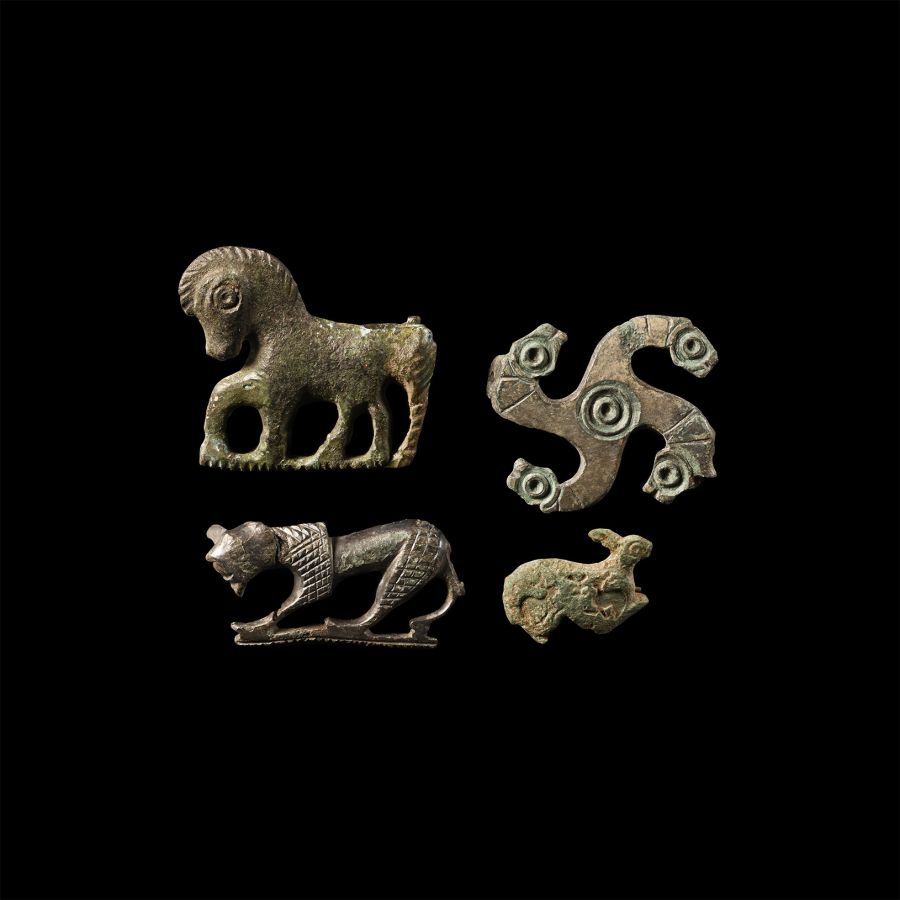
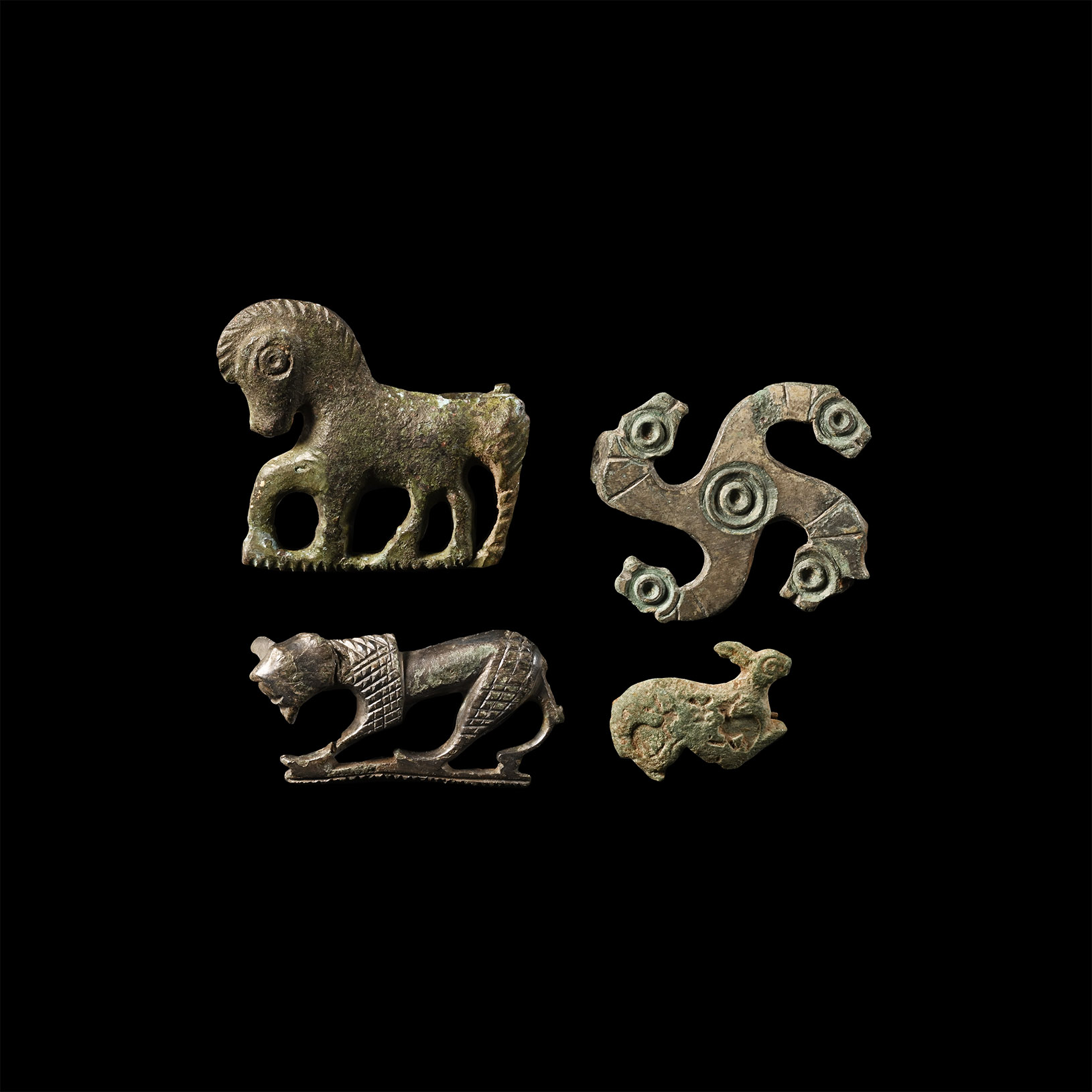
Roman Plate Brooch Collection
1ST-4TH CENTURY A.D.
7/8 - 1 3/8 in. (41.3 grams total, 21-36 mm).
A group of four bronze plate brooches: a horse walking left on a corded groundline, pin lug, pin and catchplate to reverse; a lioness in a stalking posture standing on a groundline, with incised face and mane detailing; pin lug to reverse; a hare bounding right with two recessed panels to the body also in the form of hares, pin lug, pin and catchplate to reverse; whorl brooch with central ring-and-dot ornament with four arms radiating outwards, each with a beast-head terminal, pin lug and catchplate to reverse. [4]
ProvenanceAcquired before 2000.
From the collection of a European gentleman living in the UK.
TimeLine Auctions follows a vetting process to ensure the authenticity and legality of all items, reinforcing our commitment to integrity and responsible trading. Each antiquity, antique, and coin lot undergoes thorough examination by a vetting committee of at least ten external specialists, professional trade association members, scientists, and archaeologists: Our Vetting Process
AUCTIONS:
TimeLine is a leading auction house specialising in antiquities, ancient art, collectables, natural history, coins, medals, and books. Our auctions offer museums, collectors, historians, and enthusiasts the opportunity to acquire unique and historically significant pieces.
-
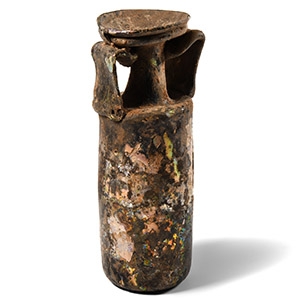
Large Roman Iridescent Glass Vessel
3rd-4th century A.D.Estimate: £500 - 700 (‡+bp*)
Opening Bid: £125
A broad cylindrical bottle with broad shoulder, slender neck, stepped neck and upwards-flaring rim, two applied rectangular handles; iridescent surfaces. 143 grams, 17 cm high
Acquired early 1990s. Ex private American collection; thence by descent. Private collection since 1998. -
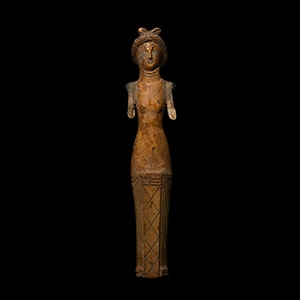
Romano-Parthian Female Bone Idol
3rd century B.C.-2nd century A.D.Estimate: £1,200 - 1,700 (+bp*)
Opening Bid: £480
A bone doll depicting a female figure with elaborately tied hairstyle, semi-naturalistic facial and anatomical detailing and geometric detailing to the garment wrapped around her lower body; stub arms; copper-alloy rivets to the shoulders. 77 grams, 19 cm high
with a London, UK gallery 1971-early 2000s. -
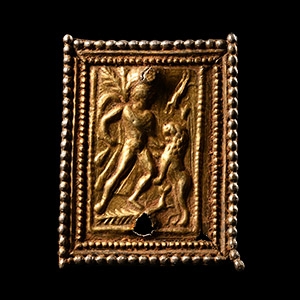
Roman Silver-Gilt Military Belt Plate with Hercules Killing the Nemean Lion
4th century A.D.Sold for (Inc. bp): £1,040
A silver-gilt strap tongue from military belt, rectangular shape with soldered bead on the back, a repoussé work representing Hercules, naked and covered only by a mantle, killing the Nemean lion, a palm of victory under the feet of the hero, a dog attacking the lion from above, foliage around the scene. 18.5 grams, 53 mm
Acquired 1980-2015. Ex Abelita family collection.
The belt fitting finds parallels with parts of belt from Asia Minor, today at the British Museum, inv. EC 252-254. These kind of plates, decorative and engraved with classical scenes, can be dated possibly to the age of Theodosius I. The quality of decoration can support the thesis of their belonging to officers of the Comitatus (the Imperial mobile army).
