Loading, please wait...

Use mousewheel to zoom in and out, click to enlarge

Details

LOT 0714

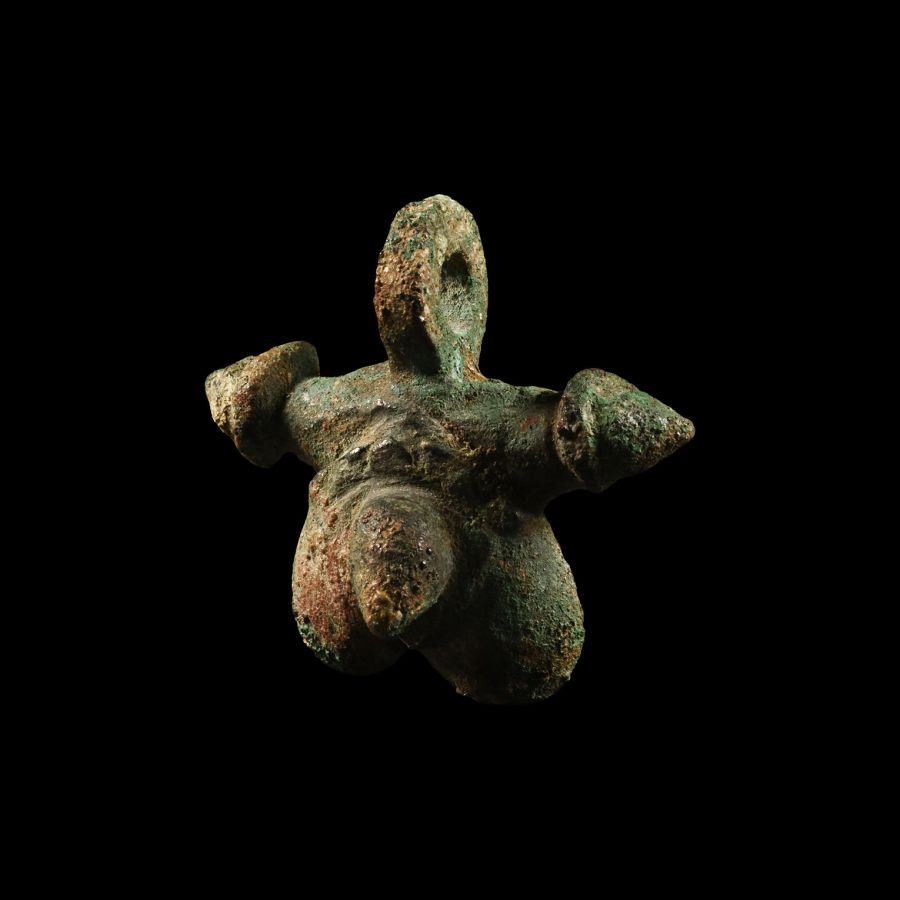
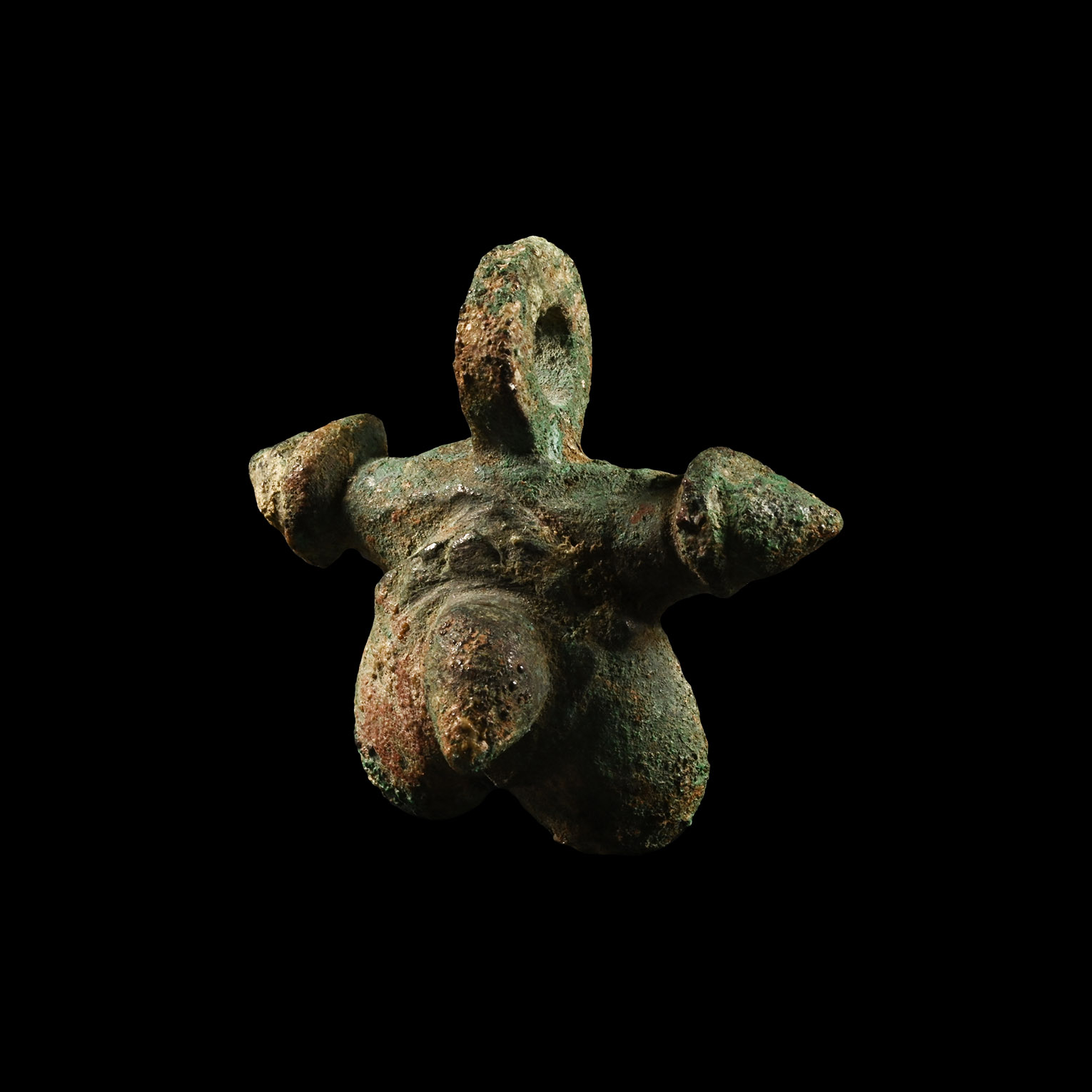
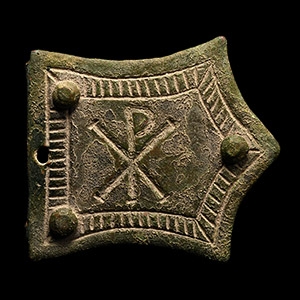
Roman Phallic Amulet

1ST-3RD CENTURY A.D.

1 3/8 in. (19.1 grams, 34 mm).

A bronze pendant comprising male genitals flanked by stubby phalloi above, pierced suspension lug.

Provenance

Acquired early 1990s.
Ex private American collection; thence by descent.
Private Swiss collection since 1998.

Literature

Cf. Beutler, F. et al., Der Adler Roms. Carnuntum und die Armee der Cäsaren, Bad-Deutsch-Altenburg, 2017, item 761, for type.

CONDITION

VETTING:

TimeLine Auctions follows a vetting process to ensure the authenticity and legality of all items, reinforcing our commitment to integrity and responsible trading. Each antiquity, antique, and coin lot undergoes thorough examination by a vetting committee of at least ten external specialists, professional trade association members, scientists, and archaeologists: Our Vetting Process


AUCTIONS:

TimeLine is a leading auction house specialising in antiquities, ancient art, collectables, natural history, coins, medals, and books. Our auctions offer museums, collectors, historians, and enthusiasts the opportunity to acquire unique and historically significant pieces.

LOT 0714

Roman Phallic Amulet

Estimate £300 - 400€350 - 460 (for guidance only)$410 - 540 (for guidance only)

Print page

RELATED LOTS

  • Roman Epigraphic Gemstone with Symbols
    Roman Epigraphic Gemstone with Symbols
    4th-5th century A.D.

    Sold for (Inc. bp): £910

    An epigraphic gem of oval shape, with a smooth surface on one side and inscriptions of a magical-Christian nature engraved in tondos and tabulae ansatae on the other side, one bearing the Greek letters Α and ω (Alpha and Omega) above the letters I and X. 0.84 grams, 17 mm


    Acquired before 1988. Ex family collection, by descent, Geneva.

    The letter Alfa and Omega (A W) are a clear link with a Christian cult, especially in this case in which the two letters are incised over the other two letter Iota and Chi IX, initials of the Greek Iesus Xριστός 'Christ'. The letters Alpha and Omega are symbols of eternity of the Divine Figure (I am the Alpha and the Omega, the First and the Last, the Beginning and the End, Revelation, 22.13).

    Lot Details

  • Roman Female Bone Doll
    Roman Female Bone Doll
    3rd-4th century A.D.

    Estimate: £500 - 700 (+bp*)

    Opening Bid: £250

    A Roman or Parthian bone figurine of a female with holes to accept pegs for separate articulated arms, hatching to the piled hairstyle, incised facial features, tiered collar, slender body with drape detailing to the bodice, belt and skirt; pierced ears to accept earrings; mounted on a custom-made stand. 214 grams total, 18 cm including stand

    Fine condition.

    Family collection since the 1960s. with Christie's, London, 29 April 2010, lot 373. Property of a Brussels gentleman. Accompanied by copies of the relevant Christie's catalogue pages.

    The doll was made of a carved bone figure of woman with separate arms attached to the body, and pieces for the ears. All the surface shows extensive marks of working by a saw, knife or a file. The body is made from bone, and the style of the doll is typical of Roman Britain. The separate parts were attached with pins or string. On the doll are still visible the little holes for the connecting string.

    Lot Details

  • Roman Auriga in Quadriga Redware Sherd
    Roman Auriga in Quadriga Redware Sherd
    4th century A.D.

    Sold for (Inc. bp): £130

    A redware ceramic fragment with moulded low-relief decoration of a victorious Auriga (chariot-driver) standing in his chariot with four rearing horses yoked to it; geometric detail to his tunic, a frond in his bent left arm and a whip in his raised right hand; incised bilinear lettering '-TA' to the left and 'PV- / TO[V?]-' to the right in Greek letters; modern mounting loop to the reverse. 74 grams, 90 mm


    Acquired 1960s-1990s. From the late Alison Barker collection, a retired London barrister.

    The pottery fragment shows an image of a charioteer in the moment of victory, with his left hand carrying a palm branch. The iconography is visible in the monument of Porphyrios in Constantinople and the charioteers of the Baccano mosaics. The detailed representation of the Auriga shows the attributes of his work: he wears a close-fitting undershirt with sleeves (γυμναστικiον) and an ornamented sleeveless tunic over it, leaving the knees exposed as is typical for charioteers (αυριγαριον).

    Lot Details

Stay up-to-date with the latest from TimeLine Auctions by joining our mailing list