
Loading, please wait...
LOT 0677
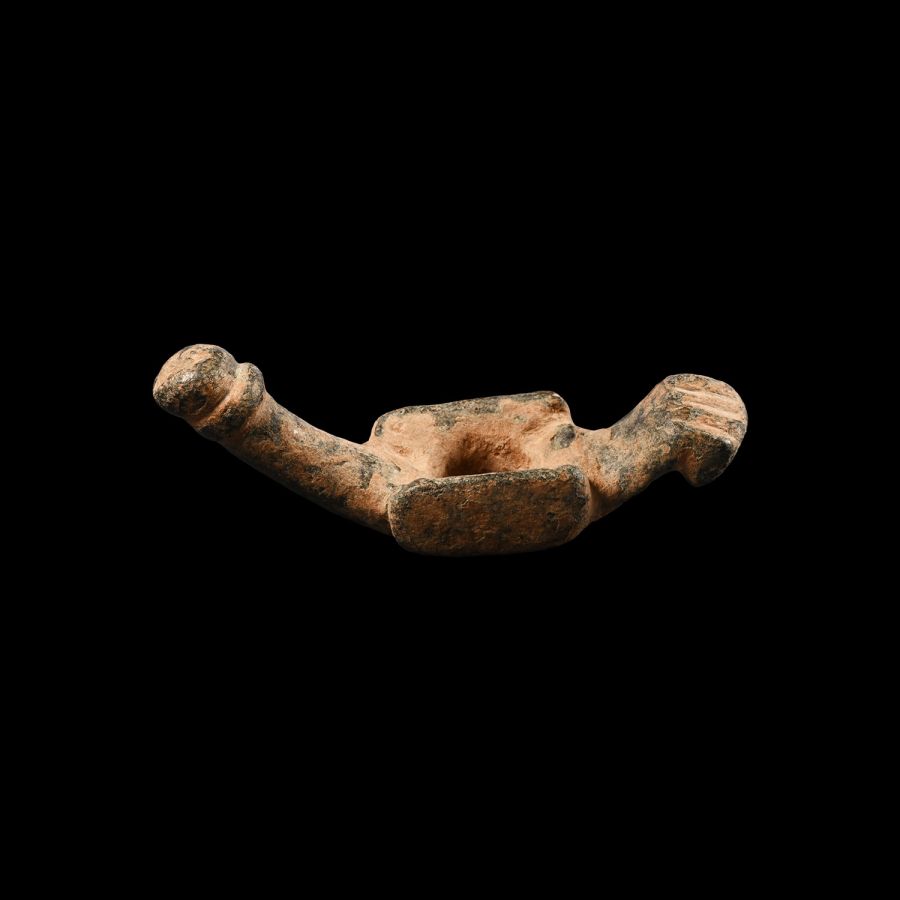
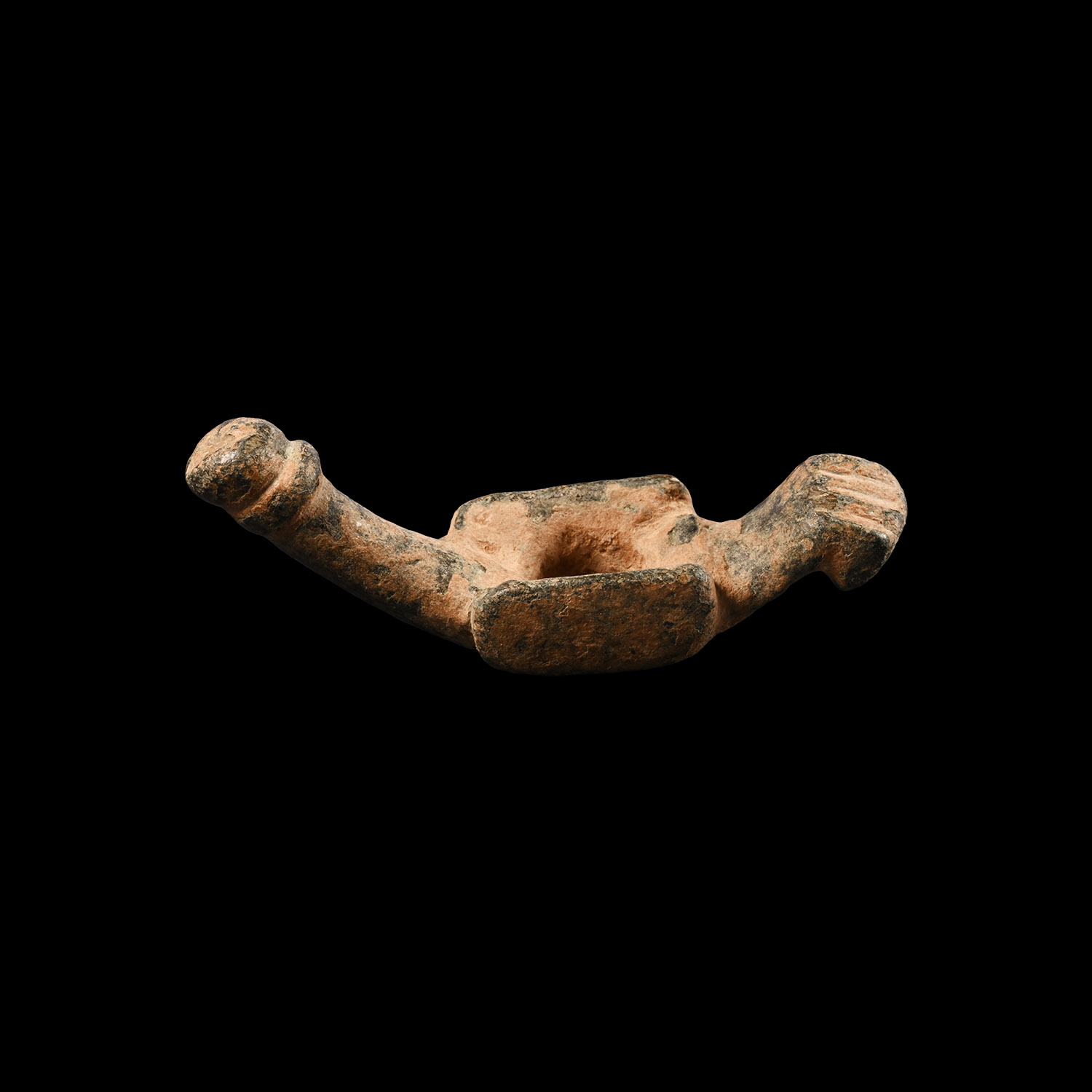
Roman Phallic Amulet
3RD-4TH CENTURY A.D. OR LATER
2 1/8 in. (26.1 grams, 55 mm).
A bronze phallic amulet composed of a hollowed truncated conical socket, with a curved arm to each side, one ending in a phallic shape, the other ending with a closed fist.
ProvenanceAcquire in the 1990s.
Ex Cambridgeshire, UK, collection.
Cf. for similar amuler or pendant Rolland, H., Bronzes Antiques De Haute Provence, Paris, 1965, item 436.
FootnotesRoman phallic amulets are represented by many examples preserved in museums and private collections, with a vast variety of types. This specimen belongs to category of double phallus, even if one of the male attributes is here represented as a fist. These amulets were worn as a wish for fertility and virile power, often hung on horses as harness pendants.
CONDITIONTimeLine Auctions follows a vetting process to ensure the authenticity and legality of all items, reinforcing our commitment to integrity and responsible trading. Each antiquity, antique, and coin lot undergoes thorough examination by a vetting committee of at least ten external specialists, professional trade association members, scientists, and archaeologists: Our Vetting Process
AUCTIONS:
TimeLine is a leading auction house specialising in antiquities, ancient art, collectables, natural history, coins, medals, and books. Our auctions offer museums, collectors, historians, and enthusiasts the opportunity to acquire unique and historically significant pieces.
LOT 0677
Roman Phallic Amulet
Estimate £100 - 140€120 - 160 (for guidance only)$140 - 190 (for guidance only)
-
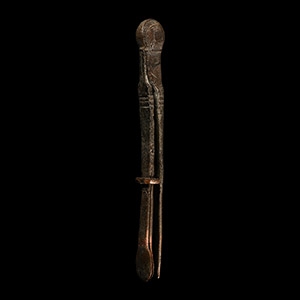
Roman Military Compass and Tweezers Multi-Tool
Circa late 2nd-4th century A.D.Sold for (Inc. bp): £260
A bronze multi-tool featuring a compass and tweezers, free-moving collar to one arm, one arm with two oval terminals and one tapering to a point. 19 grams, 90 mm
Acquired before 2000. From the collection of a European gentleman living in the UK.
This instrument, a type of circinus formed of two flat-section arms, was widely used by masons and carpenters, as well as for making wall decorations for the preparation of repetitive elements such as spirals or circles. It was widely used by the agrimensores of the army, as is proven by a very similar specimen found in Carnuntum, the camp of the Legio XIIII Gemina. -

Roman Gold Ring with Hermes Gemstone
Late 2nd-early 3rd century A.D.Sold for (Inc. bp): £650
A hollow-formed gold finger ring with inset jasper intaglio of Mercury (Hermes) standing wearing a cloak, holding a caduceus in one hand and a coin-purse in the other. 3.88 grams, 25.81 mm overall, 16.69 mm internal diameter (approximate size British H 1/2, USA 4, Europe 6.81, Japan 6)
Swiss private collection. with Geneve Encheres, Switzerland, 14 December 2017, lot 853. English private collection. -

Roman Bone Dice Pair
1st-4th century A.D.Sold for (Inc. bp): £111
A pair of bone dice with dot-in-ring numbering, both composed: 1:6, 2:5, 3:4. 4.28 grams total, 10 mm each
English collection formed in the 1990s. UK art market. Property of an Essex gentleman.
