
Loading, please wait...
LOT 0669
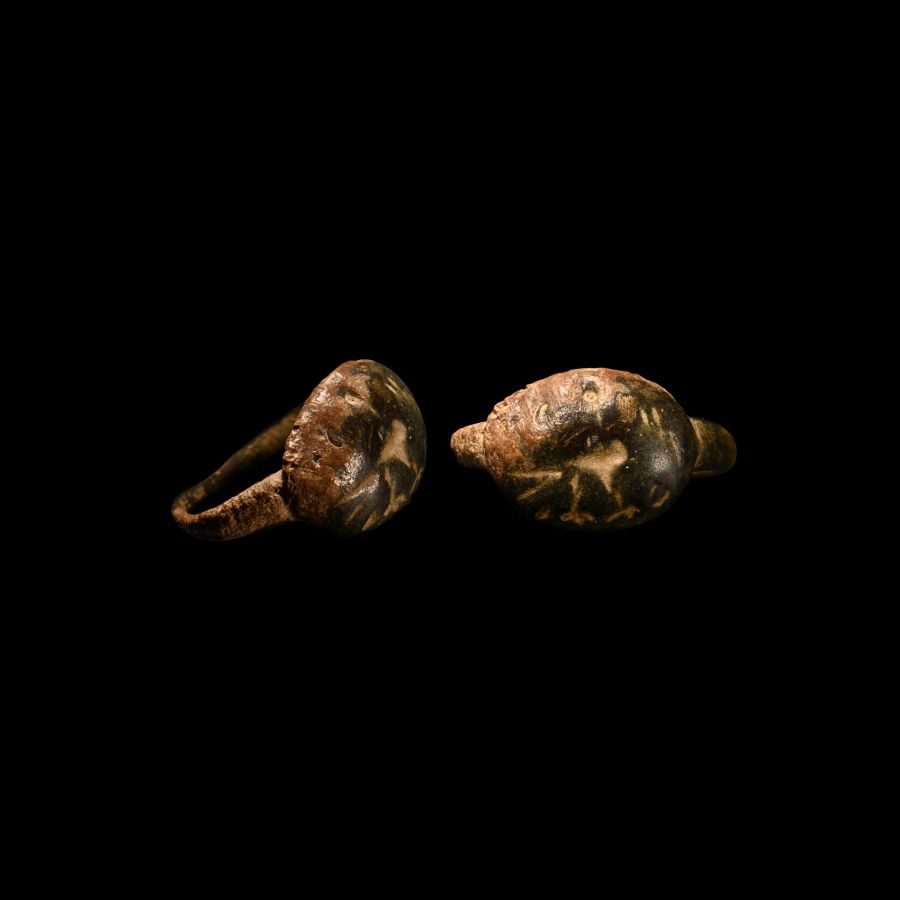
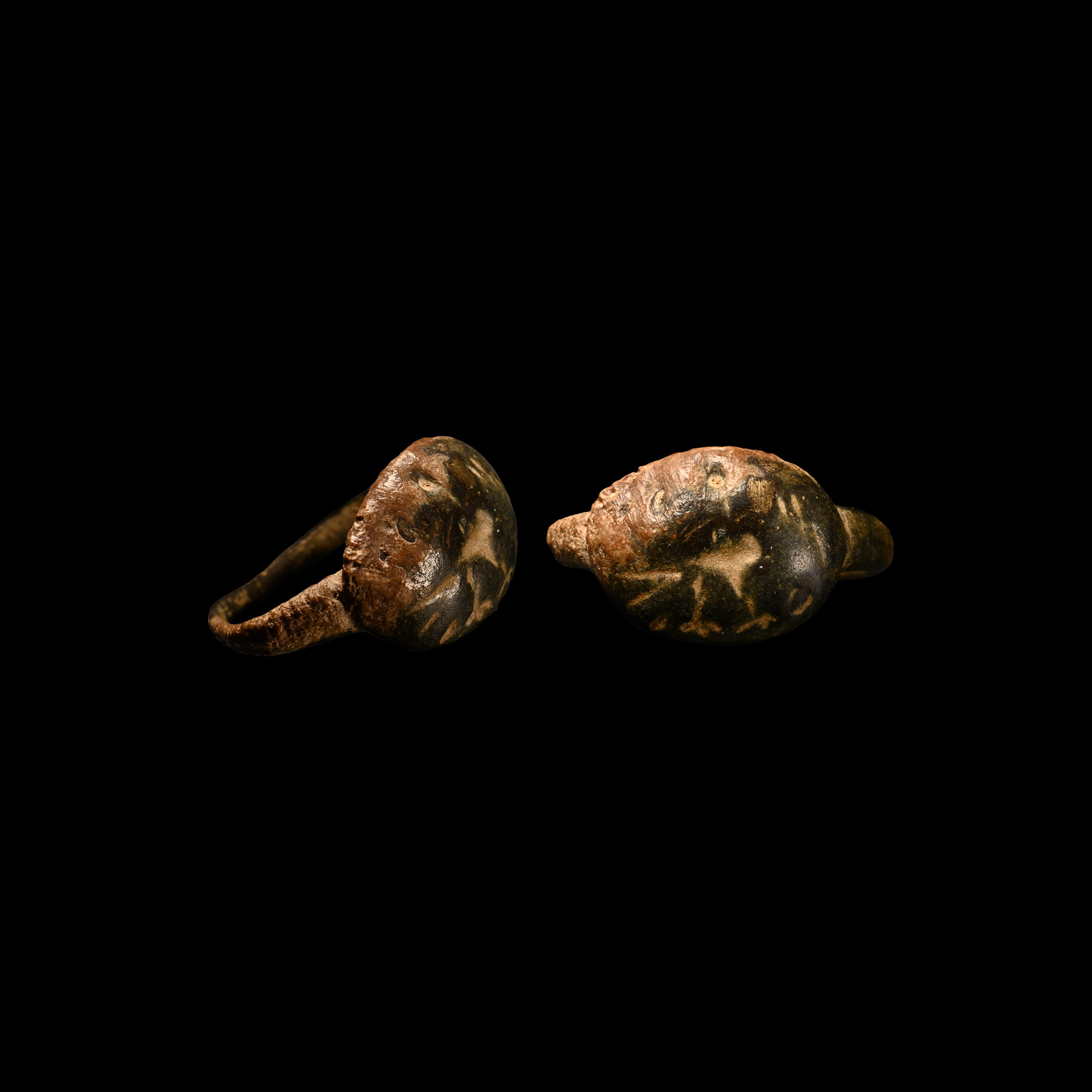
Roman Period Bronze Ring with Bird
1ST-2ND CENTURY A.D.
1 in. (5.67 grams, 23.03 mm overall, 19.19 mm internal diameter (approximate size British O 1/2, USA 7 1/4, Europe 15.61, Japan 15)).
The hoop misshapen with gently expanded shoulders and domed oval bezel engraved with a stylised bird standing right. [No Reserve]
ProvenanceFrom a European Dutch private collection circa 1970s.
Property of a Ruislip, UK, gentleman, by inheritance.
Accompanied by a previous dealer's certificate of authenticity.
TimeLine Auctions follows a vetting process to ensure the authenticity and legality of all items, reinforcing our commitment to integrity and responsible trading. Each antiquity, antique, and coin lot undergoes thorough examination by a vetting committee of at least ten external specialists, professional trade association members, scientists, and archaeologists: Our Vetting Process
AUCTIONS:
TimeLine is a leading auction house specialising in antiquities, ancient art, collectables, natural history, coins, medals, and books. Our auctions offer museums, collectors, historians, and enthusiasts the opportunity to acquire unique and historically significant pieces.
-
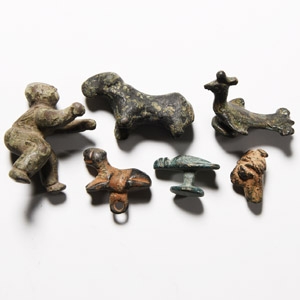
Roman and Later Bronze Artefact Group
3rd-4th century A.D. and laterSold for (Inc. bp): £130
Comprising various figures and mounts including: a sheep, a fly, a peacock, an anthropomorphic head, a mount with a lying feline and a crouching figure. 94 grams total, 18-40 mm
Acquired on the UK art market. Property of a Ruislip, UK, gentleman, by inheritance.
In the art of late antiquity and early Christianity, during the Christian Middle Ages to the present, peacock held a prominent place, not only as a decorative motif, but also as a distinctive emblematic and symbolic sign. Its image was usually combined with a kantharos or a tree of life. Individually or in pairs, it was usually represented on places which were the ones closest to the holiest part of churches (altar’s parapet wall panels). Votive statuettes were brought in the church by the believers. -
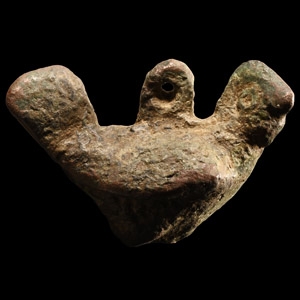
Roman Bronze Cockerel Tintinnabulum Pendant
1st-4th century A.D.Estimate: £40 - 60 (+bp*)
Opening Bid: £22
Modelled in the round with naturalistic detailing, wings closed, with loop above for attachment to a tintinnabulum. 21 grams, 32 mm
‘The Ancient Menagerie Collection’ formerly the property of a Cambridgeshire lady, collected since the 1990s and acquired from auctions and dealers throughout Europe and the USA, now ex London collection. -
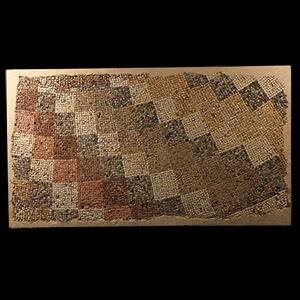
Roman Geometric Floor Mosaic
Circa 1st-4th century A.D.Sold for (Inc. bp): £8,450
Fragment or portion of floor mosaic, showing a composition of alternated patterns of different coloured squares in chequerboard pattern, combined in diagonal rows of light yellow, light blue, off-white, pink, red, light violet, again off-white, light grey, light grey, dark grey, off-white, light yellow (repeated two times) light blue and off-white shadows; on the lower part a red line is edging the composition over an off-white band. 82.5 kg, 156 cm wide including frame
Acquired 1970s-1996. Property of a North American collector. London collection, 2016. This lot has been checked against the Interpol Database of stolen works of art and is accompanied by search certificate number no.11822-207409.
The square-decorated mosaics had a strong presence in the Hispanic provinces, with some 1st century A.D. examples in the houses of Ampurias, up to the late imperial examples of the Villa of Palencia (archaeological site of La Tejada) where the main rooms show wall paintings with geometric, vegetal or decorations imitating marbles, and mosaics with simple geometric decorations alternating with elegant decorative motifs such as swastikas, chequered motifs or ropes, and Solomonic symbols. The chequerboard motif was widespread, and it is visible also in the 3rd-4rd century mosaic of the Roman Villa of Brading or in the house found under the Museum of Lincoln, in Britain.
