
Loading, please wait...
LOT 0310
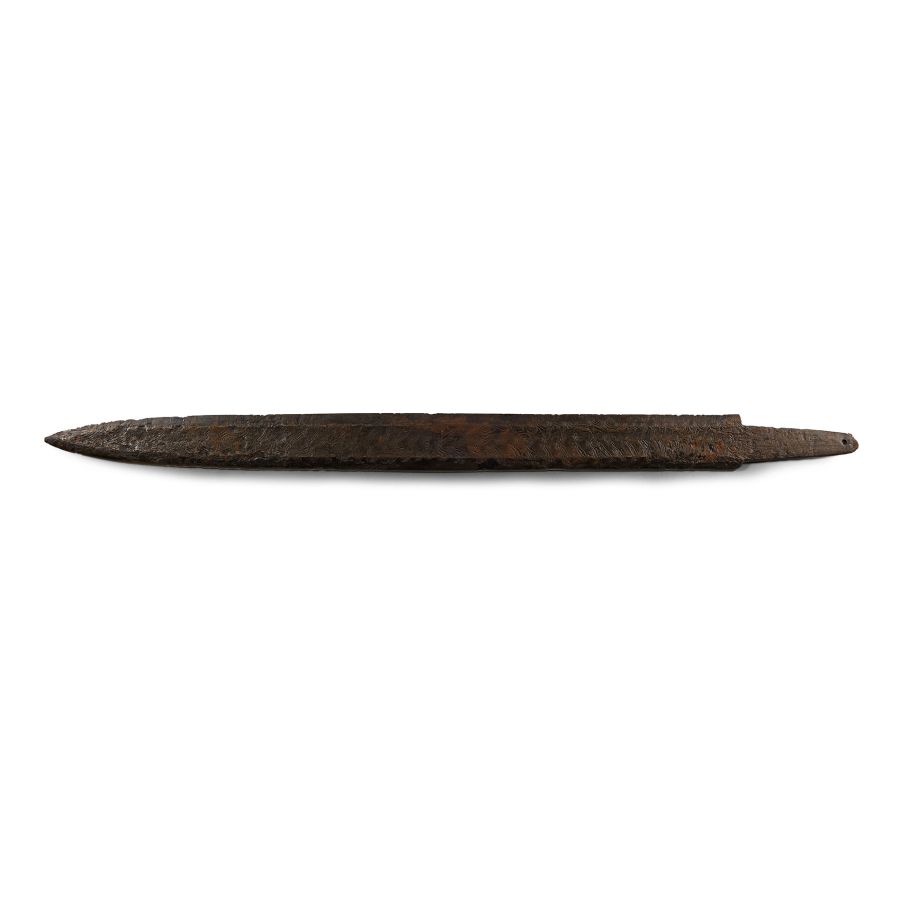
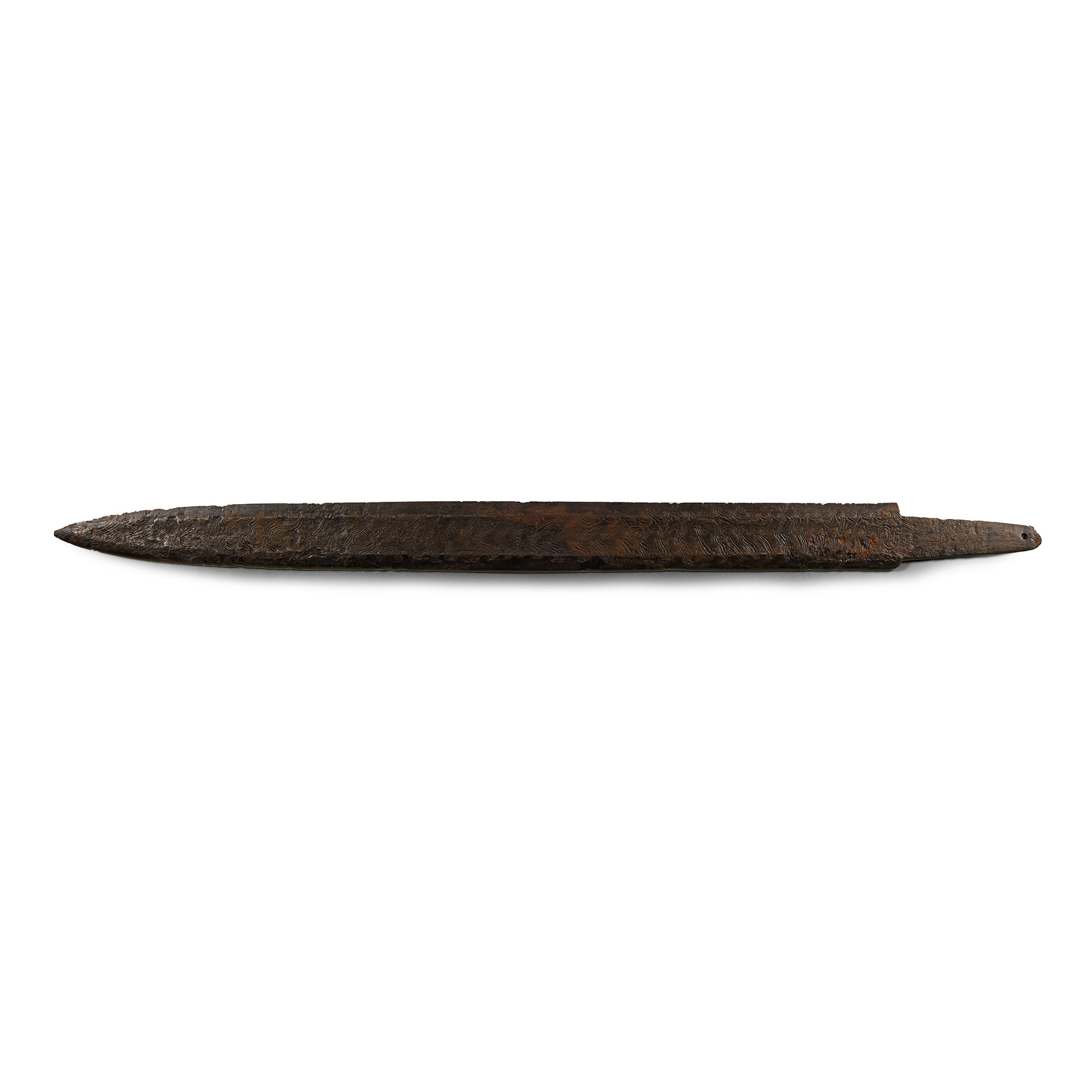
Roman Pattern-Welded Iron Spatha
CIRCA LATE 4TH CENTURY A.D.
21 1/2 in. (287 grams, 54.6 cm).
A section of a double-edged long sword (spatha) of Illerup-Wyhl typology; half of the blade still intact with the tang created in later times by shortening a part of the blade; narrow parallel cutting edges tapering towards the point; both sides showing pattern-welding in form of ZS stripes and torsion technique B.II.1.2.
ProvenanceEx private collection of Mr M.B., Mainz, Germany, since the 1980s.
Acquired from the above, 2004.
This lot has been checked against the Interpol Database of stolen works of art and is accompanied by search certificate no.11976-210915.
Cf. Miks, C., Studien zur Romischen Schwertbewaffnung in der Kaiserzeit, I-II Banden, Rahden, 2007, no.536.58, for similar.
FootnotesDr Miks refers to the spathae of the 'lllerup-Wyhl' type I as to a large group of blades which in terms of their proportions, dimensions and shape, are probably a mixture of blades of the more classical 'Straubing-Nydam' and 'Lauriacum-Hromowka' types of long Roman swords. They are one of the most complicated category of late Roman swords and therefore difficult to clearly identify. The chosen double designation (lllerup-Wyhl) takes into account the circumstance that the blades of this category could be identified in a lighter, narrower shape, with several representatives in the concentration ‘C’ of the moor finds from lllerup Ädal (Miks, 2007, A321), while heavy and broad specimens may be visible, like the well-preserved blade from body grave 22 of a late Roman influenced grave field in Wyhl (Miks, 2007, A798).
CONDITIONTimeLine Auctions follows a vetting process to ensure the authenticity and legality of all items, reinforcing our commitment to integrity and responsible trading. Each antiquity, antique, and coin lot undergoes thorough examination by a vetting committee of at least ten external specialists, professional trade association members, scientists, and archaeologists: Our Vetting Process
AUCTIONS:
TimeLine is a leading auction house specialising in antiquities, ancient art, collectables, natural history, coins, medals, and books. Our auctions offer museums, collectors, historians, and enthusiasts the opportunity to acquire unique and historically significant pieces.
LOT 0310
Roman Pattern-Welded Iron Spatha
Estimate £3,000 - 4,000€3,480 - 4,640 (for guidance only)$4,050 - 5,400 (for guidance only)
-
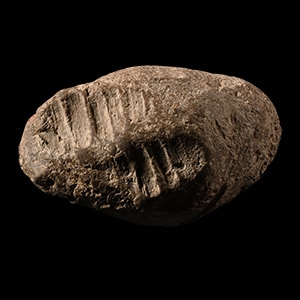
Roman Praetorian Guard Terracotta Sling Shot with Scorpion
1st century A.D.Sold for (Inc. bp): £286
Lentoid section with a raised 'keel' to one end, depicting a stylised scorpion. 25.75 grams, 43 mm
Ex Simmons Gallery, London E11, UK, in the 1990s. From a North London collection.
The sling (funda) with its lead (plumbea pondera) and stone missiles was used by special funditores, illustrated on Trajan’s Column where they are dressed in broad tunics with no armour, but carry a shield. Interestingly, this glans has the emblem usually associated with the Praetorian Guard - the scorpion. It was an emblem also used in Ptolemaic Egypt, and it is not impossible that this bullet could be Ptolemaic or Romano-Egyptian. We believe this bullet could be associated with the Praetorian regiments which means this could be one of the first pieces of evidence for their use. -
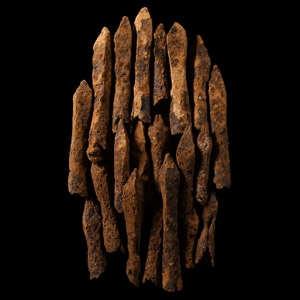
Medieval Iron Crossbow Bolt Group
Circa 12th-15th century A.D.Sold for (Inc. bp): £143
Mainly comprising socketted bolts with tapering a facetted square-section tips. 798 grams total, 5.7-10 cm
Acquired 1990s-early 2000s. East Anglian private collection. -
.jpg)
Medieval Iron Kidney Dagger
Late 15th century A.D.Sold for (Inc. bp): £1,300
Featuring a wedge-shaped blade and a lobed handle; the hilt fitted with an iron plate bending down to form points on each side of the blade, pommel with a discoid brass plate decorated with an incised flower motif. 307 grams, 46 cm
Acquired 1960s-1990s. Late Alison Barker collection, a retired London barrister.
The term 'ballock dagger' was used in medieval times to describe a dagger with a grip bearing a considerable resemblance to a phallic symbol. It was also called 'kidney dagger' during the Victorian times. The constant characteristic is the presence of two roundish and symmetrical bulbs at the guard, with the grip itself emerging upward between them and flaring slightly towards the top, sometimes being surmounted by a cap.
