Loading, please wait...
LOT 0902
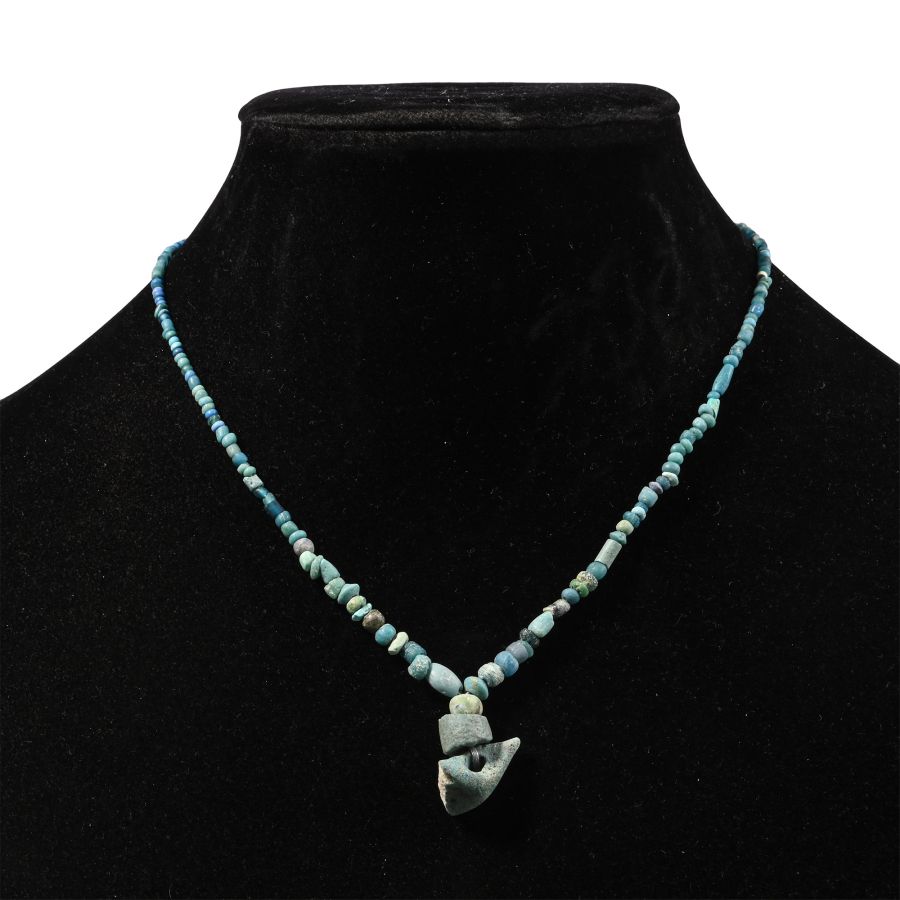
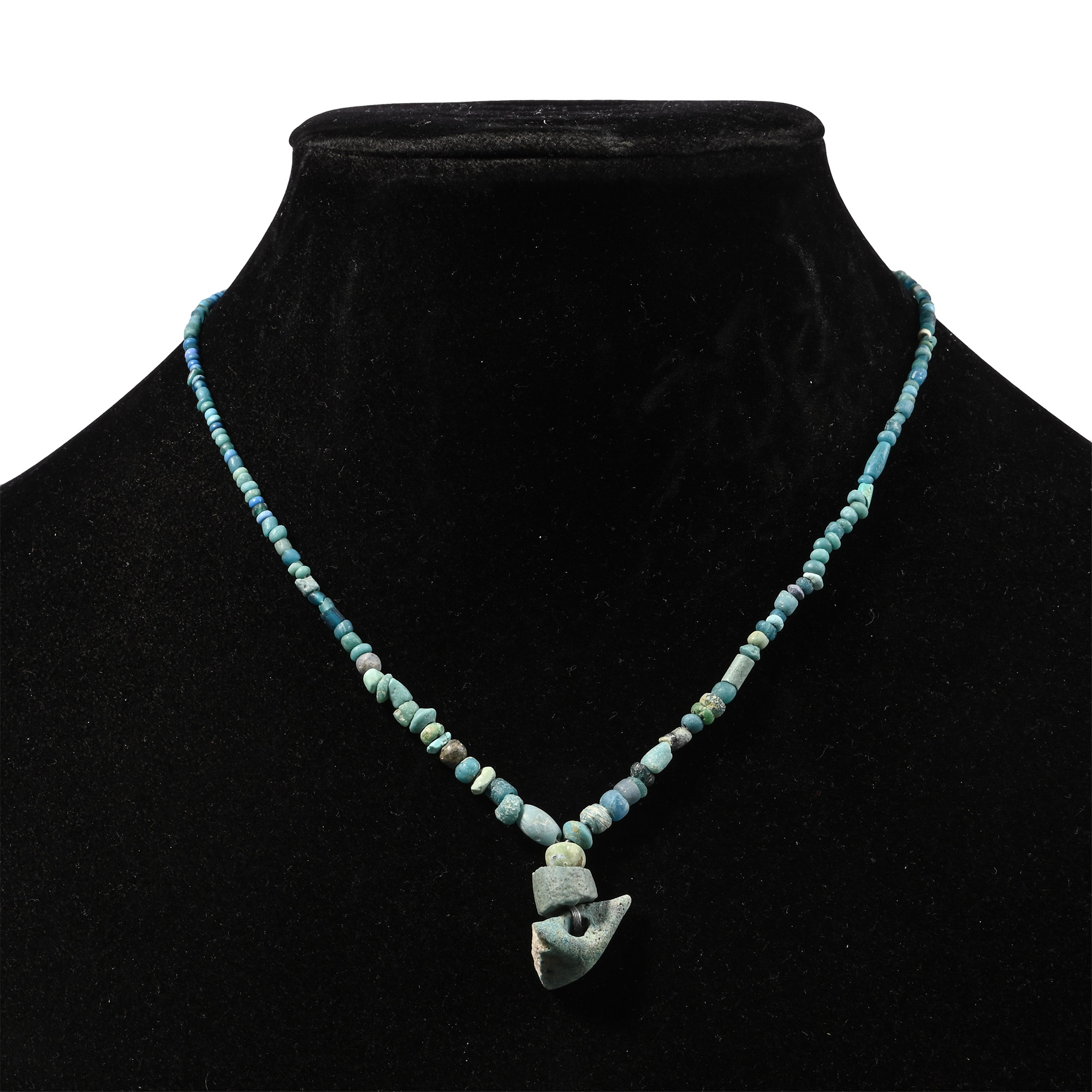
Roman Pale Blue Glass and Other Bead Necklace String
1ST-4TH CENTURY A.D. AND LATER
15 in. (7.8 grams, 38 cm).
Composed mainly of oblate and annular beads, the central feature composed of two large beads, restrung. [No Reserve]
ProvenanceEx Ancient Art Shop, Windsor, UK, 1990s.
Ex private West County, UK, collection.
TimeLine Auctions follows a vetting process to ensure the authenticity and legality of all items, reinforcing our commitment to integrity and responsible trading. Each antiquity, antique, and coin lot undergoes thorough examination by a vetting committee of at least ten external specialists, professional trade association members, scientists, and archaeologists: Our Vetting Process
AUCTIONS:
TimeLine is a leading auction house specialising in antiquities, ancient art, collectables, natural history, coins, medals, and books. Our auctions offer museums, collectors, historians, and enthusiasts the opportunity to acquire unique and historically significant pieces.
LOT 0902
Roman Pale Blue Glass and Other Bead Necklace String
Estimate £60 - 80€70 - 93 (for guidance only)$81 - 108 (for guidance only)
Opening Bid
£5 (EUR 6; USD 7) +BP*
-
Large Graeco-Roman Silver Wine Infundibulum
5th century B.C.-1st century A.D.Estimate: £30,000 - 40,000 (+bp*)
Bids: 1 | Current Bid: £17,000
With a hollow spherical body decorated with slightly concave petals radiating from each end, separated by a central grooved band; one end with a tapering funnel marked by horizontal grooves, the other with a short tapering neck and a wide rim. 356 grams, 29.5 cm
Old Austrian private collection, 1980s. Accompanied by a copy of a nine-page examination report number 154/2026 by Dr habil Mikhail Treister. Accompanied by an academic report by Dr Raffaele D’Amato. This lot has been checked against the Interpol Database of stolen works of art and is accompanied by search certificate number no.12905-242699.
Comparable instruments, usually called clepsydra in Greek and infundibulum in Latin, were in use in the 5th – first half of the 4th centuries B.C. A total of 13 such objects, or clepsydra, are known, including two of the unknown origin), represented by the finds both from Central (Lazio) and South (Campania, Calabria and Basilicata) Italy, Illyria (Apollonia) and Central Greece (Boeotia, Phocis) (all made of bronze), from the Taman peninsula in the North Pontic area, a fragmented one – from the Ulyap kurgan necropolis in the Trans-Kuban region and a silver piece from an aristocratic Thracian burial in the Plovdiv region. A distinctive feature of all these metal objects is the combination of a narrow vertical tube, at the lower end turning into a container with holes in the bottom. -
Roman Bronze Openwork Plate Brooch
2nd-3rd century A.D.Estimate: £30 - 40 (+bp*)
Opening Bid: £5
Openwork body composed of four pelta-shaped motifs radiating from a central lozenge; pin and catch on the reverse. 10.6 grams, 37 mm
From the private coin collection of a West London, UK, gentleman, formed since the mid 1980s. -
Roman Sapphire Cameo with Bust of Serapis Later Converted to Saint John the Evangelist
Circa 2nd-3rd century A.D., reworked 6th-7th century A.D.Estimate: £3,000 - 4,000 (+bp*)
Bids: 1 | Current Bid: £600
Carved in the half-round on a sapphire crystal showing striations on the reverse, depicting the upper body of Serapis/St John with modius and pleated tunic, eagle with spread wings placed on the chest. 5.06 grams, 23 mm
Acquired circa 1980. Property of a Middlesex gentleman. This lot has been checked against the Interpol Database of stolen works of art and is accompanied by search certificate number no.13351-255640.
This is a prime example of late antique or early medieval spolia, where a pagan motif was converted into a Christian one with minimal mental or manual adaptation into a visual fusion of Serapis and Saint John. During the Roman Empire, especially in the 2nd and 3rd centuries AD, depictions of the 'bust of the God Serapis standing on an eagle' were extremely popular. The eagle symbolised Jupiter-Serapis, as well as Roman power. When the Empire became Christian, this combination was immediately recognised as the Evangelist John, accompanied by his symbol, the eagle. The modius (kalathos) symbolised fertility and dominion over the underworld when placed on Serapis's head. However, it was often incorrectly (or deliberately) interpreted by Christian observers as an early form of a crown, halo, or priestly headdress. As sapphire is extremely difficult to work with, the modius was often left standing, emphasising the figure's imperial or divine dignity. There are documented cases of this kind. Most famous example: 'Gem of Serapis' (Cab. Méd., Paris), or the reinterpretation of depictions of Jupiter as God the Father. During the Christianisation process, pagan gods with beards and eagles (Jupiter/Serapis) were reclassified as John the Evangelist or Christ himself en masse.