
Loading, please wait...
_900x900.jpg "Roman Opaque White Glass Vessel")
_200x200.jpg "Roman Opaque White Glass Vessel")
.jpg "Roman Opaque White Glass Vessel")
LOT 0680
Roman Opaque White Glass Vessel
1ST-2ND CENTURY A.D.
2 5/8 in. (32.5 grams, 65 mm wide).
An opaque white glass cup or other vessel with trumpet-style neck and rim, slightly convex body and everted foot.
ProvenanceAcquired 1969-1999.
London collection of the late Mr S.M., thence by descent.
Cf. The Metropolitan Museum, accession number 17.194.92, for similar.
CONDITIONTimeLine Auctions follows a vetting process to ensure the authenticity and legality of all items, reinforcing our commitment to integrity and responsible trading. Each antiquity, antique, and coin lot undergoes thorough examination by a vetting committee of at least ten external specialists, professional trade association members, scientists, and archaeologists: Our Vetting Process
AUCTIONS:
TimeLine is a leading auction house specialising in antiquities, ancient art, collectables, natural history, coins, medals, and books. Our auctions offer museums, collectors, historians, and enthusiasts the opportunity to acquire unique and historically significant pieces.
LOT 0680
Roman Opaque White Glass Vessel
Estimate £450 - 650€520 - 750 (for guidance only)$610 - 880 (for guidance only)
-
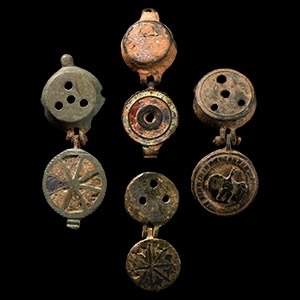
Roman Seal Box Collection
2nd-3rd century A.D.Estimate: £500 - 700 (+bp*)
Opening Bid: £250
A mixed group of bronze seal boxes and parts, one with a spread-eagle motif in high-relief. 30.7 grams total, 25-46 mm
Acquired in the late 1980s-early 1990s. Important North West London collection. -
.jpg)
Roman Marble Herm Boundary Marker
Circa 1st century B.C.Sold for (Inc. bp): £4,680
A carved marble herm boundary marker carved in the round as the bust of an adult male wearing a conical cap and with a full beard; dorsal pillar terminating behind the head. 7.3 kg, 31.5 cm high
French collection, 1960s-early 2000s. From an important Paris gallery, France. This lot has been checked against the Interpol Database of stolen works of art and is accompanied by search certificate no.11629-199364.
Possibly an architectural element or herm: herma (Ancient Greek: ἑρμῆς, usually called a 'herm' in English), is a sculptured stone block with a head and often a chest above an undecorated lower section on which male genitals may additionally be carved. From the Neolithic period onwards, in parts of Europe, divinities were worshipped in the form of either a heap of stones (cairn) or a wooden column. Piles of stones were created beside roads and at the borders of fields as they were cleared of pebbles, and religious respect was shown through the custom of each passer-by throwing a stone on the heap or offering a libation. In due course, the addition of a carved head (and phallus) to the column encouraged the belief that these monuments were especially favoured by divinities. -
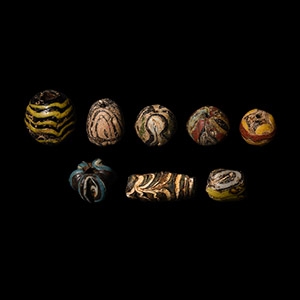
Roman Glass Bead Collection
1st century B.C.-1st century A.D. and laterSold for (Inc. bp): £234
A group of eight individually decorated coloured glass beads with swirled, folded, trail-decorated and combed decoration. 25 grams total, 12-22 mm
Acquired 1980s-1990s. H.N.collection, Milton Keynes, Bedfordshire, UK.
