Loading, please wait...

Roman Nicolo Gemstone of Boy Roman Nicolo Gemstone of Boy Roman Nicolo Gemstone of Boy
Use mousewheel to zoom in and out, click to enlarge
Details

LOT 0033

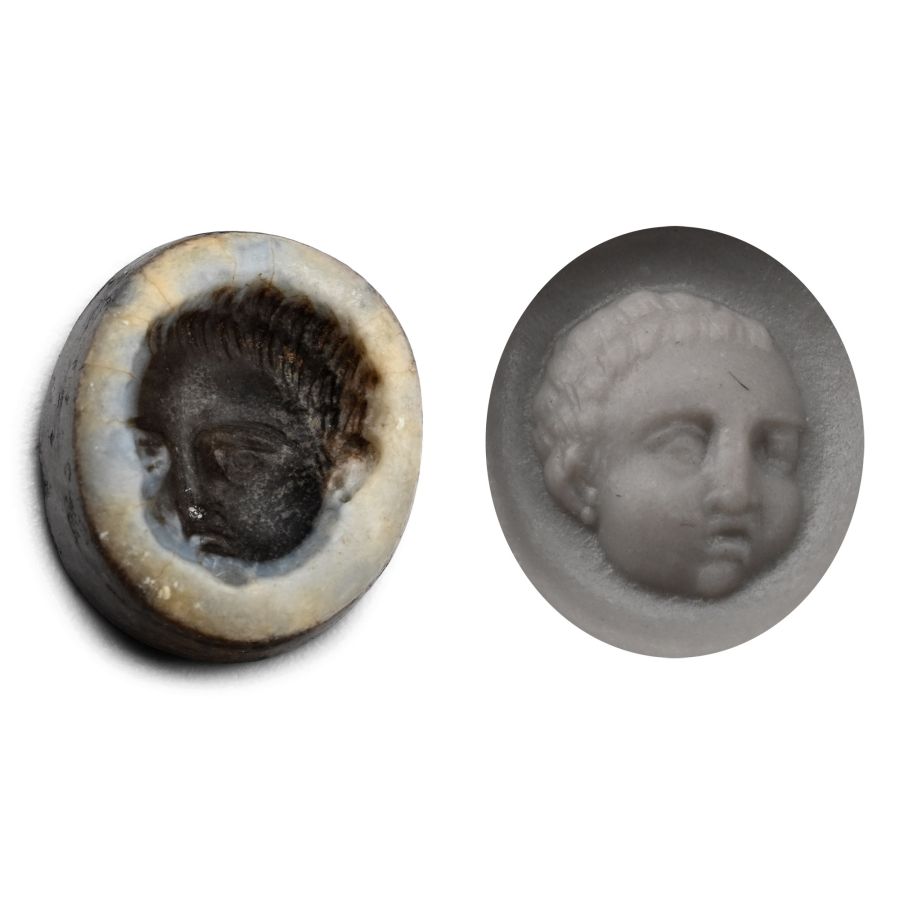
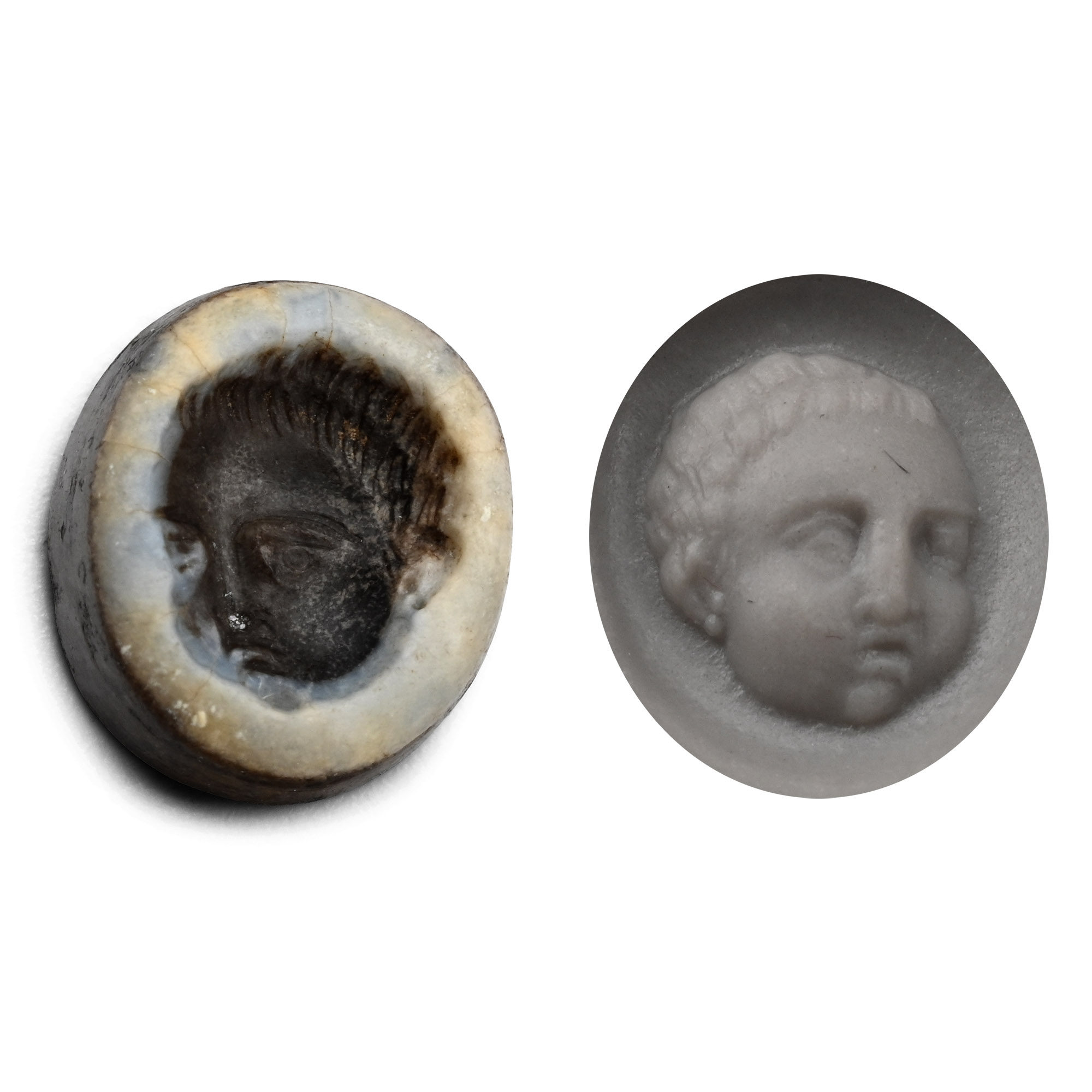
Roman Nicolo Gemstone of Boy

1ST CENTURY A.D.

1/4 in. (0.18 grams, 7 mm).

Discoid in plan with incuse juvenile head in three-quarter view; supplied with a museum-quality impression.

Provenance

Private English collection, formed between the late 1970s and early 1990s.
Private collection, London, UK.

CONDITION
VETTING:

TimeLine Auctions follows a vetting process to ensure the authenticity and legality of all items, reinforcing our commitment to integrity and responsible trading. Each antiquity, antique, and coin lot undergoes thorough examination by a vetting committee of at least ten external specialists, professional trade association members, scientists, and archaeologists: Our Vetting Process


AUCTIONS:

TimeLine is a leading auction house specialising in antiquities, ancient art, collectables, natural history, coins, medals, and books. Our auctions offer museums, collectors, historians, and enthusiasts the opportunity to acquire unique and historically significant pieces.

LOT 0033

Roman Nicolo Gemstone of Boy

Sold for (Inc. bp): £1,170

Print page

RELATED LOTS
  • Roman Bronze Figure of Aphrodite Holding a Severed Swans Head
    Roman Bronze Figure of Aphrodite Holding a Severed Swan's Head
    1st-3rd century A.D.

    Sold for (Inc. bp): £1,105

    Modelled in the round nude and and raising her right arm, holding the neck of the swan (her animal attribute); left arm descending towards her pubis, legs in contrapposto stance; gusseted drum-shaped base; repaired. 327 grams, 19.5 cm


    Acquired in the mid 1980s-1990s. From the family collection of Mr S.A., Switzerland, thence by descent. Private collection since the late 1990s. This lot has been checked against the Interpol Database of stolen works of art and is accompanied by a search certificate number no.12099-218223.

    Although the presence of the swan in this position is rather rare, iconographically, this image is part of the abundant series of statuettes of Aphrodite/Venus widely distributed during the Roman Imperial era.

    Lot Details

  • Roman Bronze Ring with Warrior
    Roman Bronze Ring with Warrior
    280-400 A.D.

    Sold for (Inc. bp): £33

    Comprising a slender hoop and a discoid bezel with a stylised figure holding a sword. 3.35 grams, 21.58 mm overall, 17.38 mm internal diameter (approximate size British N, USA 6 1/2, Europe 13.72, Japan 13)


    Acquired on the UK and EU art market before 2000. From the private collection of a Surrey, UK, gentleman.

    The small copper-alloy Roman finger ring seems to be of Guiraud Type 4f (similar to Henig Type II) and dates from the 3rd to early 5th century A.D. The size of the ring suggests it may have been worn on the end of the finger, but most probably used by a child.

    Lot Details

  • Roman Bronze Eagle with Dedication to Zeus
    Roman Bronze Eagle with Dedication to Zeus
    2nd-3rd century A.D.

    Estimate: £3,000 - 4,000 (+bp*)

    Opening Bid: £1,500

    Depicted in a standing position with an erect head, the detailed claws resting on a pedestal base, folded wings and a long tail; detailed engraving of feathers, superb rendering of the beak and round eyes; Greek inscription on the front and left side of the raised square pedestal, having a square socket allowing the insertion in a staff or shaft; the inscription could be translated as: '[Ο]Ι [ΤΗ]Σ Δ[ΙΟΣ] = To Zeus / [Ε]ΤΑ[Ι]Ρ[ΕI] (?)ΡΡΑΣ = those of the association of ? ..RRAS / ΕΥΧ ΗΝ = in fulfilment of a vow'. 233 grams, 95 mm


    UK private collection before 2000. Acquired on the UK art market. Private collection, London, UK. Accompanied by an academic report by Dr Raffaele D'Amato. This lot has been checked against the Interpol Database of stolen works of art and is accompanied by search certificate number no.13060-248309.

    In the Roman world the eagle, bird associated with the god Jupiter or Zeus (Aetos Dios = Eagle of Zeus), king of the Olympian gods, and one of his most common attributes together with thunderbolt and the long sceptre, was seen as ‘the symbol and agent of apotheosis after death’ and an eagle was released from the top of an emperor’s funeral pyre to signal the journey of the soul heavenwards. Eagles were also the principal standard of the Legions, in gold or silver, and became the military symbol for excellence. However, the eagle was not reserved only for the ruling class or for military people, but was also found on funerary altars and dedications of private citizens. As is so often the case with metal figurines, nineteen of the eagles found in Britain are from unknown contexts, but they are found at a variety of site types, including four from military sites and three from urban sites. Apart from two from villas, they do not occur at rural settlement sites or at religious sites other than the temple at Woodeaton, Oxon, where a small group of five eagle figurines was recovered (Kirk, 1949; Henig and Munby, 1973). Also of interest is the eagle figure thought to have been a sceptre terminal, which was recovered from the temple at Farley Heath, Surrey. A second sceptre terminal, identified variously as an eagle or raven, was also part of the hoard found at Willingham Fen (Bird 2007, 49 no. 81, fig. 21).

    Lot Details

Stay up-to-date with the latest from TimeLine Auctions by joining our mailing list