
Loading, please wait...
_900x900.jpg "Roman Mouse Holding Nut")
_200x200.jpg "Roman Mouse Holding Nut")
.jpg "Roman Mouse Holding Nut")
LOT 0596
Roman Mouse Holding Nut
1ST-3RD CENTURY A.D.
1 in. (17.8 grams, 27 mm).
A freestanding bronze figure of a mouse sitting on its haunches, eating a large nut, stylised incised detailing to its textured coat, feet, ears and face; small socket to wedge-shaped base.
ProvenanceAcquired before 2000.
From the collection of a European gentleman living in the UK.
Cf. The British Museum, museum number 1975,0301.2 'Bronze figure of a mouse', for similar.
CONDITIONTimeLine Auctions follows a vetting process to ensure the authenticity and legality of all items, reinforcing our commitment to integrity and responsible trading. Each antiquity, antique, and coin lot undergoes thorough examination by a vetting committee of at least ten external specialists, professional trade association members, scientists, and archaeologists: Our Vetting Process
AUCTIONS:
TimeLine is a leading auction house specialising in antiquities, ancient art, collectables, natural history, coins, medals, and books. Our auctions offer museums, collectors, historians, and enthusiasts the opportunity to acquire unique and historically significant pieces.
LOT 0596
Roman Mouse Holding Nut
Estimate £200 - 300€230 - 350 (for guidance only)$270 - 410 (for guidance only)
-
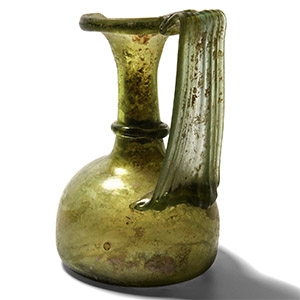
Large Roman Green Glass Jug
1st-4th century A.D.Sold for (Inc. bp): £351
A green glass jug with squat body domed shoulder, tubular neck and rolled rim, applied ribbed handle and trail to neck base; iridescent surfaces; rim chipped. 279 grams, 15.2 cm high
Acquired early 1990s. Ex private American collection; thence by descent. Private collection since 1998. -
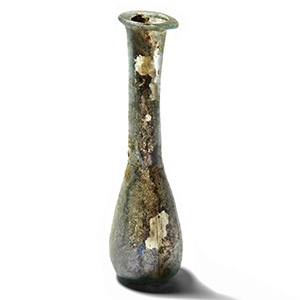
Roman Translucent Unguentarium
1st-3rd century A.D.Sold for (Inc. bp): £72
A clear glass unguentarium with a pear-shaped body, tubular neck and rolled rim; iridescent surfaces. 35 grams, 13.5 cm high
French collection, 1960s-early 2000s. From an important Paris gallery, France. -
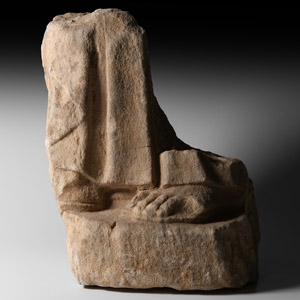
Roman Marble Statue Fragment with Feet
1st-2nd century A.D.Estimate: £2,500 - 3,500 (‡+bp*)
Opening Bid: £1,250
A marble statue fragment presenting the hem of a pleated robe, the sandaled feet of the figure emerging from beneath, with semi-naturalistic anatomical detailing, resting on a plain base. 7.1 kg, 24 cm
Acquired early 1990s. Ex private American collection; thence by descent. Private collection since 1998. This lot has been checked against the Interpol Database of stolen works of art and is accompanied by search certificate no.11624-198973.
