
Loading, please wait...
LOT 0185
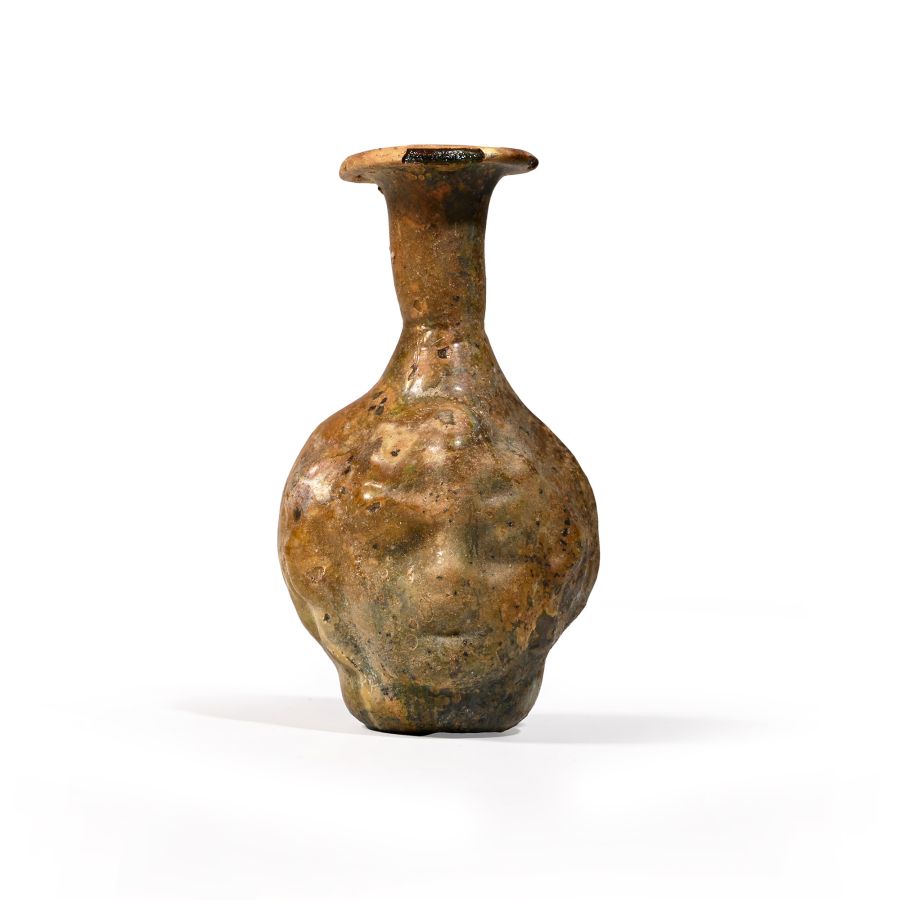
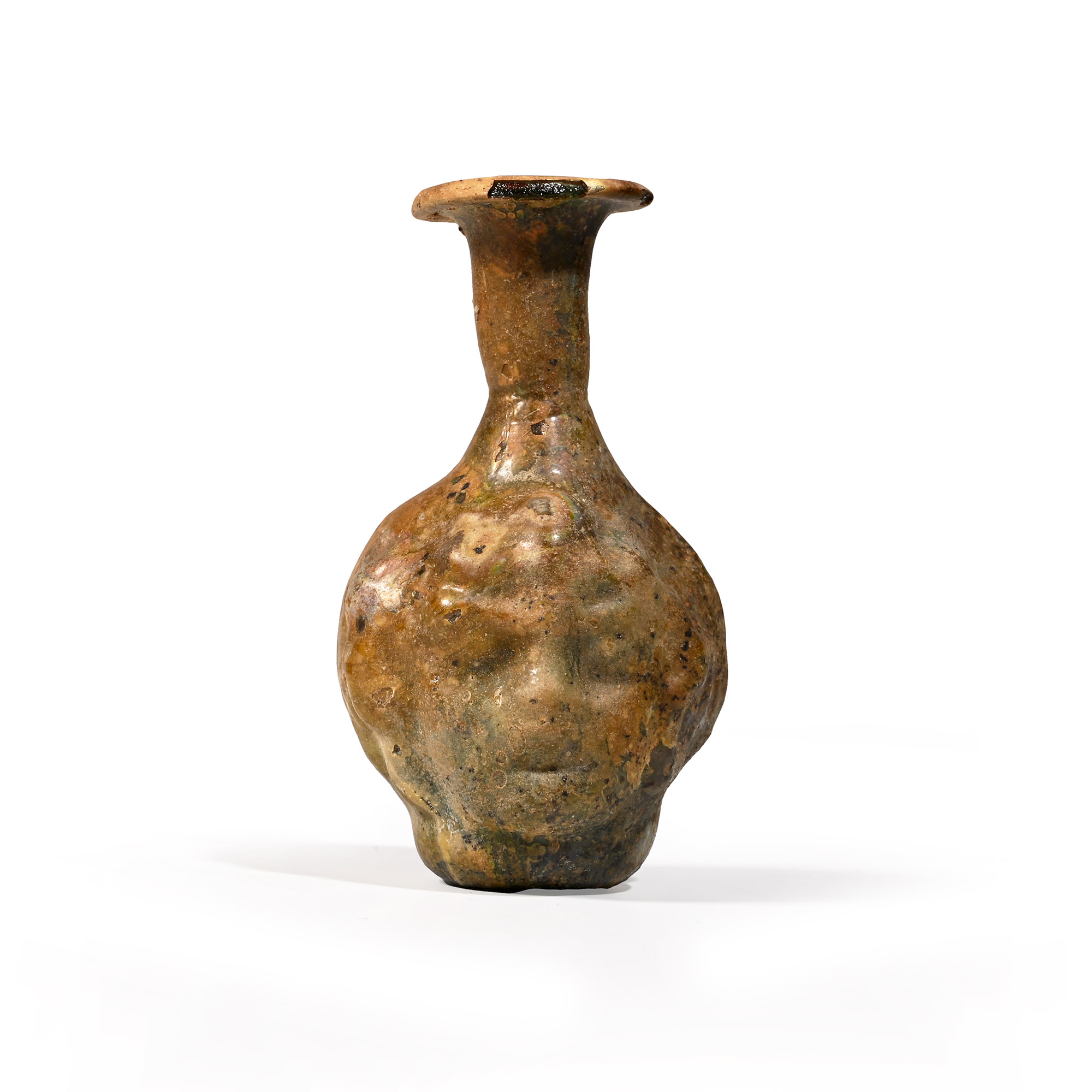
Roman Mould-Blown Blue-Green Glass Janus Flask
CIRCA 3RD-5TH CENTURY A.D.
2 5/8 in. (16.2 grams, 68 mm).
Round body formed of two plump-faced heads with dimpled chins and curly hair, one face peaceful, the other disgruntled; a long, cylindrical neck with a flaring, folded rim.
ProvenanceEx private collection of the late Mr S.M., London, UK, 1970-1999.
Accompanied by a previous typed catalogue information page with provenance.
Cf. Antonaras, A., Ancient Glass in the J.Paul Getty Museum, Malibu, 2025, p.192, no.200, for a similar janiform unguentarium or flask.
FootnotesJaniform vessels belong to a large group of mould-blown vessels that depict human heads in a naturalistic style. The body of the vessel features either a whole head or the frontal part of two heads placed back-to-back. Most of the examples, in general, are handleless flasks or unguentaria.
CONDITIONTimeLine Auctions follows a vetting process to ensure the authenticity and legality of all items, reinforcing our commitment to integrity and responsible trading. Each antiquity, antique, and coin lot undergoes thorough examination by a vetting committee of at least ten external specialists, professional trade association members, scientists, and archaeologists: Our Vetting Process
AUCTIONS:
TimeLine is a leading auction house specialising in antiquities, ancient art, collectables, natural history, coins, medals, and books. Our auctions offer museums, collectors, historians, and enthusiasts the opportunity to acquire unique and historically significant pieces.
LOT 0185
Roman Mould-Blown Blue-Green Glass Janus Flask
Estimate £600 - 800€700 - 930 (for guidance only)$810 - 1,080 (for guidance only)
Opening Bid
£300 (EUR 348; USD 405) +BP*
-
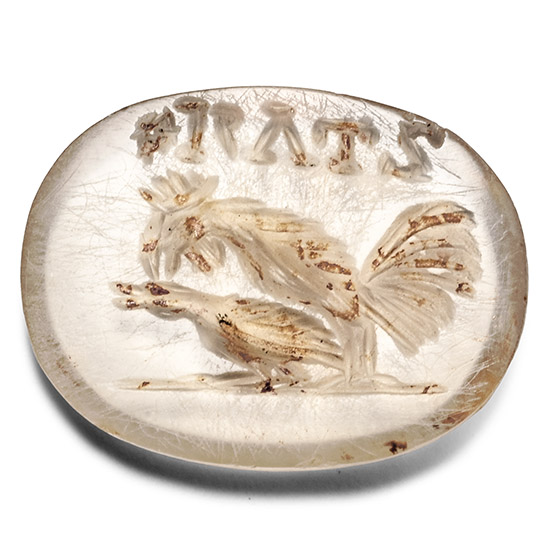
Roman Rock Crystal Gemstone of an Archigallus
Circa 1st century B.C.-1st century A.D.Estimate: £800 - 1,000 (+bp*)
Opening Bid: £250
Ellipsoid in plan with an engraved scene of a cockerel copulating with a hen, inscription above. 0.62 grams, 14 mm
Property of a European gentleman, acquired from the estate of a London collector (formed before 2000).
In ancient Rome, a cockerel, Latin gallus, was a symbol of virility and fertility. But gallus (plural galli) was also the term for a religious devotee and later for a priest of Cybele (Magna Mater). Often eunuchs, they performed ecstatic dances and rituals, sometimes even engaging in sexual acts as part of their religious practices. In Rome, the head of the Cybele priests was the archigallus, chosen by the quindecimviri sacris faciundis. Reliefs show that the archigallus was wearing luxurious and extravagant costumes and jewellery. This unique gemstone can be attributed to such an archigallus. The cult of Cybele/Magna Mater and the presence of galli also spread to Roman Britain, where it is attested, e.g. in Catterick and Corbridge. -
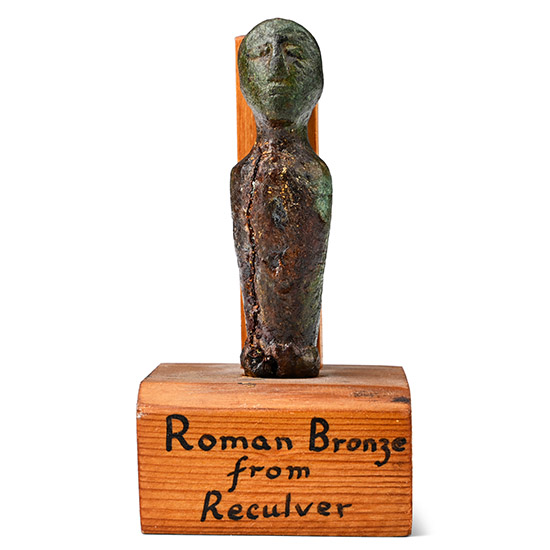
Romano-British Bronze Human Figural Pendant
Circa 2nd century A.D.Estimate: £80 - 100 (+bp*)
Opening Bid: £5
With a conical body and oval head with low-relief nose and eyes, hair combed to the back forming an attachment loop; mounted on a custom-made stand. 57 grams total, 73 mm high including stand
Found at Reculver, Kent, UK, in 1957. From the private collection of Peter Clayton, FCILIP, Dip, Arch, FSA, FRNS, Hemel Hempstead, Hertfordshire, UK; formed since the late 1950s. Accompanied by an old handwritten information card by Peter Clayton, collection no.26. -
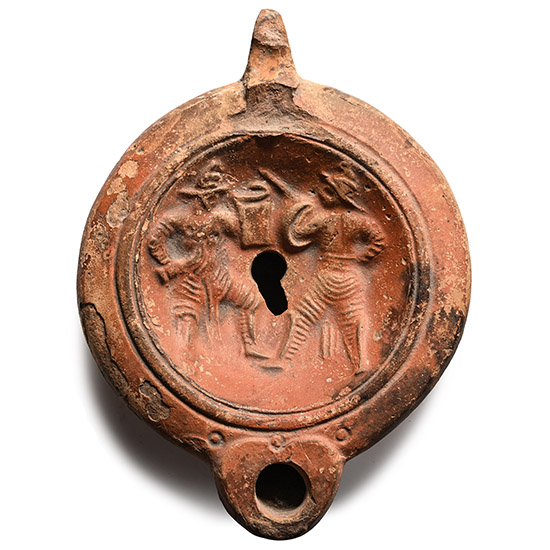
Roman Terracotta Oil Lamp with Gladiators in Combat
2nd century A.D.Estimate: £200 - 300 (+bp*)
Opening Bid: £5
Broad and squat with deeply indented discus bearing a low-relief scene of two gladiators wearing padded, hooped armour, one with a small square shield and falx, the other with a domed shield and a longer bladed weapon, each with a wide-brimmed Thracian-type helmet; loop handle partly absent; old collector's card: 'Roman lamp, buff with orange slip, late 1st or early 2nd century A.D. Heart shaped nozzle, handle missing. on the 'discus' two gladiators fighting. They are both of the 'Thrax' class i.e. Thracians. the one on the left holds an oblong buckle and a short curved dagger ('sica') that on the right holds a small round shield ('clipeus') and sword. Both wear helmets ('galea'), armour, and greaves ('ocrea'). Portobello Rd, 31 May 1958.' 113 grams, 12.4 cm
From the private collection of Peter Clayton, FCILIP, Dip, Arch, FSA, FRNS, Hemel Hempstead, Hertfordshire, UK; formed since the late 1950s. Accompanied by an old handwritten identification card written by Peter Clayton.
