
Loading, please wait...


LOT 0668
Roman Mixed Glass and Other Bead Necklace String
1ST-4TH CENTURY A.D. AND LATER
15 in. (10.5 grams, 38 cm).
Composed of polychrome oblate and annular beads with two larger beads as a central feature, restrung. [No Reserve]
ProvenanceEx Ancient Art Shop, Windsor, UK, 1990s.
Ex private West County, UK, collection.
TimeLine Auctions follows a vetting process to ensure the authenticity and legality of all items, reinforcing our commitment to integrity and responsible trading. Each antiquity, antique, and coin lot undergoes thorough examination by a vetting committee of at least ten external specialists, professional trade association members, scientists, and archaeologists: Our Vetting Process
AUCTIONS:
TimeLine is a leading auction house specialising in antiquities, ancient art, collectables, natural history, coins, medals, and books. Our auctions offer museums, collectors, historians, and enthusiasts the opportunity to acquire unique and historically significant pieces.
-
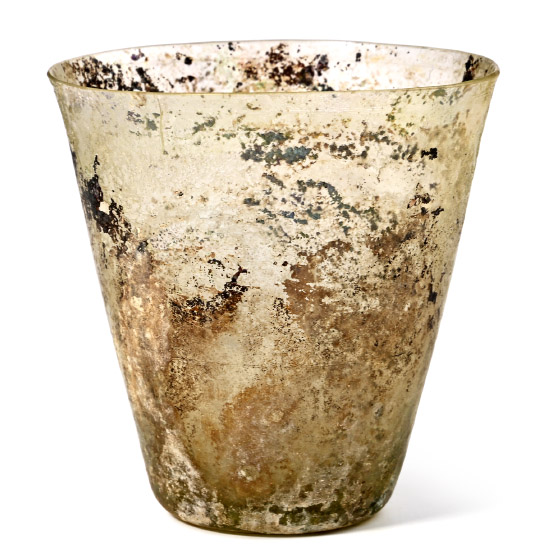
Roman Iridescent Glass Flared Kalathos
3rd-4th century A.D.Estimate: £300 - 400 (+bp*)
Opening Bid: £150
Conical body with a flat base. 67 grams, 79 mm
Acquired in the 1990s from London dealerships and auction houses. From the Lonson collection. -
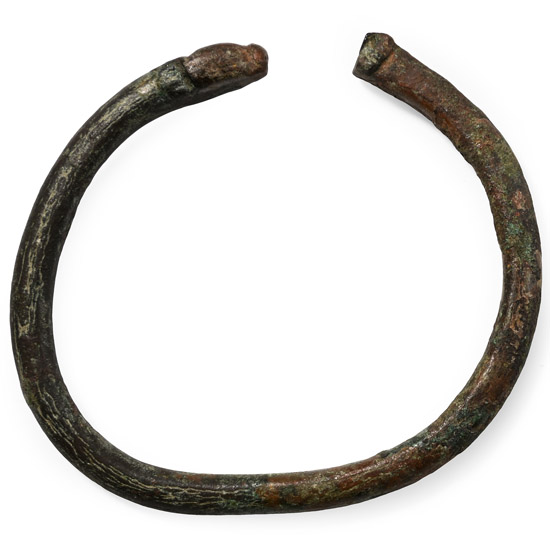
Roman Bronze Bracelet with Animal Head Terminal
1st-4th century A.D.Sold for (Inc. bp): £46
Lentoid in section with opposed beast-head finials, one absent. 39.2 grams, 67 mm
From the private collection of Mr Brian Edwards, New Malden, Surrey, UK, formed from the late 1970s-early 1980s; thence by descent. -
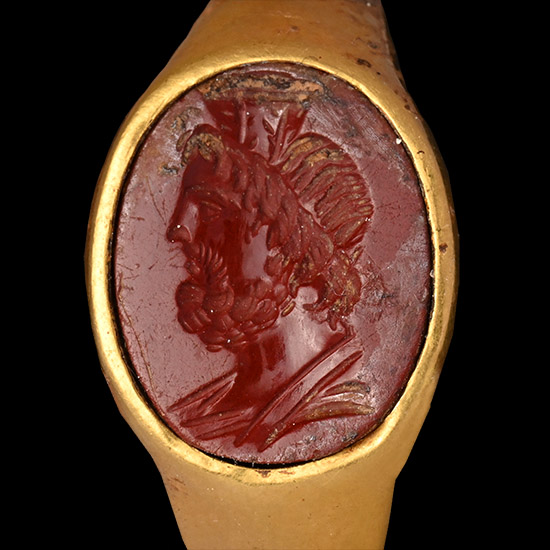
Roman Gold Ring with Bust of the God Serapis
1st-2nd century A.D.Estimate: £2,500 - 3,500 (‡+bp*)
Current Winning Bid: £2,000
Hollow-formed hoop with broad ellipsoid cell, inset red jasper intaglio profile bust of Serapis with modius; possibly a marriage, supplied with a museum-quality impression. 5.65 grams, 27.68 mm overall, 18.70 x 15.32 mm internal diameter (approximate size British L 1/2, USA 6, Europe 11.87, Japan 11)
Private European collection. Acquired in 2002. This lot has been checked against the Interpol Database of stolen works of art and is accompanied by search certificate number no.13122-246778.
Serapis was a Graeco-Egyptian god combining the Egyptian gods Osiris and Apis, but with a decidedly Greek appearance. He was promoted by Ptolemy I in the 3rd century BC to help unite the Greek and Egyptian people. Later, Ptolemaic rulers spread his worship, and Serapis became popular across the Roman Empire. Outside Egypt, he was often identified as Isis's partner, replacing Osiris. Over time, he also adopted traits associated with the Greek gods, Hades and Dionysus.
