
Loading, please wait...
_900x900.jpg "Roman Mixed Architectural and Pottery Group")
_200x200.jpg "Roman Mixed Architectural and Pottery Group")
.jpg "Roman Mixed Architectural and Pottery Group")
LOT 0607
Roman Mixed Architectural and Pottery Group
1ST CENTURY A.D. AND LATER
2 - 7 1/4 in. (1.57 kg total, 5-18.5 cm).
Including Spartan Basalt, mined in Greece, cut and polished on one side; one marble fragment marked in pencil: 'VILLA / HADRIAN', another: 'OSTIA / ANTICA'; a large amphora handle; seven pottery fragments; a carved decorative edge stone; a marble core fragment; a later floor tile fragment; with an old handwritten slip with: 'VILLA HADRIAN, AUSTRIA ATICA, Nr. ROME, ITALY.' and on the inside: 'AUSTRIA ATICA / (/ VILLA HADRIAN / (outside Rome, in nowadays Tivoli)'. [14, No Reserve]
ProvenanceAcquired on the UK market, since 1970.
From the historic mineral collection of Richard Valentine Cain, London, UK, thence by descent.
This lot is accompanied by an illustrated lot declaration signed by the Head of the Antiquities Department, Dr Raffaele D’Amato.
TimeLine Auctions follows a vetting process to ensure the authenticity and legality of all items, reinforcing our commitment to integrity and responsible trading. Each antiquity, antique, and coin lot undergoes thorough examination by a vetting committee of at least ten external specialists, professional trade association members, scientists, and archaeologists: Our Vetting Process
AUCTIONS:
TimeLine is a leading auction house specialising in antiquities, ancient art, collectables, natural history, coins, medals, and books. Our auctions offer museums, collectors, historians, and enthusiasts the opportunity to acquire unique and historically significant pieces.
-
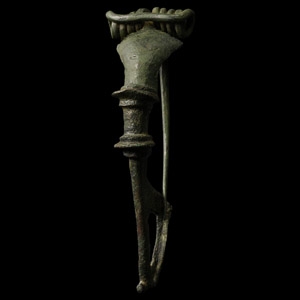
Roman Bronze Bow Brooch
1st century A.D.Sold for (Inc. bp): £117
Comprising a D-shaped flared head developing to a D-section bow with applied ledge collars, narrow foot with knop finial, openwork catch to the reverse; chord and pin to reverse of headplate. 14.8 grams, 64 mm
Ex important German collection, 1990s. This lot is accompanied by an illustrated lot declaration signed by the Head of the Antiquities Department, Dr Raffaele D’Amato. -
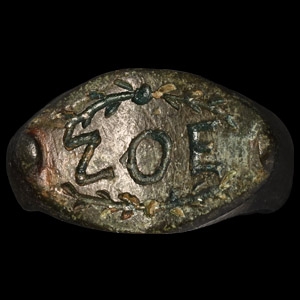
Roman Bronze Ring with ZOE
1st-4th century A.D.Sold for (Inc. bp): £975
Ellipsoid bezel with spur at each narrow end, incuse wreath and 'ZOE' (life) legend. 8.12 grams, 23.77 mm overall, 17.32 mm internal diameter (approximate size British N 1/2, USA 6 3/4, Europe 14.35, Japan 13)
Ex German art market, 2000s. Acquired from an EU collector living in London. From the collection of Surrey, UK, gentleman. This lot is accompanied by an illustrated lot declaration signed by the Head of the Antiquities Department, Dr Raffaele D’Amato. -
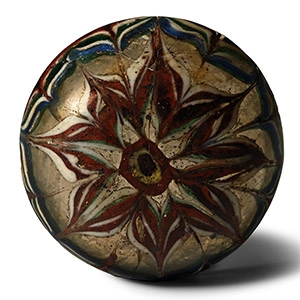
Polychrome Glass Bowl
Roman, 1st century A.D. or laterSold for (Inc. bp): £845
Shallow bowl with rounded rim, the outer face with dragged and marvered trails forming a rosette. 42.2 grams, 63 mm
S.S.H., South France, 1950s. Accompanied by a copy of an Art Loss Register certificate no.S00133093. This lot is accompanied by an illustrated lot declaration signed by the Head of the Antiquities Department, Dr Raffaele D’Amato.
Such decorated shallow bowls were mainly produced in the Eastern Provinces of the Roman Empire, and some scholars proposed Alexandria as the workshop. They were realised with mosaic glass technique, mould-pressed and tooled.
