Loading, please wait...

Roman Millefiori Glass Eye-Shaped Dish Roman Millefiori Glass Eye-Shaped Dish Roman Millefiori Glass Eye-Shaped Dish
Use mousewheel to zoom in and out, click to enlarge
Details

LOT 0588

Roman Millefiori Glass Eye-Shaped Dish

1ST-2ND CENTURY A.D.

5 1/8 in. (46.6 grams, 13 cm wide).

Ellipsoidal in green and yellow millefiori glass imitating foliage, with a central almond-shaped bowl.

Provenance

Paris collection, 1990s.
From an important Paris gallery, France.
Ex private Parisian collection.

This lot has been checked against the Interpol Database of stolen works of art and is accompanied by search certificate no.11981-209793.

CONDITION
VETTING:

TimeLine Auctions follows a vetting process to ensure the authenticity and legality of all items, reinforcing our commitment to integrity and responsible trading. Each antiquity, antique, and coin lot undergoes thorough examination by a vetting committee of at least ten external specialists, professional trade association members, scientists, and archaeologists: Our Vetting Process


AUCTIONS:

TimeLine is a leading auction house specialising in antiquities, ancient art, collectables, natural history, coins, medals, and books. Our auctions offer museums, collectors, historians, and enthusiasts the opportunity to acquire unique and historically significant pieces.

LOT 0588

Roman Millefiori Glass Eye-Shaped Dish

Estimate £2,500 - 3,500€2,900 - 4,060 (for guidance only)$3,380 - 4,730 (for guidance only)

Print page

RELATED LOTS
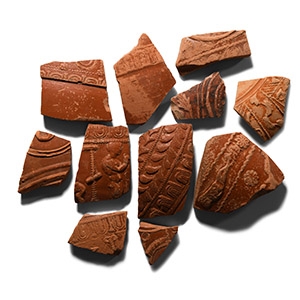
  • Roman Vechten Fort Terracotta Sherd Collection
    Roman 'Vechten Fort' Terracotta Sherd Collection
    1st-4th century A.D.

    Sold for (Inc. bp): £33

    Comprising a large quantity of pottery and red-ware sherds from large and small vessels, including an amphora neck and part of a handle. 586 grams total, 7-74 mm


    Found near Vechten, Netherlands. Netherlands private collection. Acquired from a private collector in 2009. Property of a Nottinghamshire gentleman. Accompanied by a typed information sheet.

    Fectio, modern Vechten, was a fort in the limes, the frontier zone of the Roman Empire, situated at the site of the bifurcation of the rovers Rhine and Vecht. Numismatic evidence suggests that it was founded by the Roman general Tiberius (the future emperor) during the 4/5th campaigns. It probably served as a military base during punitive raids. Around the middle of the 2nd century AD, the wood and earth fort was replaced by a stone fortification and occupied by the Ala I Thracum, who had previously been stationed in Britain. At the end of the 2nd/beginning of the 3rd century, the silting up of the Rhine’s arm on which Fectio lays had progressed to such an extent that access from the river was no longer possible. In the more than two and a half centuries of its existence, the camp was destroyed and rebuilt several times until the fort site was finally abandoned - as evidenced by archaeological traces of fire after a final destruction in 270/275 A.D.

    Lot Details

  • Roman British Decorated Bronze Crossbow Brooch
    Roman 'British' Decorated Bronze Crossbow Brooch
    4th-5th century A.D.

    Sold for (Inc. bp): £169

    With onion-knop terminals, carinated bow with a band of diagonal line decoration; the footplate with ring-and-dot decoration to each end, flanking a central linear decoration; pin and catch-plate to reverse. 55 grams, 89 mm


    Found UK. Acquired from Alan Cherry at the Birmingham Coin Fair, 2003. Property of a Nottinghamshire gentleman. Accompanied by an identification card.

    Lot Details

  • Roman Lead Sarcophagus Panel with Sphinxes, Dolphins and Masks of Medusa
    Roman Lead Sarcophagus Panel with Sphinxes, Dolphins and Masks of Medusa
    2nd-3rd century A.D.

    Sold for (Inc. bp): £4,420

    Decorated with a high-relief pattern comprising sphinxes, dolphins and masks of Medusa in fields between columns; ropework and floral border strips with laurel leaves. 6.4 kg, 41 cm wide


    From a West Sussex, UK, collection, 1990s.

    There were many ways of burying bodies during the Roman Empire. Although the majority were buried without coffins, there is evidence for wooden coffins, lead-framed wooden coffins, tile burials and lead and stone coffins. This item belongs to types widespread in the Eastern Mediterranean. The panel is decorated with a columned structure, and within each section are symbols of the outer-world, including gorgons, sphinx and dolphins. The sphinx, having a human head and breasts, legs and paws of a lion, and wings of a bird, was generally associated with protecting imperial tombs and temples. The roundels featuring the head of Medusa, known for her potent gazes that could turn one to stone, was favoured on sarcophagi and architectural ornaments because it was believed that her image would protect those within. The dolphin was considered to ferry the souls of the dead to the afterlife. Very often these sarcophagi were connected by a pipe to the ground above so that mourners could pour in offerings into the grave.

    Lot Details

Stay up-to-date with the latest from TimeLine Auctions by joining our mailing list