
Loading, please wait...
LOT 0132
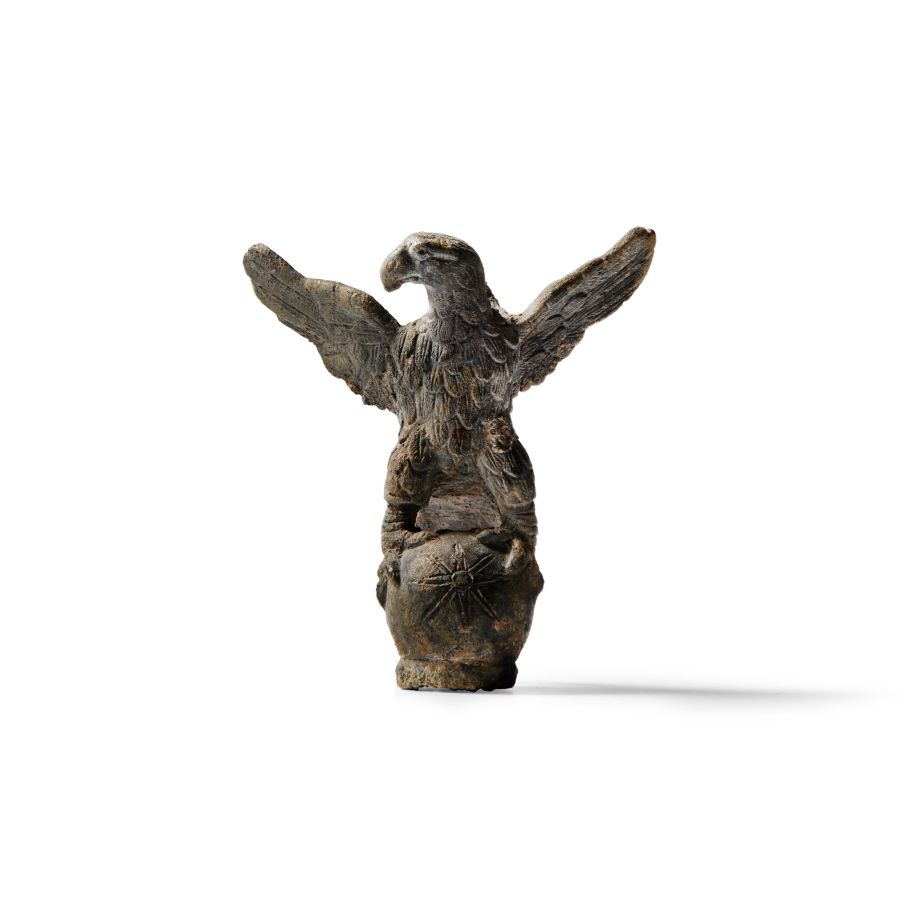
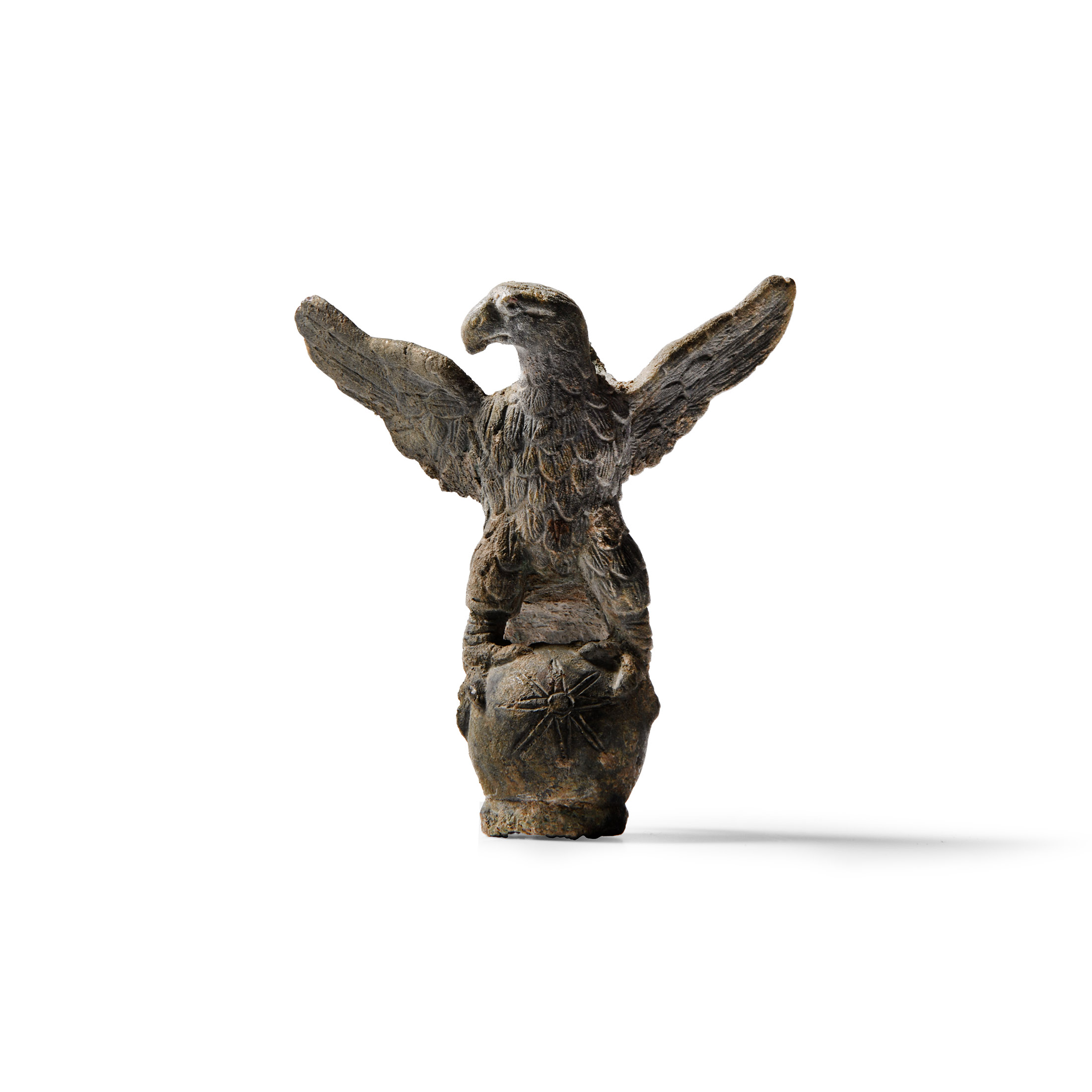
Roman Military Eagle Staff Terminal
2ND-3RD CENTURY A.D.
3 1/2 in. (166 grams, 88 mm high).
A free-standing bronze imperial or military eagle terminal from a staff or a sceptre, modelled in the round in a dynamic pose standing on a globe, wings spread, head turned to the right, semi-naturalistic anatomical and feather detailing; the globe bearing an incised eight-armed stylised Macedonian star; sub-triangular lug to back of the neck; collar to globe with hollow underside.
Provenancewith Bonham's, London, Knightsbridge, UK, 16 May 2002, lot 301.
Accompanied by a copy of the relevant Bonhams catalogue pages.
Accompanied by an academic report by Dr Raffaele D'Amato.
This lot has been checked against the Interpol Database of stolen works of art and is accompanied by search certificate number no.11582-198947
See Kirk, J.R., ‘Bronzes from Woodeaton, Oxon’ in Oxoniensia, 1949, pp.1-45; Mitten, D.G., Master Bronzes from the Classical World, Mainz, 1967, p.278, fig.271, for a similar eagle formed as part of a bust; Henig, M. & Munby, J., ‘Three Bronze Figurines’ in Oxoniensia 38, 1973, pp.386-387; Bird, J., ‘Catalogue of Iron Age and Roman artefacts discovered before 1995,’ in Poulton, R., Farley Heath Roman temple, Surrey Archaeological Collection, 93, 2007, pp.34-69; Toepfer, K.M., Signa Militaria. Die römischen Feldzeichen in der Republik und im Prinzipat, Mainz, 2011, pls.146-147; Durham, E., ‘The Silchester Bronze Eagle and Eagles in Roman Britain’ in Archaeological Journal 170, 2013, pp.78-105; Beutler, F. et al., Der Adler Roms. Carnuntum und die Armee der Cäsaren, Bad-Deutsch-Altenburg, 2017, item 44.
FootnotesIn the Roman world, the eagle was associated with the god Jupiter or Zeus, king of the Olympian gods, and was seen as ‘the symbol and agent of apotheosis after death’. An eagle was released from the top of an emperor’s funeral pyre to signal the journey of the soul towards heaven. A sacred attribute of Jupiter, this eagle terminal may have been attached to a sceptre of the statue of the god. Eagles were also the principal standard of the legions, and became the military symbol for excellence.
CONDITIONTimeLine Auctions follows a vetting process to ensure the authenticity and legality of all items, reinforcing our commitment to integrity and responsible trading. Each antiquity, antique, and coin lot undergoes thorough examination by a vetting committee of at least ten external specialists, professional trade association members, scientists, and archaeologists: Our Vetting Process
AUCTIONS:
TimeLine is a leading auction house specialising in antiquities, ancient art, collectables, natural history, coins, medals, and books. Our auctions offer museums, collectors, historians, and enthusiasts the opportunity to acquire unique and historically significant pieces.
-
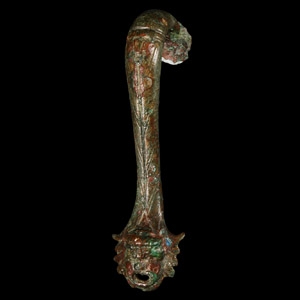
Roman Tankard Handle with Actor's Mask
1st-2nd century A.D.Sold for (Inc. bp): £130
A bronze tankard handle terminating in a male mask shown with an open mouth and wild hair, degenerate foliate detailing to the stem. 94 grams, 10.8 cm
Acquired early 2000s. Property of a Birmingham, UK, collector. Property of an Essex, UK, gentleman. -
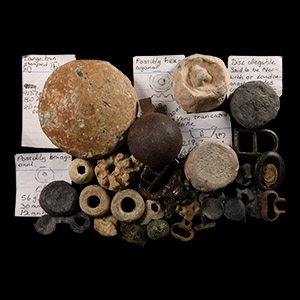
Roman to Civil War Artefact Group
1st-17th century A.D.Sold for (Inc. bp): £26
A group of detector finds including lead trade weights, thimbles, buckles, seals, buttons and other items. 1.87 kg total, 19-78 mm
Found UK. Ex property of a Nottingham, UK, collector. -
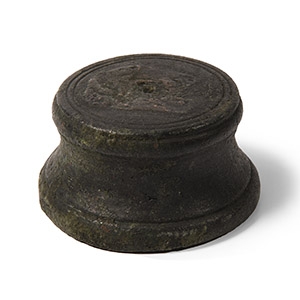
Roman Statuette Base
1st-4th century A.D.Sold for (Inc. bp): £143
A copper-alloy statuette base formed with a waisted edge and circular upper and lower faces, the lower with a greater circumference than the upper. 86 grams, 53 mm
Essex gallery, early 2000s.
