
Loading, please wait...
LOT 0703
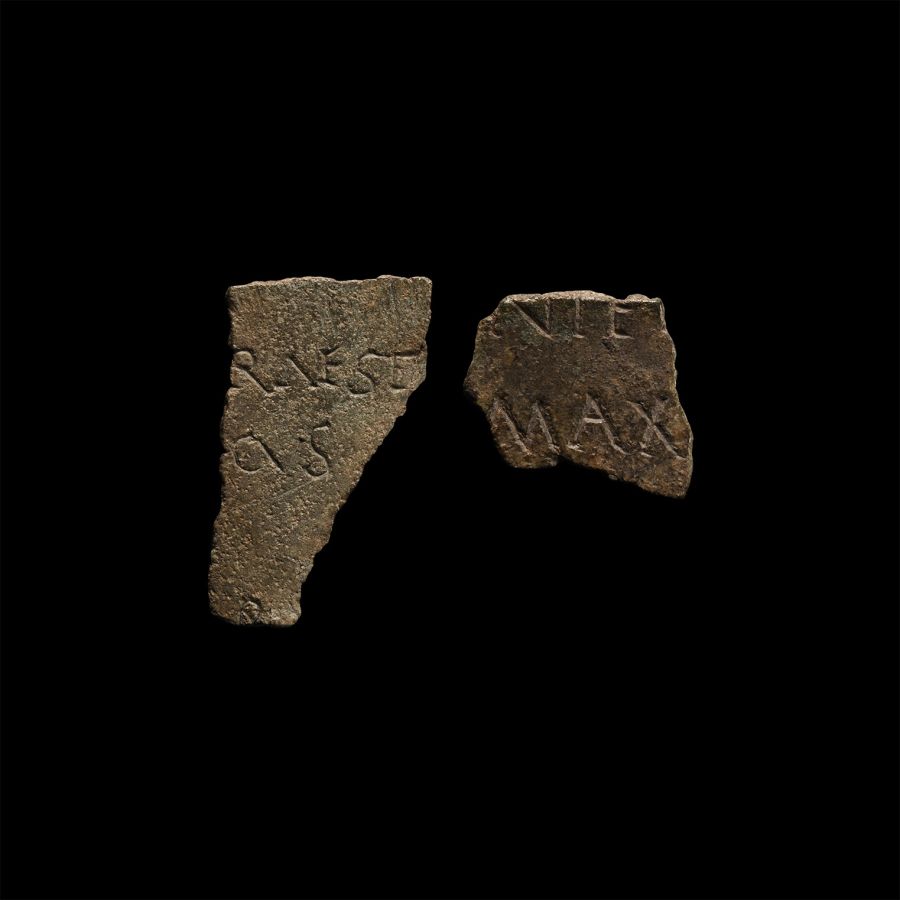
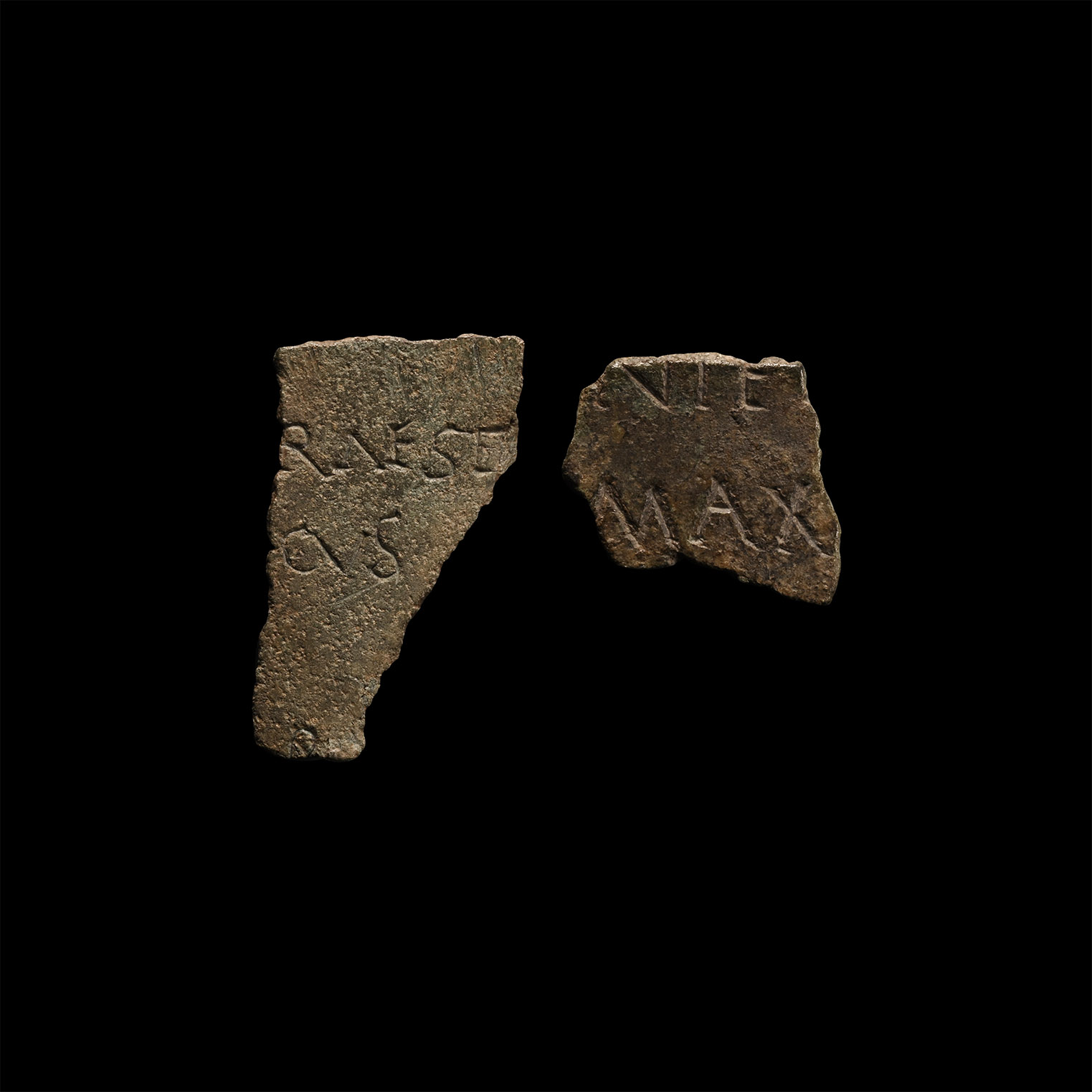
Roman Military Diploma Fragments
2ND CENTURY A.D.
3/4 - 1 1/4 in. (7.13 grams total, 21-32 mm).
A pair of bifacial bronze military diploma fragments bearing Latin text: fragment A, side 1: 'CAEL[IBES] / DVM [TAXAT]'; side 2: 'NI[- - -] MAX'; fragment B, side 1: 'RNESE / CVS'; side 2: 'AL[- - - / - - -] LL'. [2, No Reserve]
ProvenanceAcquired before 2000.
From the collection of a European gentleman living in the UK.
Cf. Beutler, F. et al., Der Adler Roms. Carnuntum und die Armee der Cäsaren, Bad-Deutsch-Altenburg, 2017, items 905, for type.
FootnotesStylistically, the diploma seems connected with the empire of Hadrian, based in style used in letters M and A. The text of the extrinsecus can be partially reconstructed in the sentences ANTO{NI}NUS AVGVSTVS PONTIFEX {MAX}IMUS... AVT SIQUI {CAEL}IBES ESSENT CUM IIS QUAS POSTEA DUXISSENT {DUM}TAXAT SINGULI SINGULAS (...if they were in celibate then, to the maximum limit of only one (wife) for each...). The diploma gives 'HONESTA MISSIO' (honourable discharge) and Roman citizenship to the veterans of an unknown unit, also granting them permission to marry. The text of the internal side (intus) should report the dating, and the names of the soldiers and witnesses.
CONDITIONTimeLine Auctions follows a vetting process to ensure the authenticity and legality of all items, reinforcing our commitment to integrity and responsible trading. Each antiquity, antique, and coin lot undergoes thorough examination by a vetting committee of at least ten external specialists, professional trade association members, scientists, and archaeologists: Our Vetting Process
AUCTIONS:
TimeLine is a leading auction house specialising in antiquities, ancient art, collectables, natural history, coins, medals, and books. Our auctions offer museums, collectors, historians, and enthusiasts the opportunity to acquire unique and historically significant pieces.
-
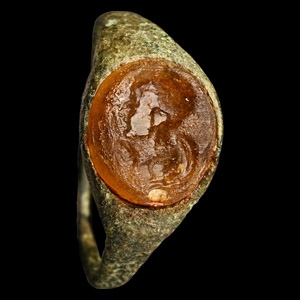
Roman Ring with Julius Caesar Intaglio
1st century B.C.Sold for (Inc. bp): £234
A copper-alloy finger ring with an oval-shaped bezel, set with a glass intaglio with profile bust left, probably Julius Caesar. 1.71 grams, 21.79 mm overall, 17.31 mm internal diameter (approximate size British L 1/2, USA 6, Europe 11.87, Japan 11)
Acquired in the 1970s. Important European collection. -
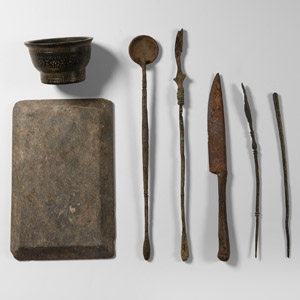
Roman Medical Implements and Palette
1st-4th century A.D.Estimate: £600 - 800 (+bp*)
Opening Bid: £300
A copper-alloy medical instrument group comprising: a bowl with incised geometric decoration; a rectangular palette with bevelled edges; knife with single-edged iron blade and decoratively incised pommel; spoon with circular bowl, collared stem with expanded waist and finial formed as a probe; pin with tapering round-section body, shallow conical finial and decoratively incised head; a scoop probe with remains of elongated shallow scoop, expanded neck with collars, slender ribbed stem and bulbous probe to terminal; scoop with leaf-shaped bowl and balustered stem. 332 grams total, 4.8-17 cm
Acquired before 2000. From the collection of a European gentleman living in the UK. -
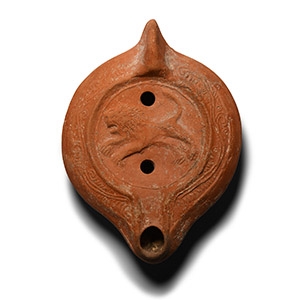
Large Roman Redware Lamp with Lion
4th century A.D. or laterEstimate: £250 - 350 (+bp*)
Opening Bid: £125
A clay lamp with rounded lug handle, shoulder with foliage in relief on each side, separated from the slightly concave discus by a ridge, which continues toward the round-tipped nozzle forming a wide channel between the discus and the wick hole; two equal-sized filling-holes at upper and lower part of the discus decorated with a lion running left, raised slightly convex base-ring with an additional inner ring. 163 grams, 13.5 cm
Acquired from a central London Antiquities Dealers Association (ADA) member's gallery in 1990. From the estate of a Lancashire gentleman.
The present lamps seems to be molded in Terra Sigillata Africana (TSA) = African Red Slip (ARS) and can be related to Atlante types VI. The passage from lamps of Loeschcke type VIII in TSA with a heart-shaped nozzle ( = Atlante form I) to the channelled so-called Christian lamps ( = Atlante forms VIII and X, or Hayes types I and II) was progressively achieved by three factors: the transformation of the initially circular discus into an oval shape, the elongation of the nozzle, and the increased width and length of the channel.
