
Loading, please wait...
_900x900.jpg "Roman Medical Instrument Group")
_200x200.jpg "Roman Medical Instrument Group")
.jpg "Roman Medical Instrument Group")
LOT 0716
Roman Medical Instrument Group
1ST-3RD CENTURY A.D.
4 3/4 - 6 1/4 in. (26.9 grams total, 12.3-16 cm).
A group of two medical instruments comprising: a probe with one thick rounded end and a triangular blade to the other; a probe with one knopped end and a flat spoon or pallette to the other. [2, No Reserve]
ProvenanceEx UK art market, 1970s.
Property of a London gentleman.
TimeLine Auctions follows a vetting process to ensure the authenticity and legality of all items, reinforcing our commitment to integrity and responsible trading. Each antiquity, antique, and coin lot undergoes thorough examination by a vetting committee of at least ten external specialists, professional trade association members, scientists, and archaeologists: Our Vetting Process
AUCTIONS:
TimeLine is a leading auction house specialising in antiquities, ancient art, collectables, natural history, coins, medals, and books. Our auctions offer museums, collectors, historians, and enthusiasts the opportunity to acquire unique and historically significant pieces.
-
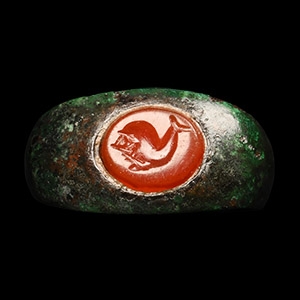
Roman Ring with Dolphin Gemstone
2nd-3rd century A.D.Sold for (Inc. bp): £208
A bronze ring with expanding, rounded shoulders, the oblong bezel set with a carnelian intaglio engraved with a dolphin. 3.21 grams, 19.41 mm overall, 16.07 mm internal diameter (approximate size British G, USA 3 1/4, Europe 4.92, Japan 4)
Acquired before 2000. From the collection of a European gentleman living in the UK. -
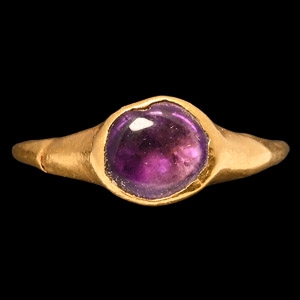
Roman Gold Ring with Gemstone
Circa 2nd-3rd century A.D.Sold for (Inc. bp): £650
A slender gold finger ring with ellipsoid cell and inset cabochon amethyst. 1.07 grams, 19.64 mm overall, 15.84 mm internal diameter (approximate size British H 1/2, USA 4, Europe 6.81, Japan 6)
UK private collection, since 1956. Formed in the 1950s by by Mr and Mrs S. Broukal, thence by decent. with Bonham's, London, New Bond Street, 30 November 2016, lot 155 [Part]. English private collection. -
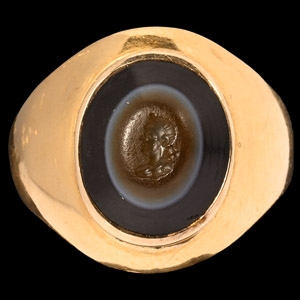
Roman Portrait Gemstone in Gold Ring
2nd-3rd century A.D. and laterSold for (Inc. bp): £1,690
A sardonyx cabochon gemstone with intaglio portrait bust of a male wearing a diadem, possibly Apollo; set in a later gold ring. 12.89 grams, 30.12 mm overall, 22.07 mm internal diameter (approximate size British X, USA 11 1/2, Europe 26.29, Japan 25)
Ex Dr. A.R., Leipzig, 1980-1980s. with Gorny and Mosch, 13 December 2017, lot 424. English private collection.
