
Loading, please wait...
LOT 0646
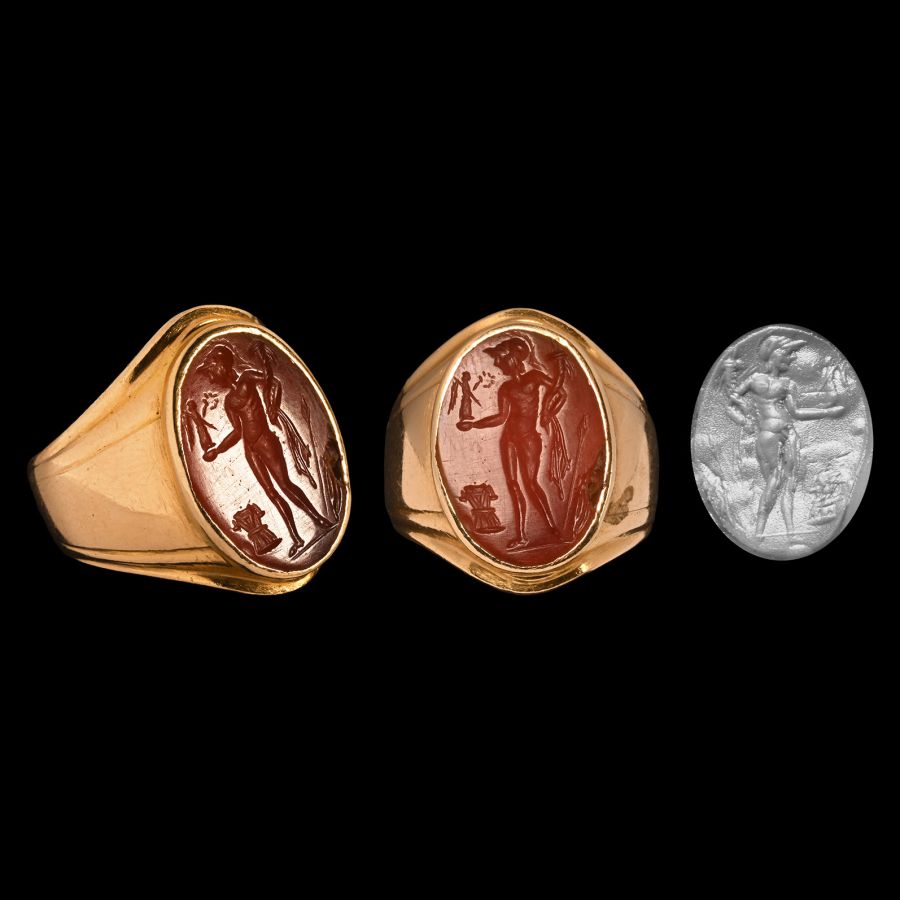
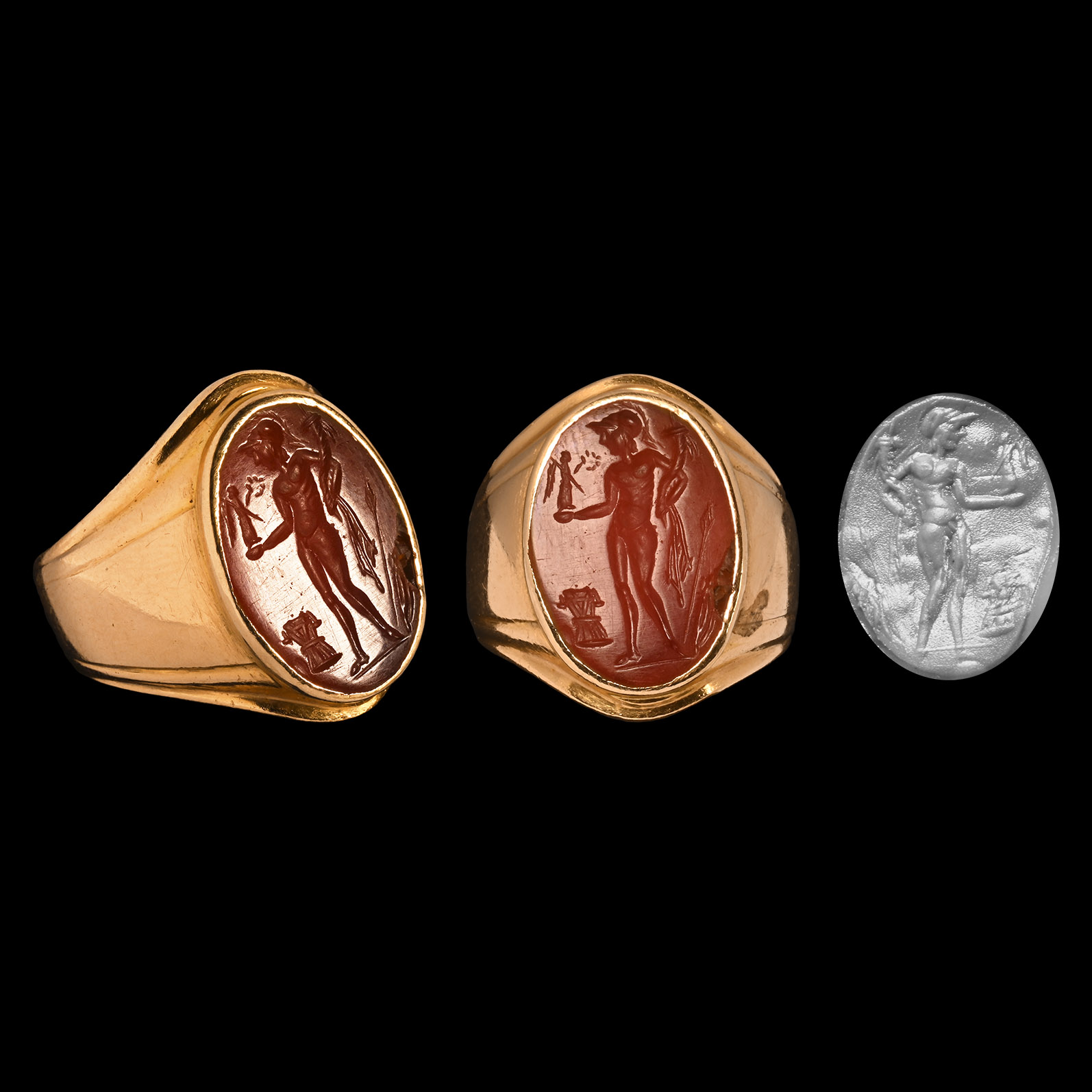
Roman Mars Gemstone in Gold Ring
1ST-2ND CENTURY A.D. AND LATER
7/8 in. (8.93 grams, 21.88 mm overall, 17.70 mm internal diameter (approximate size British N, USA 6 1/2, Europe 13.72, Japan 13)).
An ellipsoid carnelian gemstone with intaglio figure of Mars wearing a helmet and bearing a cornucopia in one hand and a miniature figure of Victory in the other; set in a later gold ring.
ProvenanceEx Marianne Maspero, 1980.
with Pierre Berge & Associes, Paris, France, 16 May 2018, lot 230.
English private collection.
Mars was the ancient Roman god of war and agriculture; the majority of his festivals were held in March, when the season for military campaigning commenced, whilst the season for farming ended. Mars symbolised military power as a method for securing peace and stability and was believed a protective father of the Roman people. In Roman mythology, Mars raped Silvia, thus fathering Romulus and Remus, the famous twins suckled by the She-wolf and founders of the city of Rome. The animals most closely associated with Mars are the woodpecker, wolf and bear.
CONDITIONTimeLine Auctions follows a vetting process to ensure the authenticity and legality of all items, reinforcing our commitment to integrity and responsible trading. Each antiquity, antique, and coin lot undergoes thorough examination by a vetting committee of at least ten external specialists, professional trade association members, scientists, and archaeologists: Our Vetting Process
AUCTIONS:
TimeLine is a leading auction house specialising in antiquities, ancient art, collectables, natural history, coins, medals, and books. Our auctions offer museums, collectors, historians, and enthusiasts the opportunity to acquire unique and historically significant pieces.
-

Roman Enamelled Bronze Vessel Lid
2nd-4th century A.D.Estimate: £10,000 - 14,000 (‡+bp*)
Opening Bid: £5,000
A bronze domed discoid vessel lid, carinated body and gently inverted lower rim, circumferential frieze displaying 'yellow' and red champlevé enamelled flower heads within foliate roundels, alternating with stylised amphoras and volute scrolls creating heart shapes set against a rich blue field; central projecting stem with hexagonal plate, ornamented with a central domed flower head, amphora and foliate motifs surrounding; two suspension lugs with loops to the perimeter of the lower rim; repaired. 435 grams, 15 cm wide
Acquired from Ariadne Galleries Inc, New York, 30 October 2003. This lot has been checked against the Interpol Database of stolen works of art and is accompanied by search certificate no.11622-198955.
Champlevé is a decorative technique which involves cutting cells into a metal surface and filling the void with enamel, using the raised metal borders between the cells to create the design outline. -
Roman and Later Artefact Group
2nd century A.D. and laterSold for (Inc. bp): £33
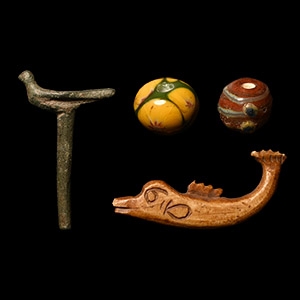
A mixed group comprising: a bone dolphin with slot to the raised; the tip of a bronze hair-pin; and two later glass beads. 11.56 grams total, 12-38 mm
Acquired in the late 1990s-2000. Property of an East London gentleman. -
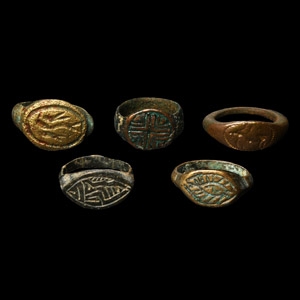
Roman and Other Ring Collection
Early 1st millennium A.D. and laterSold for (Inc. bp): £338
A mixed group of copper-alloy finger rings of various types, each bearing an incuse design to the bezel: a stylised bird; a cross; a stylised fish; a geometric motif and possible horse and rider. 25 grams total, 20-25 mm
Early 1990s London collection. Acquired on the UK art market. From a private collection, Lancashire, UK.
