
Loading, please wait...
_900x900.jpg "Roman Marbled Amber Glass Vase")
_200x200.jpg "Roman Marbled Amber Glass Vase")
.jpg "Roman Marbled Amber Glass Vase")
LOT 0116
Roman Marbled Amber Glass Vase
4TH CENTURY A.D.
3 3/8 in. (47 grams, 85 mm high).
Of squat carinated form, slender tapering neck with everted rim, decorative white marbling over the body.
ProvenanceAcquired early 1990s.
Ex private American collection; thence by descent.
Private collection since 1998.
Cf. Lightfoot, C.S., Ancient Glass in the National Museums of Scotland, Edinburgh, 2007, item 453, for type.
CONDITIONTimeLine Auctions follows a vetting process to ensure the authenticity and legality of all items, reinforcing our commitment to integrity and responsible trading. Each antiquity, antique, and coin lot undergoes thorough examination by a vetting committee of at least ten external specialists, professional trade association members, scientists, and archaeologists: Our Vetting Process
AUCTIONS:
TimeLine is a leading auction house specialising in antiquities, ancient art, collectables, natural history, coins, medals, and books. Our auctions offer museums, collectors, historians, and enthusiasts the opportunity to acquire unique and historically significant pieces.
-
.jpg)
Roman Early Christian Globus Cruciger Carnelian Gemstone
Circa 4th century A.D.Sold for (Inc. bp): £390
With a saint and globus cruciger; supplied with a museum-quality impression. 0.60 grams, 12 mm
From the collection of a Swiss gentleman formed in Europe from 1970-1980s; thence by descent from the family in London. -
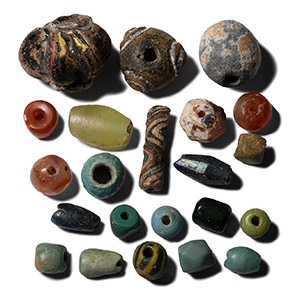
Roman Glass and Stone Bead Collection
Circa 1st century A.D. and laterSold for (Inc. bp): £65
Comprising: a large glass melon bead; an oblate melon bead with 'eye' motifs; a cylindrical polychrome glass bead with trails; an oblate millefiori bead; with a number of other beads in carnelian, glass and modelled clay. 53 grams total, 7-27 mm
Acquired in the 1980s-1990s. Property of a Nottinghamshire gentleman. -
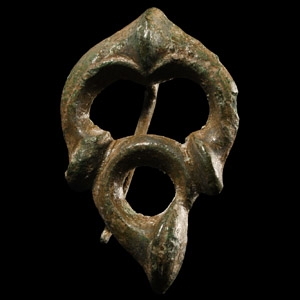
British Roman Military Bronze Trumpet-Whorl Plate Brooch
1st-2nd century A.D.Sold for (Inc. bp): £98
With openwork sub-triangular body made up of three curved trumpets motifs; to the reverse the double pin lug supporting the hinged copper alloy pin, and, at the opposite end is a flat longitudinal catch plate. 7.19 grams, 35 mm
Found whilst searching with a metal detector near Conistone with Kilnsey, North Yorkshire, UK, early 2022. This is a find of note and has been designated to be of Regional importance. Accompanied by a copy of the British Museum's Portable Antiquities Scheme (PAS) report no.SWYOR-A187CC.
