
Loading, please wait...
_900x900.jpg "Roman Marble Portrait of Gaius Caesar")
_200x200.jpg "Roman Marble Portrait of Gaius Caesar")
_900x900.jpg "Roman Marble Portrait of Gaius Caesar")
_200x200.jpg "Roman Marble Portrait of Gaius Caesar")
.jpg "Roman Marble Portrait of Gaius Caesar")
.jpg "Roman Marble Portrait of Gaius Caesar")
LOT 0111
Roman Marble Portrait of Gaius Caesar
AUGUSTAN, CIRCA 1 A.D.
19 in. (17.4 kg total, 48 cm high including stand).
Modelled in the round and carved in Parian marble, head of a male youth depicted turning slightly to his left, hair trimmed in the Julian style; with soft facial features and long neck; believed to be of Gaius Iulius Caesar Vipsanianus (20 B.C.- 4 A.D.); mounted on a custom-made stand.
ProvenanceAcquired on the London art market in the 1970s by the previous owner’s late father.
with Christie’s London, 25 April 2007, no.260.
UK private collection, London.
Anonymous sale, Bonhams, London, 16 April 2015, no.130.
Accompanied by an academic report by Dr Raffaele D’Amato.
This lot has been checked against the Interpol Database of stolen works of art and is accompanied by a search certificate number no.163499-10061.
This lot has been cleared against the Art Loss Register database, and is accompanied by an illustrated lot declaration signed by the Head of the Antiquities Department, Dr Raffaele D’Amato.
Cf. Toynbee, J.M.C., Roman Historical Portraits, London, 1978, p.133, 162; La Rocca, E., Rom als Vorbild für Pompeji: Aspekte der Kolonisierung in Pompeji wiederentdeckt: Antikenmuseum Basel und Sammlung Ludwig, Rome, 1994, pp.27-50; Hurlet, F., Les collègues du prince sous Auguste et Tibère. De la légalité républicaine à la légitimité dynastique, Rome : École Française de Rome, 1997, pp.5-692. (Publications de l'École française de Rome, 227); La Rocca, E., Ensoli S., Aurea Roma, dalla città pagana alla città cristiana, Roma, 2000; La Rocca, E. (ed.), Augusto (catalogue exhibition), Milano, 2013.
FootnotesGaius Caesar (20 B.C.-4 A.D.) and his brother Lucius Caesar (17 B.C.-2 A.D.) held significant positions in the political and dynastic plans of Emperor Augustus. Born to Augustus's daughter Julia and his advisor Marcus Vipsanius Agrippa, they were adopted by Augustus in 17 B.C. to become his heirs, since he lacked natural-born sons. Portraits of the brothers depict them as resembling Augustus, indicating their importance within the imperial family.
Gaius's portraits were classified into five types, with this head identified as Type IV, likely created in 1 A.D. to celebrate his consulship. A similar portrait of Gaius exists in Corinth alongside his brother and Augustus. In 1 B.C., Gaius was appointed to govern the eastern provinces, where he successfully negotiated a peace treaty with King Phraates V of Parthia. However, tragedy struck when Gaius fell ill in Anatolia and died at 23 years of age, following the death of his brother Lucius. These deaths disrupted Augustus' plans for succession and led him to adopt Tiberius, his stepson, who eventually became emperor in 14 A.D.
TimeLine Auctions follows a vetting process to ensure the authenticity and legality of all items, reinforcing our commitment to integrity and responsible trading. Each antiquity, antique, and coin lot undergoes thorough examination by a vetting committee of at least ten external specialists, professional trade association members, scientists, and archaeologists: Our Vetting Process
AUCTIONS:
TimeLine is a leading auction house specialising in antiquities, ancient art, collectables, natural history, coins, medals, and books. Our auctions offer museums, collectors, historians, and enthusiasts the opportunity to acquire unique and historically significant pieces.
LOT 0111
Roman Marble Portrait of Gaius Caesar
Estimate £18,000 - 24,000€20,880 - 27,840 (for guidance only)$24,300 - 32,400 (for guidance only)
-
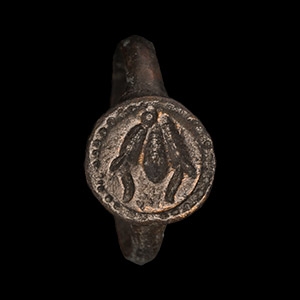
Roman Bronze Ring with Insect
3rd century A.D.Sold for (Inc. bp): £117
D-section hoop and discoid bezel with pelletted border enclosing a fly. 5.83 grams, 24.49 mm overall, 19.94 mm internal diameter (approximate size British R 1/2, USA 8 3/4, Europe 19.38, Japan 18)
Acquired on the London art market in the late 1980s-1990s. From the family collection of an East London, UK, gentleman. This lot is accompanied by an illustrated lot declaration signed by the Head of the Antiquities Department, Dr Raffaele D’Amato. -
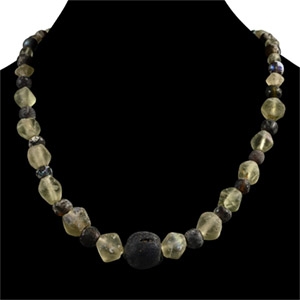
Roman Glass Bead Necklace
1st-2nd century A.D.Sold for (Inc. bp): £78
A designer necklace composed of graduated glass beads including green polyhedral and blue spherical; with modern clasp, restrung. 92 grams, 47 cm
Previously acquired in the 1980s. From a North West London, UK, collection. Property of a Californian, USA, collector. This lot is accompanied by an illustrated lot declaration signed by the Head of the Antiquities Department, Dr Raffaele D’Amato. -
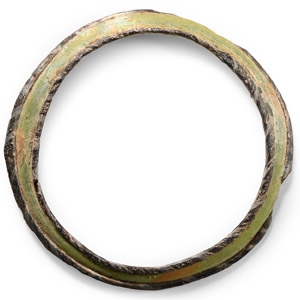
Late Roman Iridescent Multi-Coloured Bracelet
4th-6th century A.D.Sold for (Inc. bp): £46
The shank triangular in section with applied polychrome trails to inner and outer edges. 21.9 grams, 87 mm
Acquired 1980-2015. Ex Abelita family collection. This lot is accompanied by an illustrated lot declaration signed by the Head of the Antiquities Department, Dr Raffaele D’Amato.
