
Loading, please wait...
_900x900.jpg "Roman Marble Left Foot from a Sculpture")
_200x200.jpg "Roman Marble Left Foot from a Sculpture")
_900x900.jpg "Roman Marble Left Foot from a Sculpture")
_200x200.jpg "Roman Marble Left Foot from a Sculpture")
.jpg "Roman Marble Left Foot from a Sculpture")
.jpg "Roman Marble Left Foot from a Sculpture")
LOT 0111
Roman Marble Left Foot from a Sculpture
2ND CENTURY A.D.
5 7/8 in. (771 grams total, 15 cm high including stand).
Comprising an elegantly carved lower part of the calf and foot, a detailed rendering of the toes; the proportions suggesting that the subject was a child or a young woman; mounted on a custom-made display stand.
ProvenanceNicolas Koutoulakis (1910-1996), thence by descent.
Ex Galerie Dominique Thirion, Brussels, 1990s.
Private collection of Mr K.A., France.
with Kallos Gallery, London, UK.
Accompanied by an academic report by Dr Raffaele D'Amato.
This lot has been checked against the Interpol Database of stolen works of art and is accompanied by a search certificate number no.13010-246748.
Exhibited at the Harwich Museum, Harwich, Essex, UK, 8th June 2026-14th September 2026; accompanied by a copy of a photograph of the artefacts on display.
LiteratureSee various examples in Reinach, S., Répertoire de la statuaire grecque et romaine, Paris, 1897-1930, pl.324 (Amazons), 330, 337, 340-346, 350-357, 359-354, 370, 372, 375-378 (Aphrodite), 394-395 (Genii, Nike), 401-402 (dancers), 406 (Nymphs), 419 (Niobids), 422 (Isis), 445,461 (children), 475 (Ganymedes).
FootnotesThe foot was a prominent feature on sculptures: more susceptible to weathering and the ravages of time than a head or a torso, the fragments that survive are often badly damaged. It is also possible that this piece belonged to a sculpture created via the acrolith technique, in which the sculptor focused his attention solely on the unclothed parts of the figure, which were made from a more valuable material than the rest of the piece.
CONDITIONTimeLine Auctions follows a vetting process to ensure the authenticity and legality of all items, reinforcing our commitment to integrity and responsible trading. Each antiquity, antique, and coin lot undergoes thorough examination by a vetting committee of at least ten external specialists, professional trade association members, scientists, and archaeologists: Our Vetting Process
AUCTIONS:
TimeLine is a leading auction house specialising in antiquities, ancient art, collectables, natural history, coins, medals, and books. Our auctions offer museums, collectors, historians, and enthusiasts the opportunity to acquire unique and historically significant pieces.
-
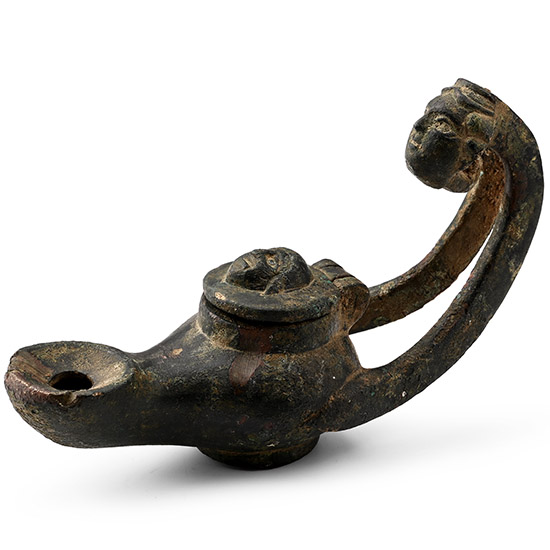
Roman Bronze Oil Lamp with Masks
1st-2nd century A.D.Sold for (Inc. bp): £1,170
With an elongated body, long nozzle with a rounded tip; raised rim to filling hole with hinged lid bearing a mask with sockets to the eyes for silver inserts; handle curved and terminating in a female mask with hair dressed in tiers, eyes recessed to be inlaid with silver; broad nozzle with cup and raised rim; socket to underside for mounting on a stand. 560 grams, 15.5 cm
From the collection of a gentleman, acquired on the London art market in the 1990s.
The lamp is crafted in a very fine style, probably in a classical form from the 1st or 2nd century. It belongs to a type known and widespread in the Mediterranean, with parallels in Paris, Madrid, the museums of Cadiz, Tarragona, and Aquileia. -
.jpg)
Roman Carnelian Gemstone with Eros Before an Altar in Gold Ring
1st century A.D.Sold for (Inc. bp): £2,860
Finely engraved Roman carnelian intaglio showing nude winged Amor in front of a pillar with his weapons, helmet, shield, and spear, putting on a shin guard, standing before an altar, set in a later gold ring; supplied with a museum-quality impression. 3.55 grams, 21.09 mm overall, 18.46 mm internal diameter (approximate size British Q, USA 8, Europe 17.49, Japan 16)
Acquired on the European art market. This lot has been checked against the Interpol Database of stolen works of art and is accompanied by search certificate number no.13323-258009.
This particular iconography shows the god of love arming himself, standing in front of an altar surmounted by a helmet, and with a hoplon shield at its bottom. He is putting a greave on his right leg, and a spear occupies the central part of the scene. Figuratively, Amor is maybe represented arming himself for a 'love deed'. But the scene can be referred to the battle against the Titans, to which all the Olympian gods took part. -
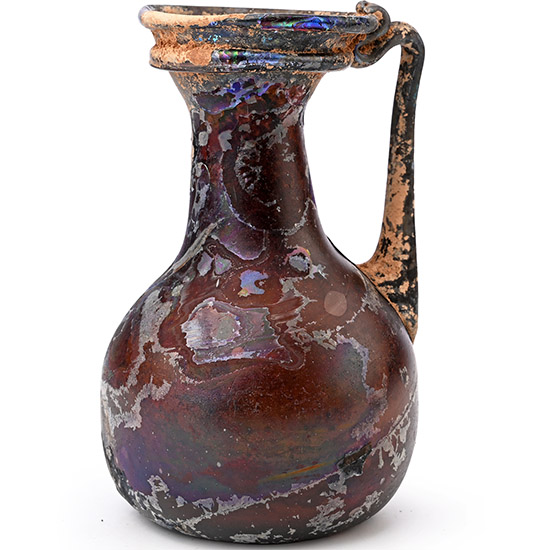
Roman Aubergine Glass Pitcher
3rd-4th century A.D.Sold for (Inc. bp): £468
Comprising a bulbous body with a dimple base and a funicular neck with an applied band below the rim and a handle to the rear. 93.2 grams, 10.8 cm
From an important London, UK, collection 1980-2020.
The pitcher shows the style of production of the Roman Rhine workshops. Several hundred vessels with applied decoration are known from the Roman Rhineland. The numerous finds from graves and the evidence of glass furnaces in Cologne suggest that a large proportion of these vessels were produced in local workshops, then spread throughout the empire.
