
Loading, please wait...
LOT 0152
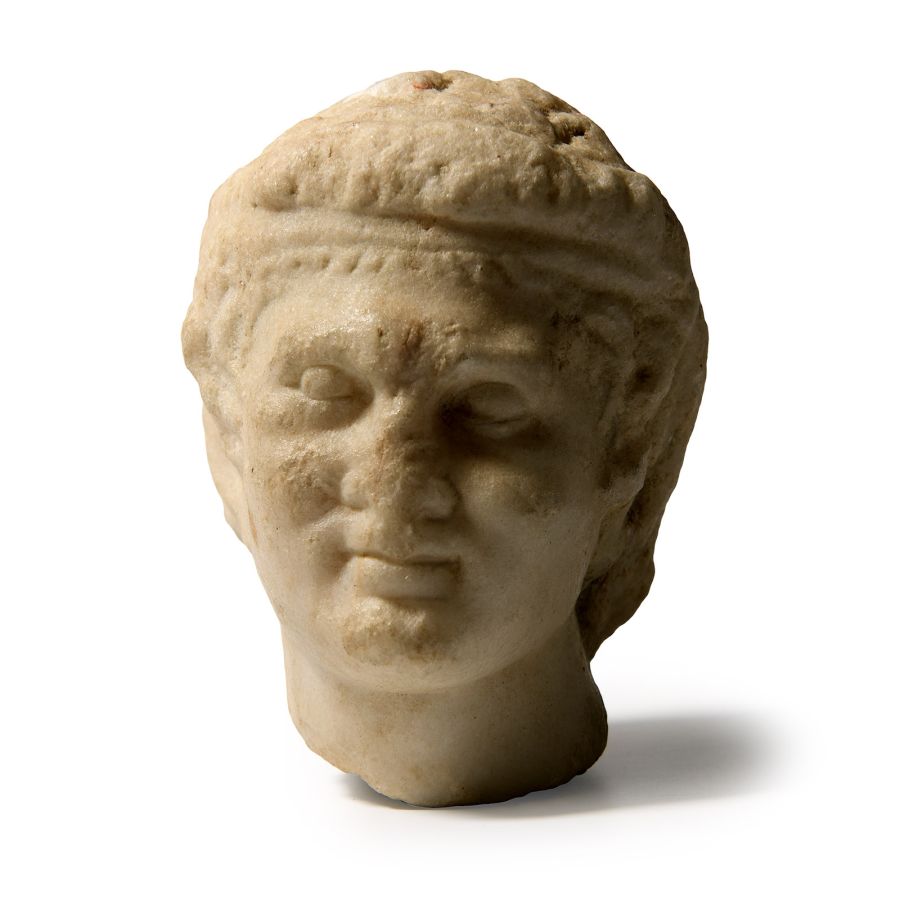
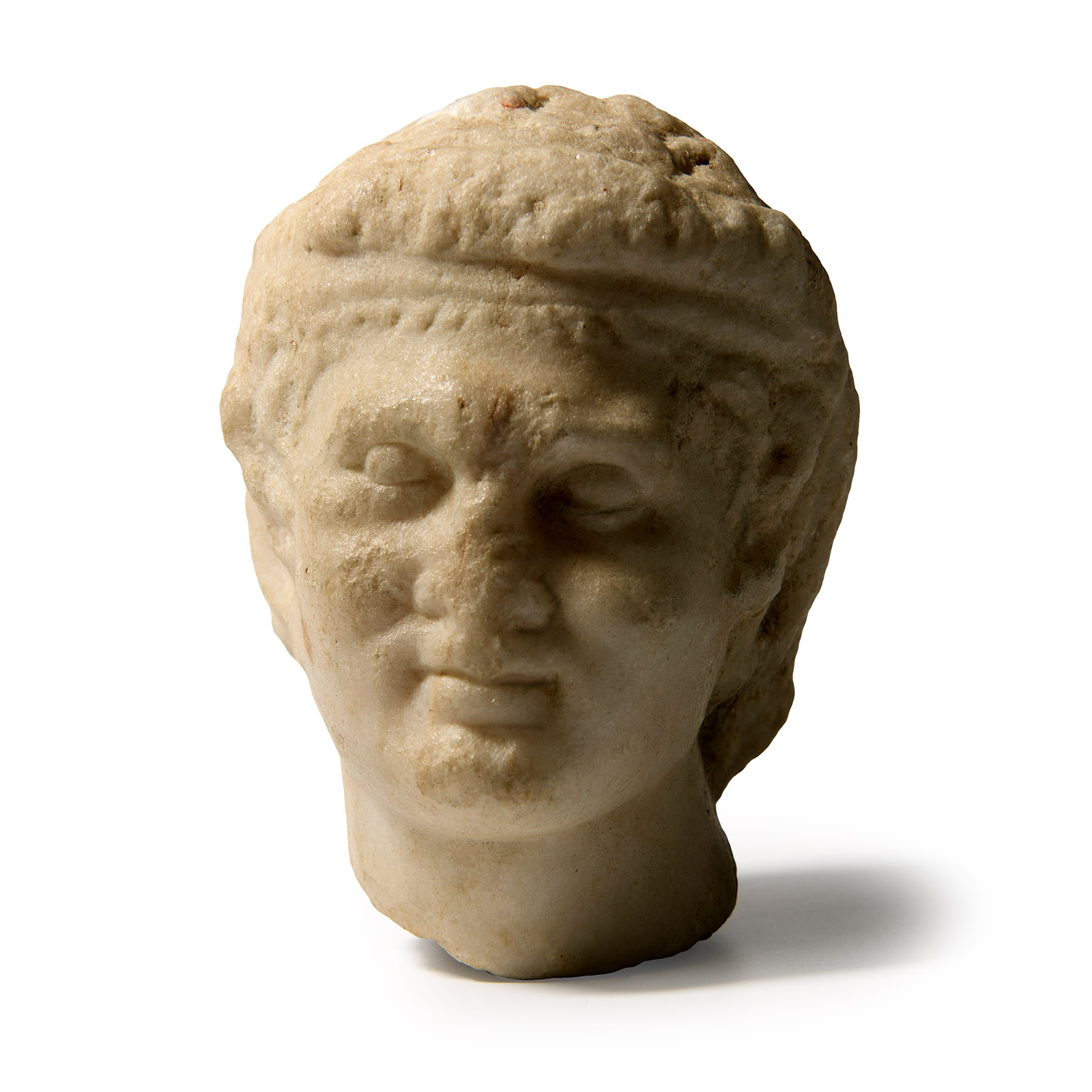
Roman Marble Head of a Satyr
1ST-3RD CENTURY A.D.
3 1/2 in. (519 grams, 88 mm).
Of Praxitelic type with fillet to the brow, tousled hair and rounded facial features with stern expression.
ProvenanceAcquired early 1990s.
Ex private American collection; thence by descent.
Private Swiss collection since 1998.
This lot has been checked against the Interpol Database of stolen works of art and is accompanied by search certificate no.11632-199025.
For similar Roman copies of Praxiteles's satyr, see the Walters Art Gallery, MA, inv. no. 23.22; the Metropolitan Museum of Art, NY, acc. no. 08.258.43; the British Museum, London, 1838, 1231.1; cf. Scrinari, V.S.M., Sculture Romane di Aquileia, Roma, 1972, nos.111-112; Stewart, A., Greek Sculpture, Yale, 1990, p.280, no.498; Pasquier A., Martinez, J.L., Praxitele, Paris, 2007, pp.270-275.
FootnotesThe head appears to be a copy of the Praxitelian type known as 'the Pouring Satyr'. The head, realised with sensitivity, but technically and stylistically academic, could be dated to the first half of the 2nd century A.D.
CONDITIONTimeLine Auctions follows a vetting process to ensure the authenticity and legality of all items, reinforcing our commitment to integrity and responsible trading. Each antiquity, antique, and coin lot undergoes thorough examination by a vetting committee of at least ten external specialists, professional trade association members, scientists, and archaeologists: Our Vetting Process
AUCTIONS:
TimeLine is a leading auction house specialising in antiquities, ancient art, collectables, natural history, coins, medals, and books. Our auctions offer museums, collectors, historians, and enthusiasts the opportunity to acquire unique and historically significant pieces.
-
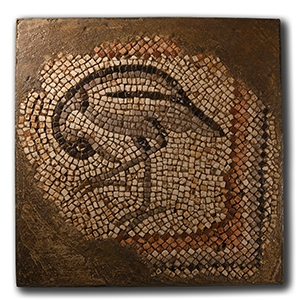
Eastern Roman Mosaic Depicting a Bird
4th century A.D.Sold for (Inc. bp): £2,860
In a rectangular matrix; cream, olive, pink and other tesserae depicting a bird advancing with head bowed, with banded frame. 10.35 kg, 40.3 x 40.3 cm
Former collection of Mr Pierre Bart (1889-1964), official of the French mandate in Syria and Lebanon (1919-1936) and delegate to the Lebanese government until 1946. Transmitted by descent. -
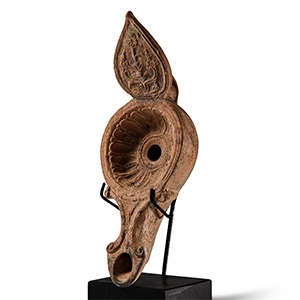
Large Roman Terracotta Oil Lamp with Reflector
1st century A.D.Sold for (Inc. bp): £780
Cup-shaped body with socketted lotiform discus and central filling hole, tapering nozzle with volute scrolls to the rim, D-shaped finial; loop handle and piriform reflector with low-relief ornament of an urn with vine scrolls and perching birds; mounted on a custom-made stand. 257 grams total, 18 cm wide including stand
From the private collection of the late Mr S.M., London, UK, 1969-1999; thence by descent. -
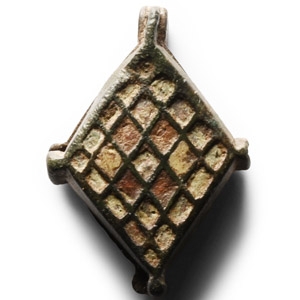
Romano-British Enamelled Bronze Seal Box
Circa 2nd century A.D.Sold for (Inc. bp): £78
Lozengiform two-part container with grid to the obverse, enamel fill to the cells. 7.22 grams, 31 mm
Found Southern England. Acquired on the UK art market in the 1980s. From an East Anglian private collection.
