
Loading, please wait...
LOT 0124
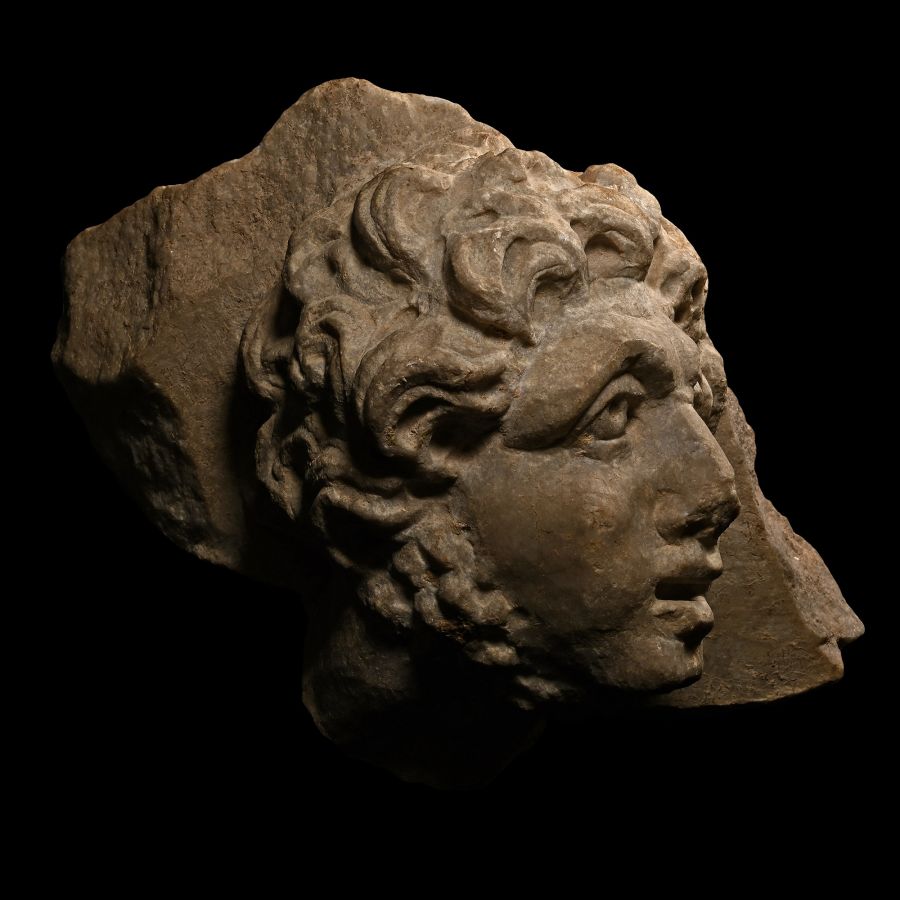
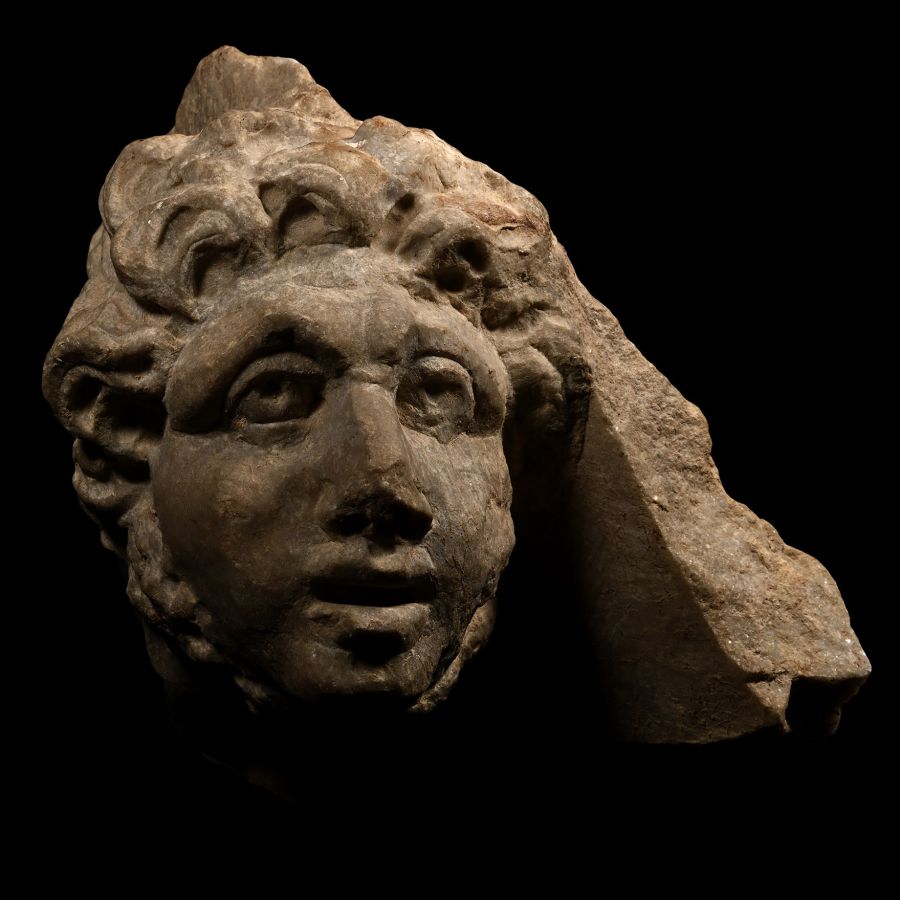
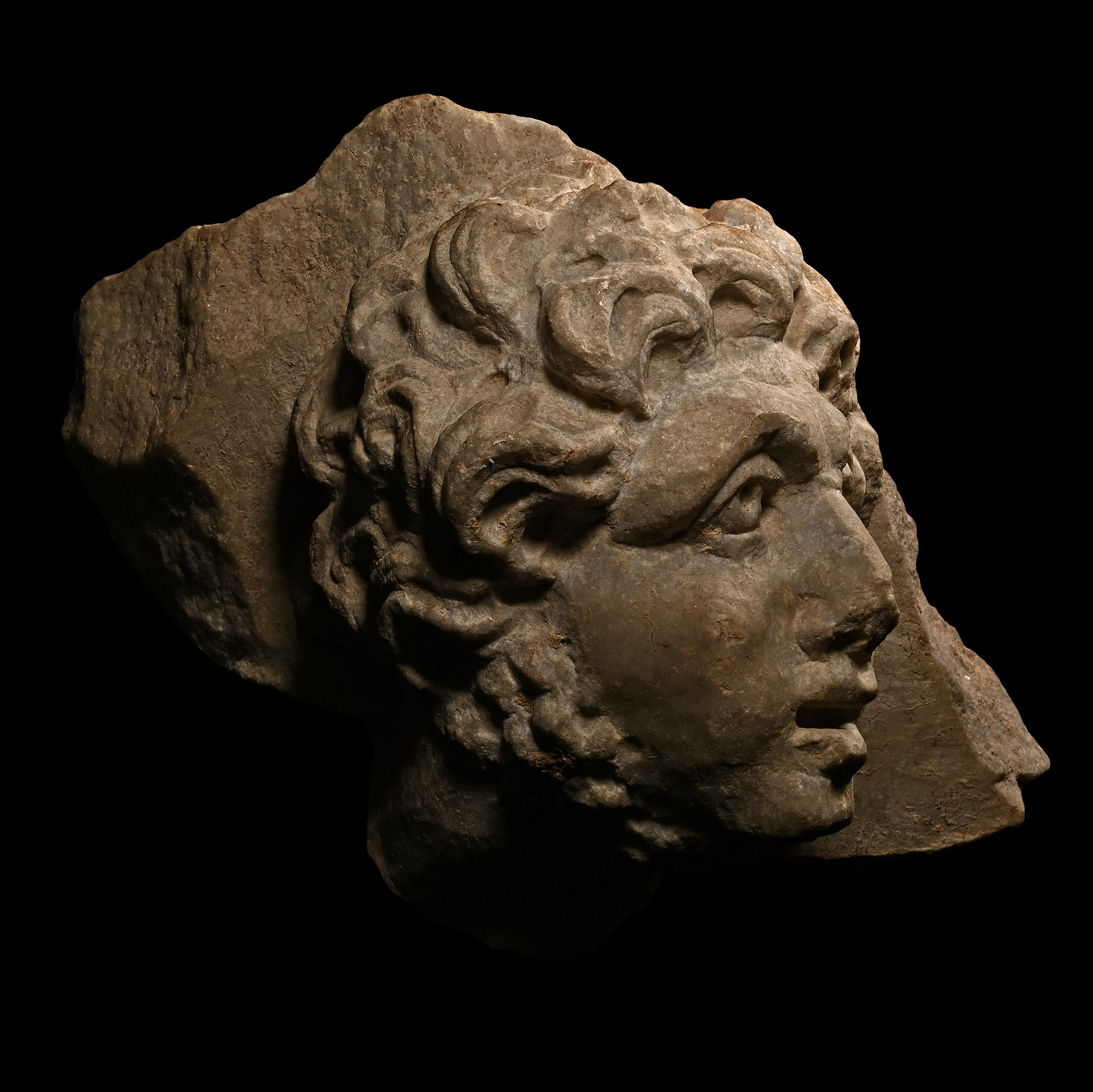
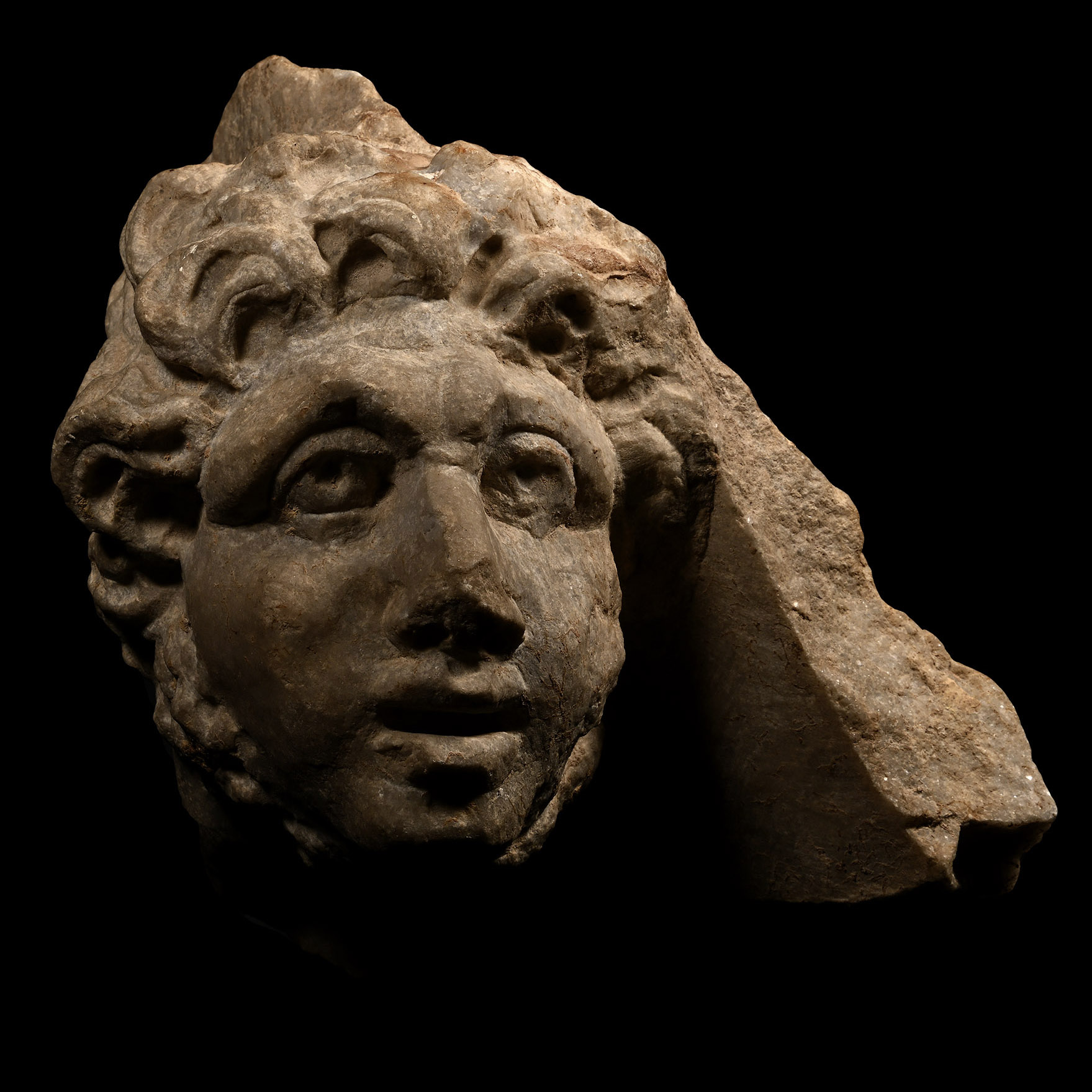
Roman Marble Head of a Man in Relief
3RD-EARLY 4TH CENTURY A.D.
12 1/4 in. (9.85 kg, 31 cm).
Frieze fragment with bust of a male in animated pose, head tilted upwards and eyes wide open; the hair executed in successive curly waves around the thick brow, the broad nose merging into the small open mouth; short curly beard on the neck but face clean-shaven; with steel mounting rod beneath.
ProvenancePrivate collection of a sculptor, Munich; acquired in the 1970s on the Munich art market (Ohlendorf).
Accompanied by an academic report by Dr Raffaele D'Amato.
Accompanied by a copy of an Art Loss Register certificate no.S00044779.
This lot has been checked against the Interpol Database of stolen works of art and is accompanied by search certificate number no.12478-228802.
This lot has been cleared against the Art Loss Register database, and is accompanied by an illustrated lot declaration signed by the Head of the Antiquities Department, Dr Raffaele D’Amato.
For similar sculptures see Bianchi Bandinelli, R., Roma, la fine dell'arte antica, Milano, 1970, figs.2, 14; Castagnoli, F., Il Vaticano nell’Antichità Classica, Roma, 1992, pl.L, p.214, figs.97-99.
FootnotesThe subject seems to be a retainer of military commanders, usually represented on their sarcophagi in wild hunting parties where men, lions and boars fight. It is highly probable that the head was originally from a massive sarcophagus of a general, like the one in Palazzo Mattei in Rome.
CONDITIONTimeLine Auctions follows a vetting process to ensure the authenticity and legality of all items, reinforcing our commitment to integrity and responsible trading. Each antiquity, antique, and coin lot undergoes thorough examination by a vetting committee of at least ten external specialists, professional trade association members, scientists, and archaeologists: Our Vetting Process
AUCTIONS:
TimeLine is a leading auction house specialising in antiquities, ancient art, collectables, natural history, coins, medals, and books. Our auctions offer museums, collectors, historians, and enthusiasts the opportunity to acquire unique and historically significant pieces.
-
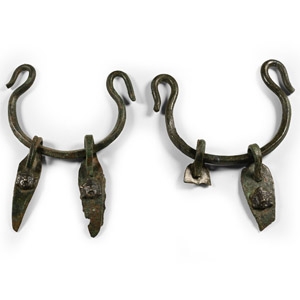
Romano-British 'Silchester' Bronze Figural Vessel Handle Pair
1st-2nd century A.D.Sold for (Inc. bp): £130
Matched pair of drop-handles for a situla or other large vessel, each an arched rod with curved and returned ends attached to a looped bar and leaf-shaped panel with an applied mask or gorgoneion below (one absent). 180 grams total, 9.5-10.3 cm wide
Found North Hampshire near the Roman town of Calleva (Silchester), the Iron Age Celtic capital of the Attrabates tribe. Recorded with Reading Museum, in the 1970s. From an old Hampshire, UK, collection. Ex Ancient & Gothic, UK. Accompanied by copies of two typed and hand illustrated previous information sheets including provenance. This lot is accompanied by an illustrated lot declaration signed by the Head of the Antiquities Department, Dr Raffaele D’Amato. -
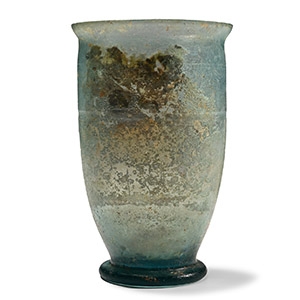
Roman Glass Goblet with Cut Design
Circa 100-300 A.D.Estimate: £700 - 900 (+bp*)
Opening Bid: £350
Translucent with straight sides narrowing to the dimpled base, flared and rolled rim, the body decorated with two horizontal ribbed lines. 104 grams, 10.5 cm
Swiss private collection, Basel. Before that in a Swiss private collection, Bern. Previously with Sayd & Fayez Barakat & Sons, Bethlehem and Jerusalem. Accompanied by a certificate of authenticity from Shaher Barakat, Jerusalem. This lot is accompanied by an illustrated lot declaration signed by the Head of the Antiquities Department, Dr Raffaele D’Amato.
The Hebrew word 'zekhukhith' (glass) appeared in the Old Testament, but it was frequently used in the Mishnaic Hebrew and in correlation with the Aramaic 'zegugita'. In the Talmudic times white and coloured, transparent glasses were very valuable. This magnificent goblet was found on Mons Scopus, in Jerusalem and it shows the skill and the capacity of the Roman glass blowers of the time. After the establishment and unification of the Roman Empire under Augustus (27 B.C.), glass manufacturing quickly travelled throughout the Empire, and with the ease of production, glass entered the same sphere of use and popularity as metal and clay vessels. -

Roman Bronze Bow Brooch Group
Circa 2nd century A.D.Sold for (Inc. bp): £91
Comprising: knee brooch with chord and pin; slender Polden Hill type with hole to the catchplate. 14.1 grams total, 34-51 mm
Acquired on the UK art market before 2000. Property of an Essex, UK, gentleman. This lot is accompanied by an illustrated lot declaration signed by the Head of the Antiquities Department, Dr Raffaele D’Amato.
