Loading, please wait...

Use mousewheel to zoom in and out, click to enlarge

Details

LOT 0840

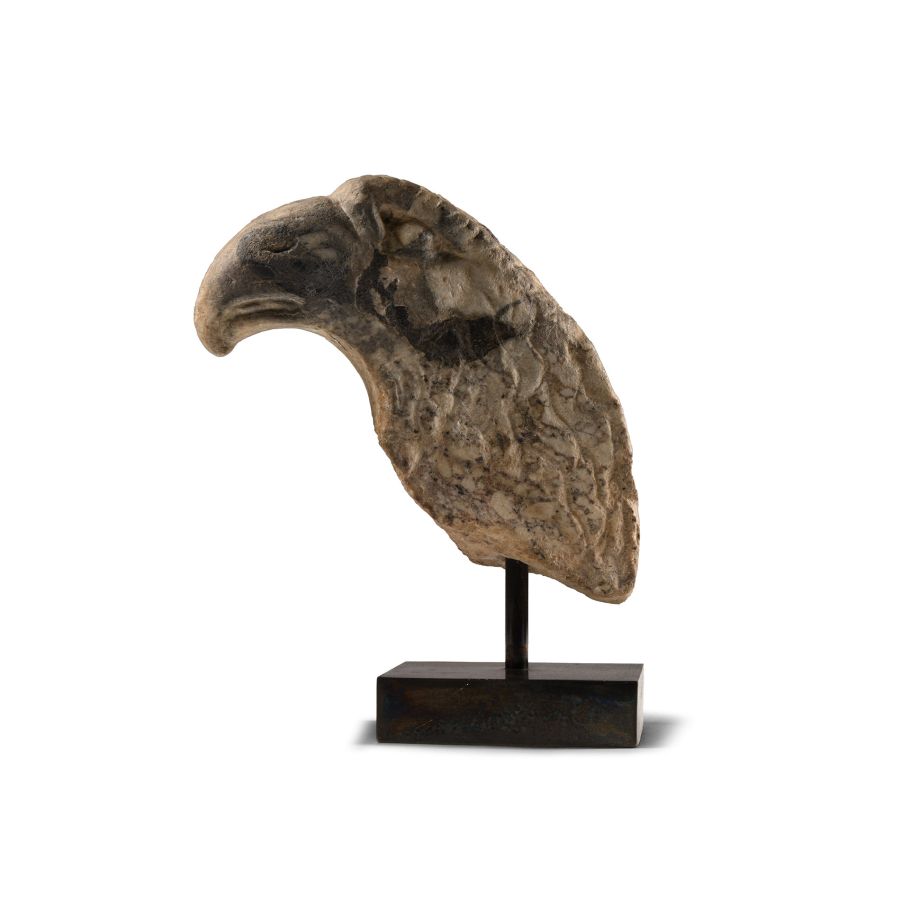
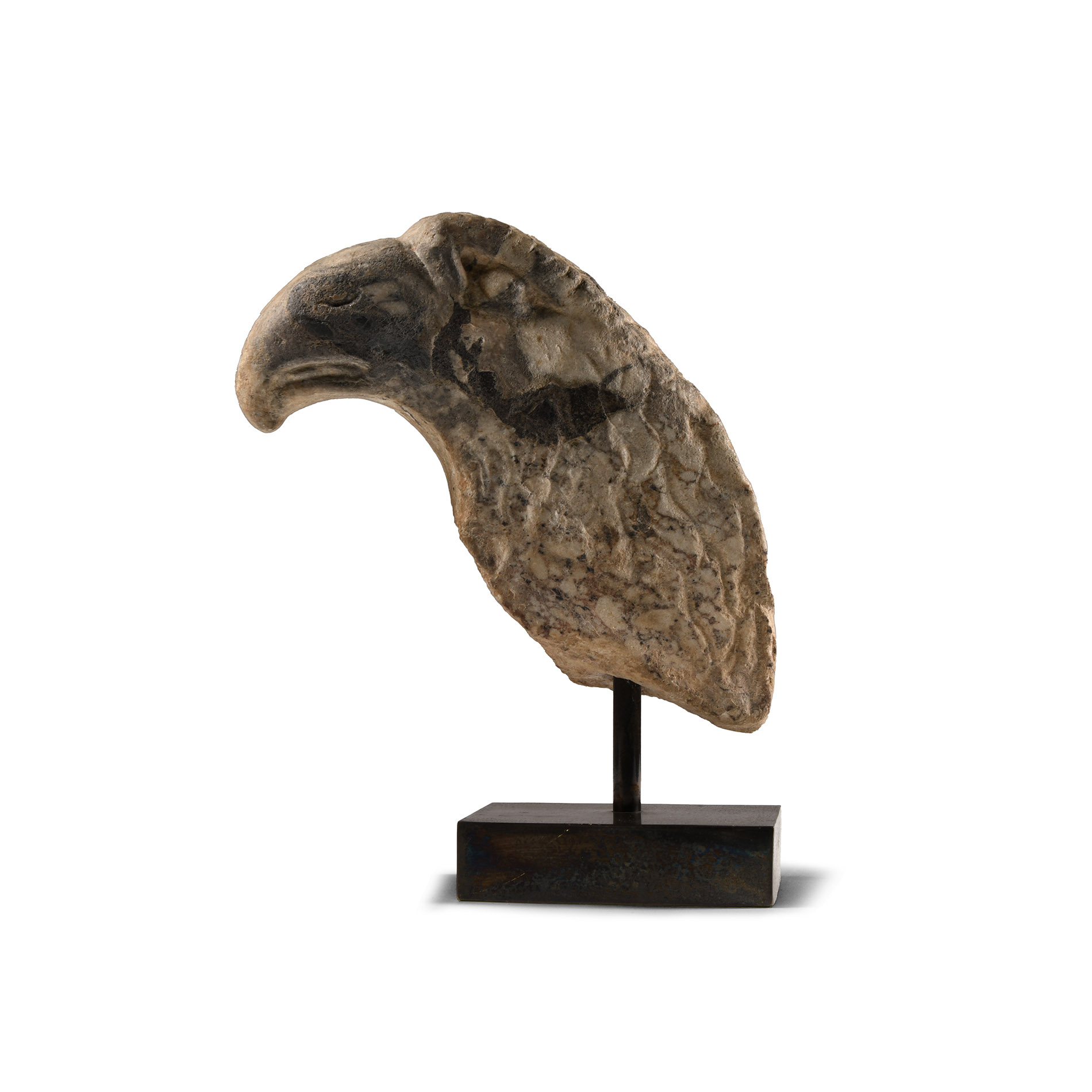
Roman Marble Eagle Head

1ST-4TH CENTURY A.D.

9 in. (1.88 kg total, 23 cm high including stand).

Carved facing left, with deep-set hooded eyes and a hooked beak, stylised feather detailing to the head; mounted on a custom-made display base.

Provenance

Ex Simmons Gallery, London E11, UK.
Ex London collection, 1980s-1990s.

Literature

Cf. for a similar colossal marble eagle Bell, G.L., Amurath to Amurath, London, 1911, fig.3, p.10; Mendel, G., Catalogue des sculptures grecques, romaines et byzantines, Constantinople, 1914, nos.1135 (1949), vol.III, p.369; Reinach, S., Répertoire de la statuaire grecque et romaine, Tome III, 1920; Bertelli, G., ‘Amari usque ad mare, Acceptus e magister David a Siponto: nuove acquisizioni’, in Eurasiatica 4, 2016, Università degli Studi di Bari “Aldo Moro”, p. 67, fig. 6.

Footnotes

In the Greco-Roman world, the eagle was the symbol of Zeus. It is most probable that this eagle flanked a statue of the god. A story is bruited abroad to the effect that Zeus, wanting to determine the centre of the world, let eagles fly of equal speed from west and east. The birds, flying in opposite directions, met at Pytho and that marked the central point of the whole world.

CONDITION

VETTING:

TimeLine Auctions follows a vetting process to ensure the authenticity and legality of all items, reinforcing our commitment to integrity and responsible trading. Each antiquity, antique, and coin lot undergoes thorough examination by a vetting committee of at least ten external specialists, professional trade association members, scientists, and archaeologists: Our Vetting Process


AUCTIONS:

TimeLine is a leading auction house specialising in antiquities, ancient art, collectables, natural history, coins, medals, and books. Our auctions offer museums, collectors, historians, and enthusiasts the opportunity to acquire unique and historically significant pieces.

LOT 0840

Roman Marble Eagle Head

Sold for (Inc. bp): £650

Print page

RELATED LOTS

  • Roman Polychrome Wall Painting Fragment with Winged Siren
    Roman Polychrome Wall Painting Fragment with Winged Siren
    Late 1st century B.C.-early 2nd century A.D.

    Sold for (Inc. bp): £20,800

    Decorated with a frieze of partially preserved acanthus volutes from which emerges a figure of a winged female, possibly a siren, the body and the head of a woman with brown hair, the outstretched wings in pink and yellow; ochre background, cream-coloured line border with a green raised edge (part of the wall) below; mounted on a custom-made display stand. 979 grams total, 16 cm high including stand


    From a European collection formed in the 19th century or earlier, based on the custom-made tooled leather box similar to another fragment kept in a case of similar manufacture with a label reading 'Fragment de Pompéi provenant de la vente Préat 1868' sold at Sotheby's New York, 12 December 2013, lot 84. Mitsukoshi department store, Nihonbashi, Tokyo, by 1974. Japanese art market, 1974-1978. Accompanied by an academic report by Dr Raffaele D'Amato. This lot has been checked against the Interpol Database of stolen works of art and is accompanied by search certificate number no 11828-207723.

    This painted stucco was probably part of a decorative frame. Such decorations can be seen on the famous Villa of Oplontis, where the painted walls of the Triclinium nr. 14 have been divided thrice by columns with a sphinx as ornament on the top of the pillar, decorated with acanthus scrolls and sirens beneath the sphinxes.

    Lot Details

  • Roman Bronze Folding Tripod with Bacchus Busts and Panther
    Roman Bronze Folding Tripod with Bacchus Busts and Panther
    2nd century A.D.

    Estimate: £40,000 - 60,000 (‡+bp*)

    Opening Bid: £16,667

    With three extendable legs each topped with bust of Bacchus, his long hair collected in a crown of vine leaves and branches, wearing a panther skin exomis; the feet formed as feline paws; the middle part of the frontal leg formed as an S-curve topped with a panther's head with open jaws. 9.9 kg, 101 cm

    Traces of gilding over all the whole surface, fine condition, restored, excessively rare.

    Ex collection of Dr Djafari (1900-1981), Kaiserslautern, Germany. Accompanied by an academic report by Dr Raffaele D’Amato. This lot has been checked against the Interpol Database of stolen works of art and is accompanied by search certificate number no.11801-206499.

    Folding tripod stands were well known in the ancient world, in both Greek and Roman contexts. These folding supports for tables, bracers and cauldrons are known finds from important excavations in the Roman world, like Pompeii. The purpose of such folding stands varied: during the meal they were placed between the triclinary beds, and bowls and application plates were hung to the hooks at the back of the holders, here shaped like the heads of a Bacchus. They were also used for the fire in military encampments, or in the temples of the gods. Others were used as the support frames for bronze bowls, either for washing or for ritual purposes. Many were offered as funerary gifts, like the splendid example in the chariot grave of Környe. Roman folding tripods were also used in religious rituals (here clearly linked to the cult of the god of wine, as shown by the presence of panthers) and sacrifices. Burnt offerings and libations were offered to the gods in cauldrons that would have been attached to the hooks behind the heads on the upper section.

    Lot Details

  • Roman Bifacial Green Jasper Gemstone with Saddled Male Donkey and EVM
    Roman Bifacial Green Jasper Gemstone with Saddled Male Donkey and EVM
    1st century A.D.

    Estimate: £800 - 1,000 (+bp*)

    Opening Bid: £444

    The intaglio with a donkey (mule?) grazing, body facing right; Latin inscription on the verso ‘EVM’ (him). 0.98 grams, 12 mm


    Acquired in the late 1980s-early 1990s. Important North West London collection.

    Donkeys were used by the Roman army from circa 200 B.C. but mules, the hybrid offspring of a male donkey and a female horse, were to become the most important working animals for the military and were used to pull heavy artillery such as catapults. It has been estimated that there were probably half a million mules serving in the Roman army by the time of Augustus (31 B.C.-A.D. 14). DNA studies have now shown that mules may have comprised up to 50% of the equids in the Roman Empire. The use of pack-mules for the army continued in the Eastern Roman army until the fall of Constantinople.

    Lot Details

Stay up-to-date with the latest from TimeLine Auctions by joining our mailing list