
Loading, please wait...
LOT 0236
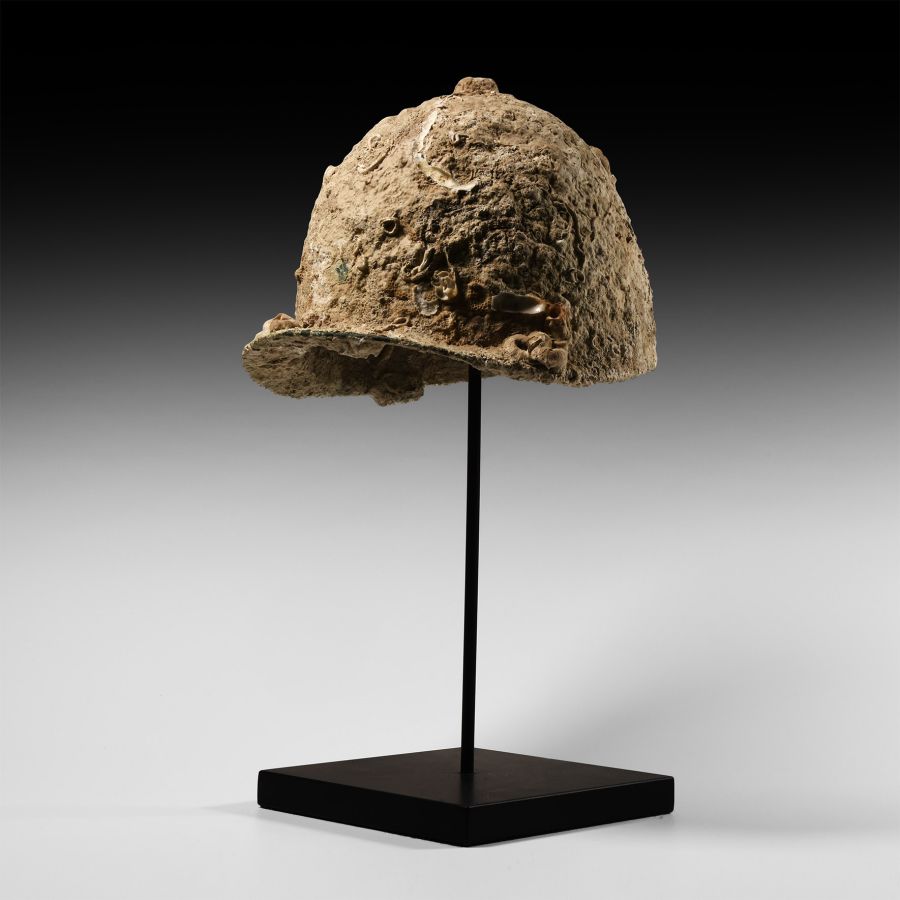
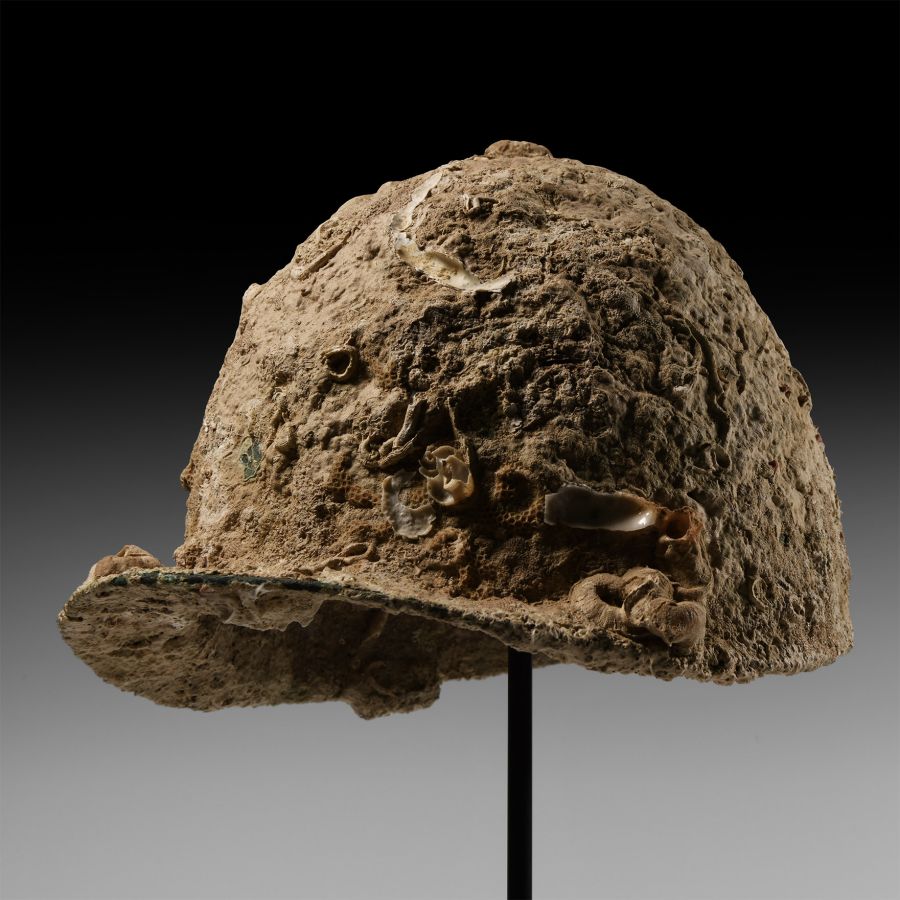
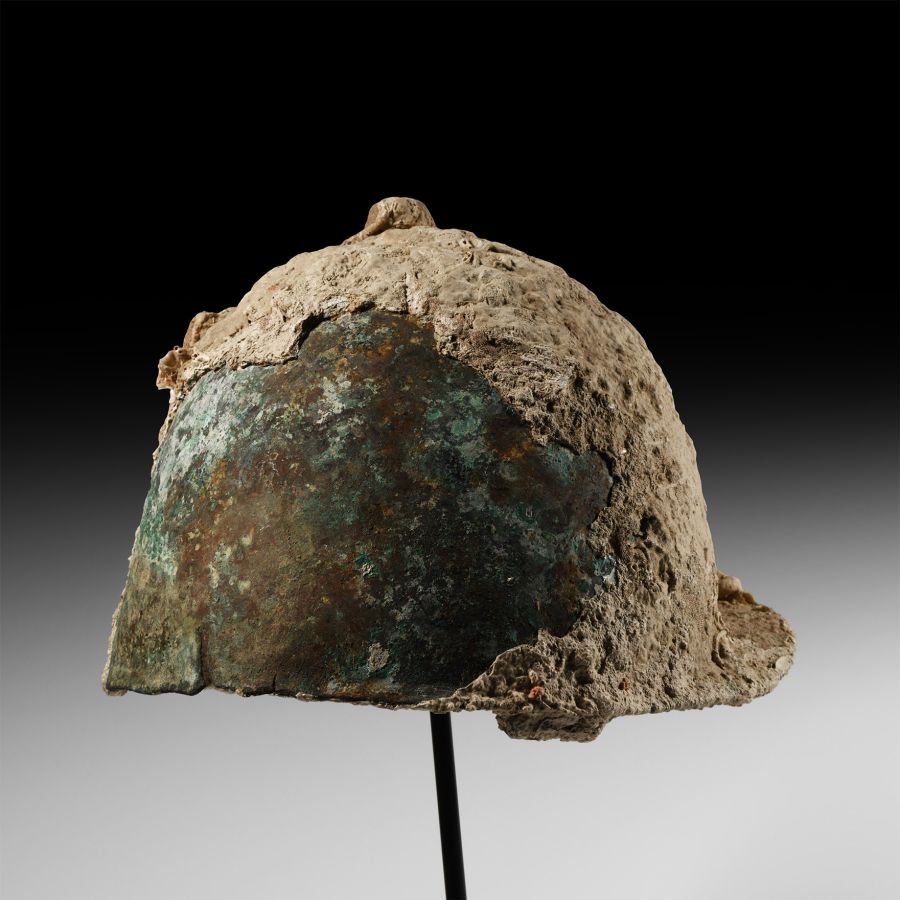
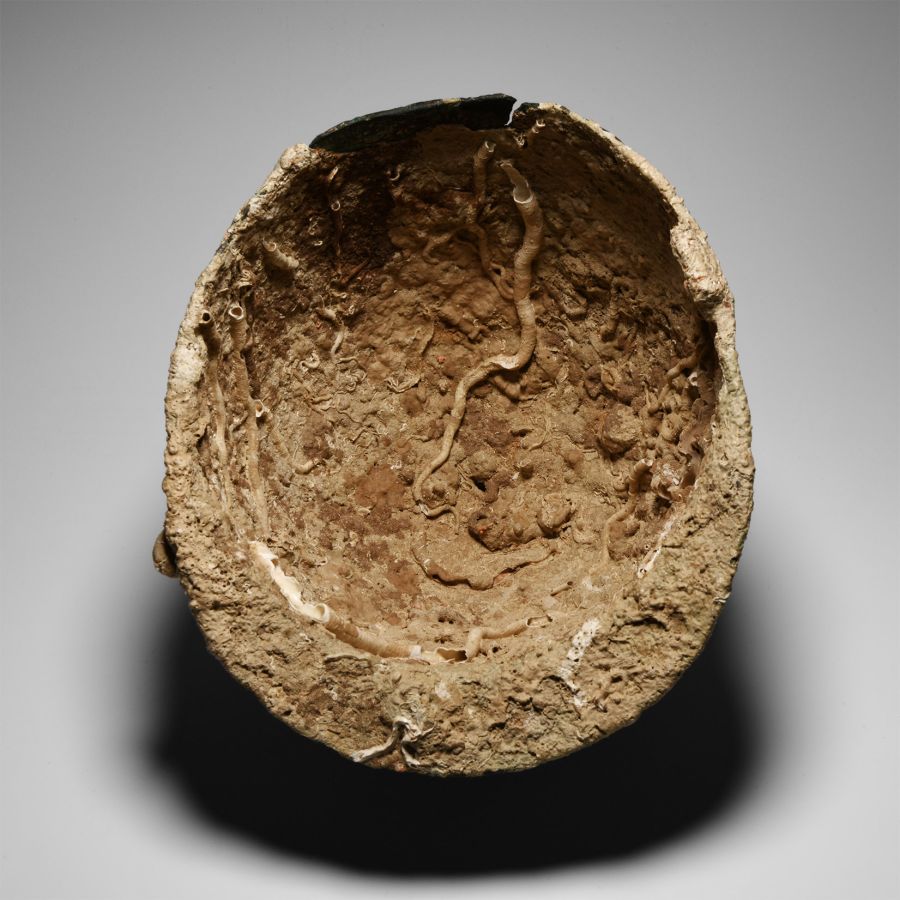
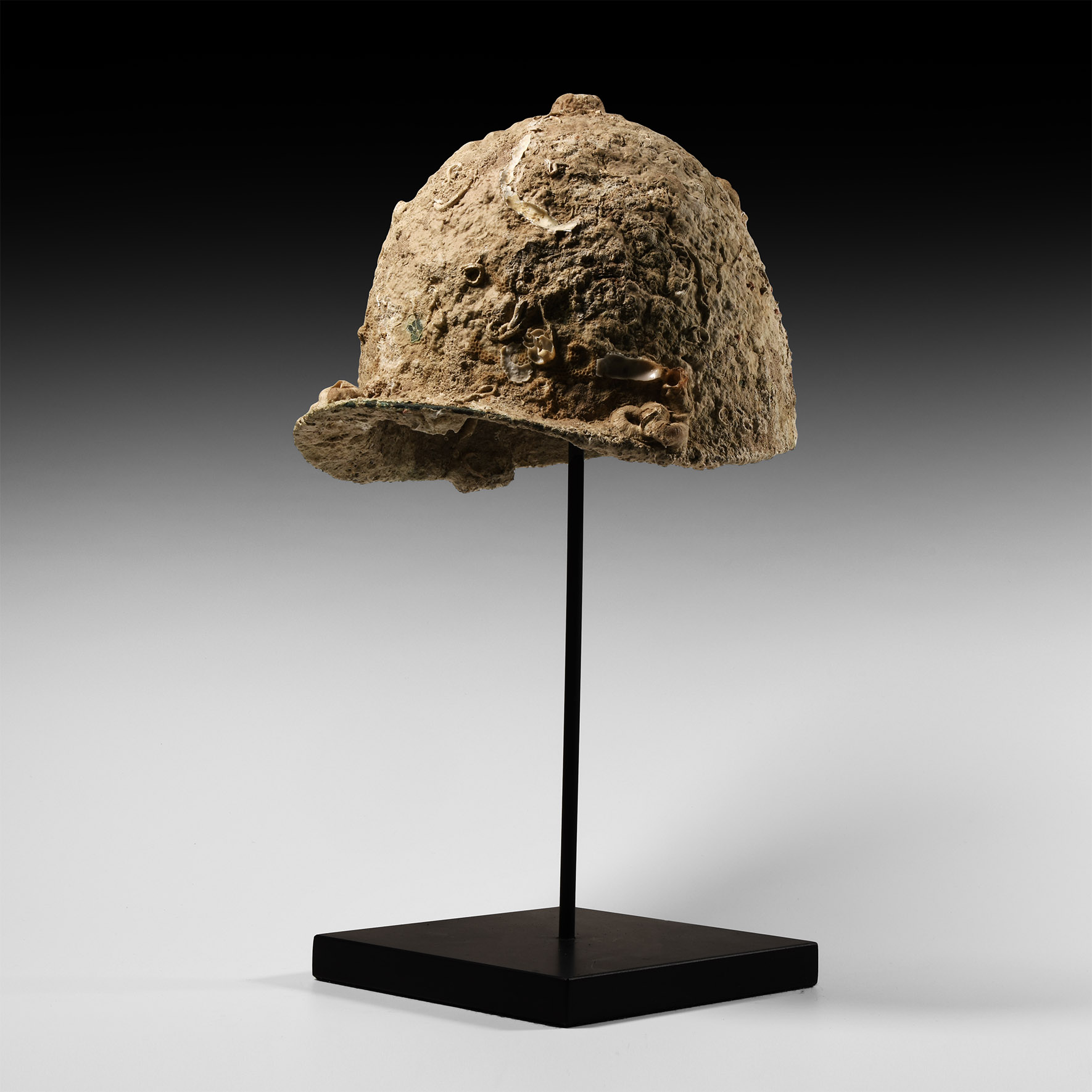
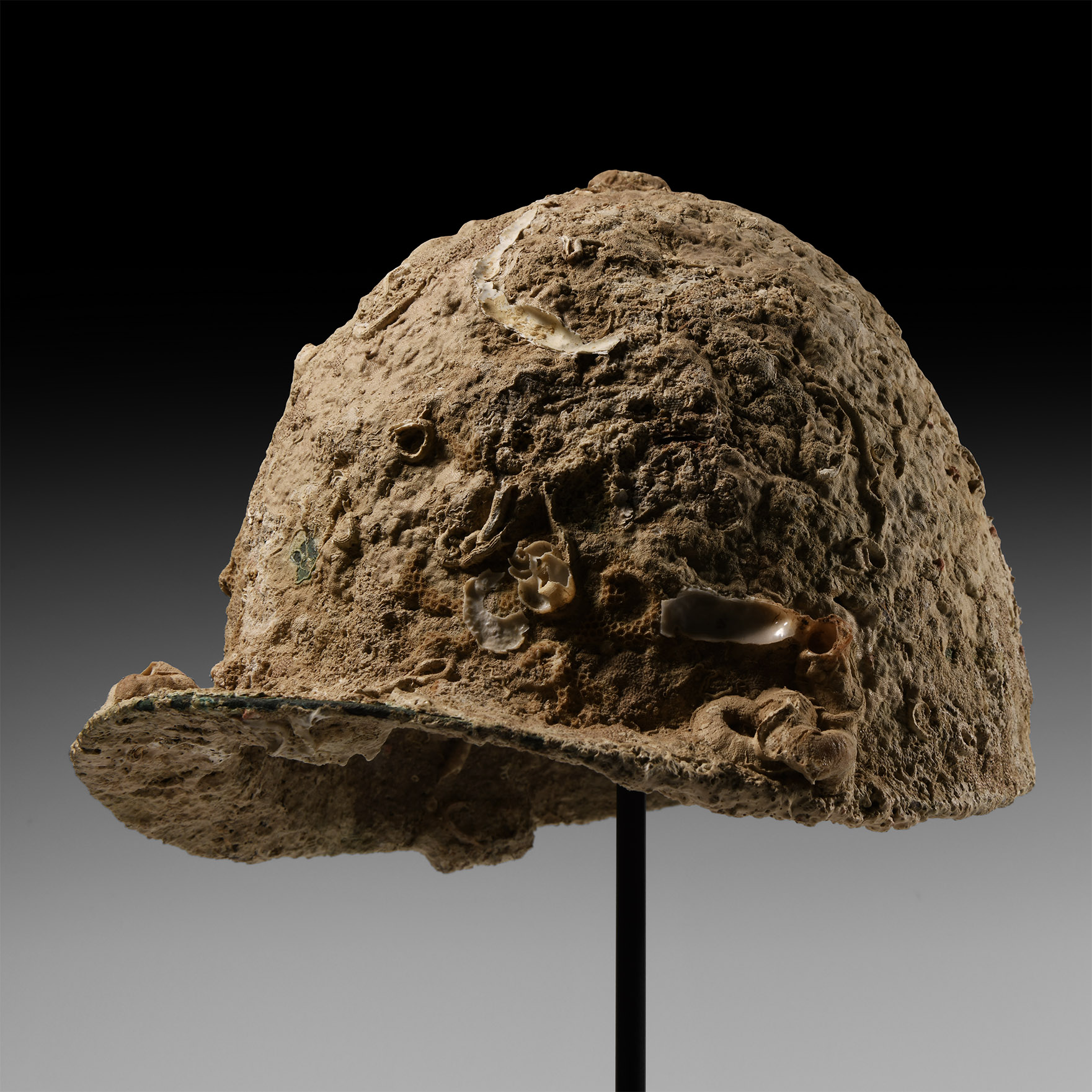
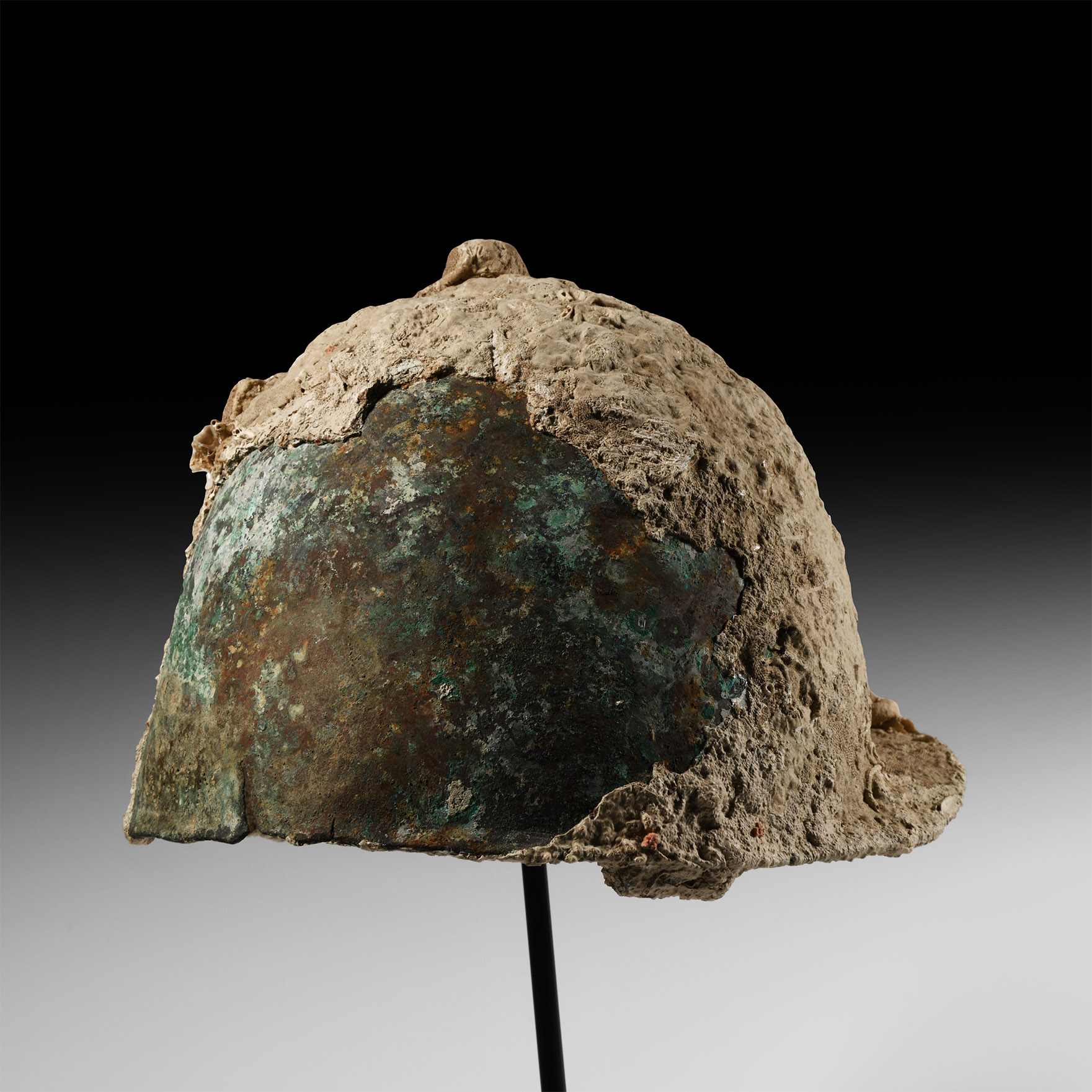
Roman Legionary Helmet with Inscription
1ST CENTURY B.C.
11 in. (17 3/4 in.) (2.2 kg, 28 cm (4 kg total, 45 cm high including stand)).
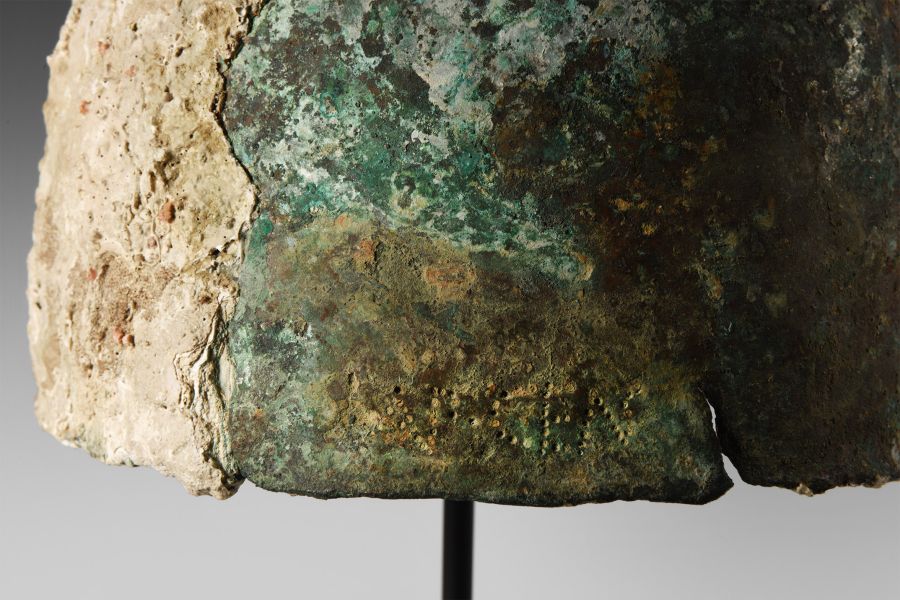
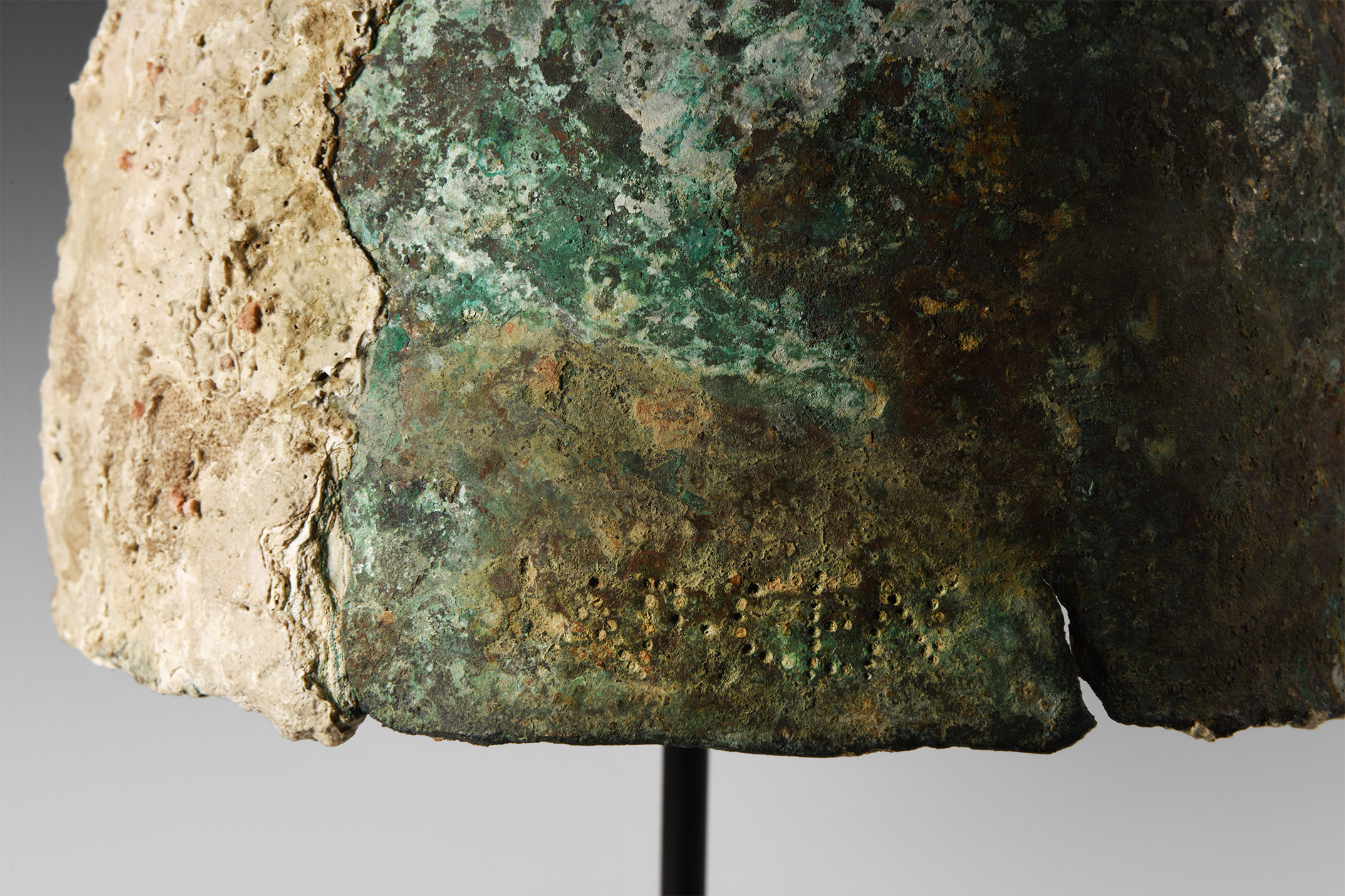
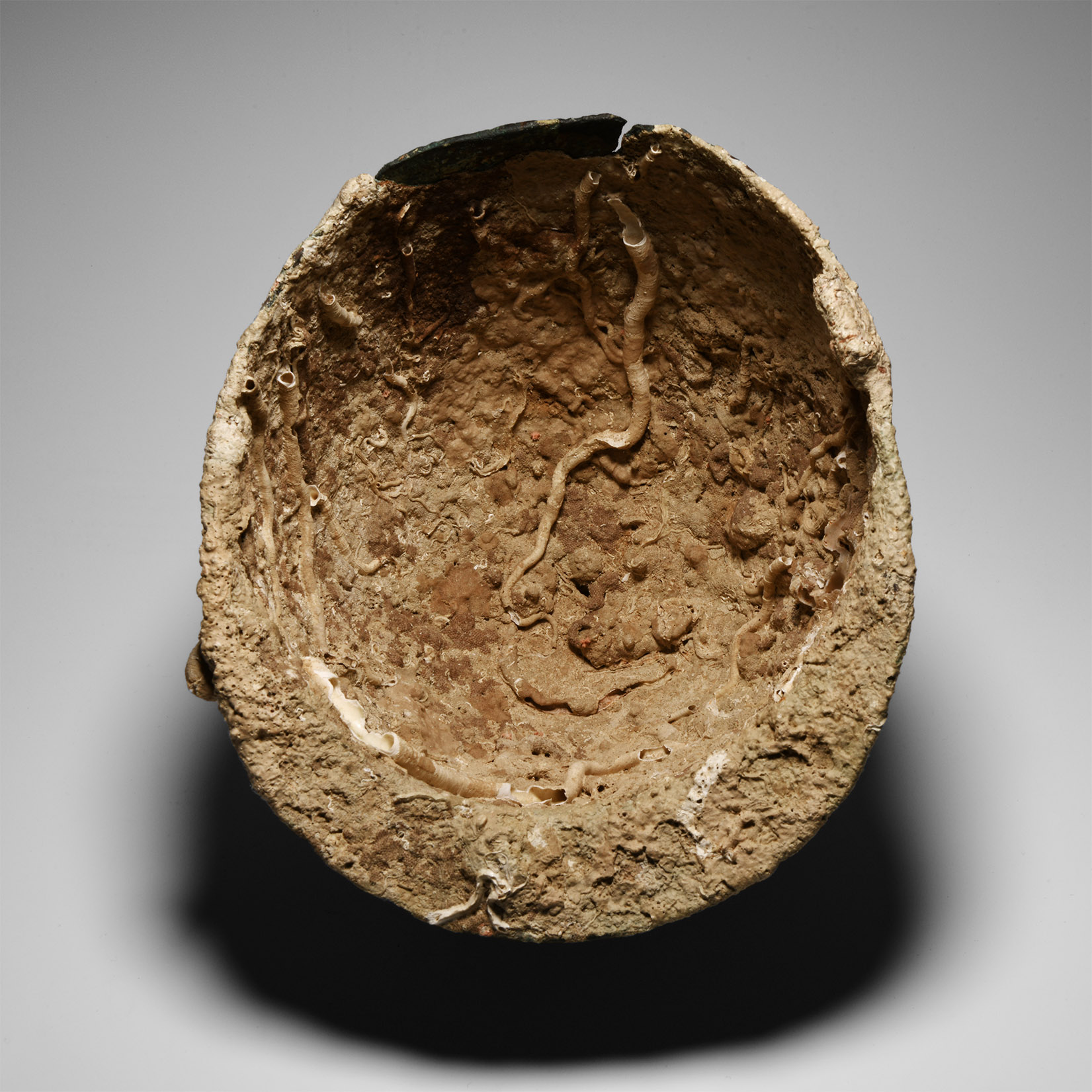
A bronze Montefortino helmet with bulbous domed skull and a plain crest knob with flattened top; plain and flat neck guard with thickened rim; the front with punched Latin inscription 'A N CFN'; the surface largely covered in marine encrustations; accompanied by a custom-made display stand.
ProvenancePrivate Swiss collection, acquired 2001.
Accompanied by an academic report by Dr Raffaele D'Amato.
This lot has been checked against the Interpol Database of stolen works of art and is accompanied by searcher certificate no.11576-198953.
Cf. Robinson, R., The Armour of Imperial Rome, New York, 1975, pls.22-27, pp.18ff.; Schaaf, U., 'Etruskich-Römische Helme' in Antike Helme, RGZM Monographien 14, Mainz, 1988, pp.318-326, and nos.112-113; D'Amato, R., Arms and Armour of the Imperial Roman Soldier, London, 2009, fig.20; Junkelmann, M., Römische Helme, Mainz, 2000, pp.52ff., pl.VI (AG 537); Travis, H. & Travis J., Roman Helmets, Stroud, 2014, pp.51-52.
FootnotesThis Montefortino specimen belongs to type C or D of Robinson’s classification, also identified under the continental system as Buggenum. The helmets of this category, mainly legionary helmets, were produced in mass by the state to be supplied to the troops fighting in the civil wars of the 1st century B.C. Artistic sources of the same period provide evidence for the use of Montefortino and Buggenum type helmets in sea battles, which has been confirmed by archaeological finds from the Albenga ship. The legionary helmets had inscriptions punched upon them, indicating the name of the wearer and the unit, i.e. cohors, centuria or turma. Here the punched letters 'AN' refer probably to the initials of the owner (Ancus N.?), and 'CFN' to centuria of Fabius C.
CONDITIONTimeLine Auctions follows a vetting process to ensure the authenticity and legality of all items, reinforcing our commitment to integrity and responsible trading. Each antiquity, antique, and coin lot undergoes thorough examination by a vetting committee of at least ten external specialists, professional trade association members, scientists, and archaeologists: Our Vetting Process
AUCTIONS:
TimeLine is a leading auction house specialising in antiquities, ancient art, collectables, natural history, coins, medals, and books. Our auctions offer museums, collectors, historians, and enthusiasts the opportunity to acquire unique and historically significant pieces.
LOT 0236
Roman Legionary Helmet with Inscription
Estimate £12,000 - 17,000€13,920 - 19,720 (for guidance only)$16,200 - 22,950 (for guidance only)
-
Western Asiatic Paddle-Shaped Axehead
3rd millennium B.C.Sold for (Inc. bp): £124
A copper-alloy axehead with roughly lozenge-shaped butt, oblong socket and paddle-shaped cheeks; incised concentric lines following the outline of the butt and flared, projecting knop at the centre. 335 grams, 16 cm
Early 1990s London collection. Acquired on the UK art market. From a private collection, Lancashire, UK.
The axe belongs to subtype H2.J.b of the Gernez classification. These axes are characterised by decoration often executed with remarkable care and technical skill. The enlargement and indentation of the back of the collar varies, whilst the shape of the blade is, by contrast, standardised, with divergent rectilinear edges and a straight cutting edge or, more rarely, a rounded cutting edge, as in the example offered here. -
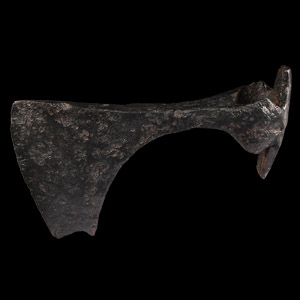
Viking Period Bearded Type Axehead
Circa 9th-11th century A.D.Sold for (Inc. bp): £598
A hand-forged iron skeggöx (bearded axe) with asymmetrical triangular section narrow blade widening to a broad bevelled edge with square chin, curved edge, flared wings to the scooped socket and dorsal bar. 855 grams, 20 cm
Acquired 1971-1972. From the collection of the vendor's father. Property of a London, UK, collector.
Iron axeheads of this typology show a sub-trapezoidal asymmetrical blade, often perforated through the centre. They are characterised by two projections spurs from the top and the bottom of the back of the shaft-hole. -
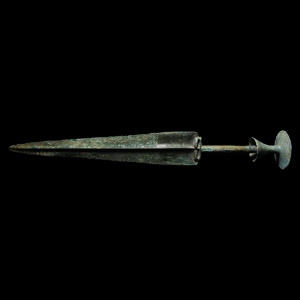
Luristan 'Cotton Reel' Pommel Sword
13th-6th century B.C.Sold for (Inc. bp): £889
A bronze sword with a broad double-edged blade with a central ridge on both sides, square bronze hilt with goblet-shaped pommel surmounted by a disc. 725 grams, 51 cm
Fine condition.
Acquired 1980-2015. Ex Abelita family collection.
Bimetallic swords (some examples are entirely cast in iron and others entirely cast in bronze) with disc pommel, slender cylindrical grip and tapering blades of this type are among the most common types of daggers / swords in Northern Iranian graveyards. This type has occasionally been referred to as the 'cotton reel' pommel, as below the flat circular pommel there is a second, a rather wide disc, and a plain or incised cylindrical grip in between.
