
Loading, please wait...
LOT 0623
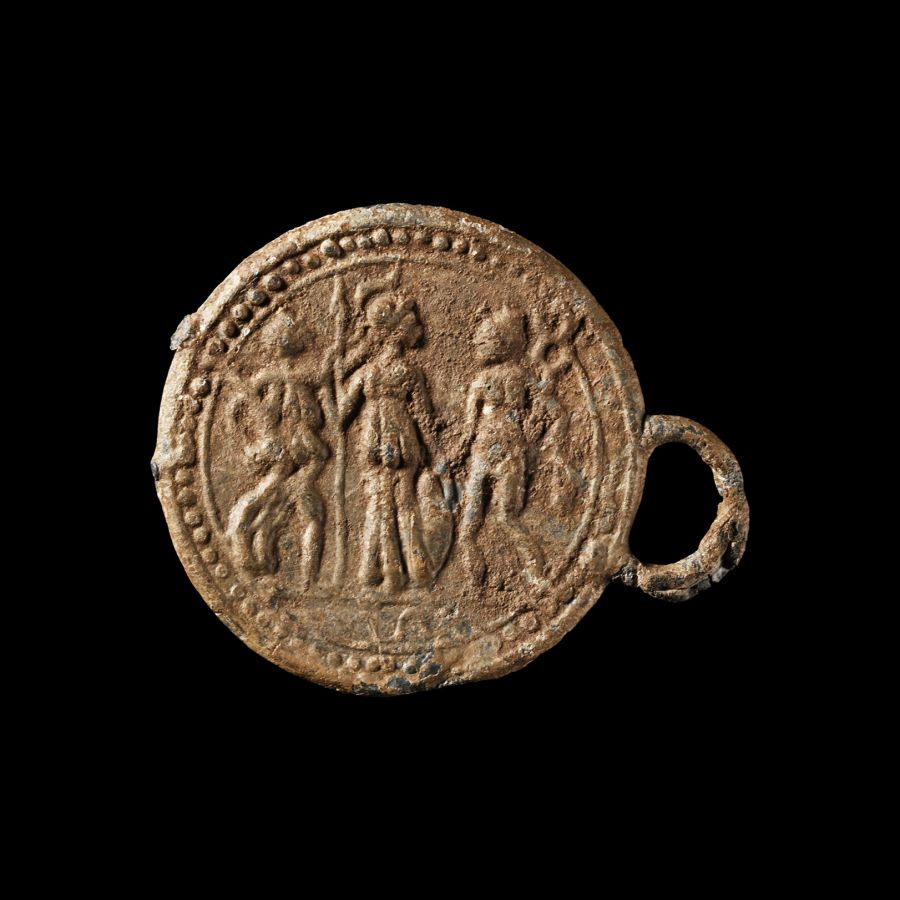
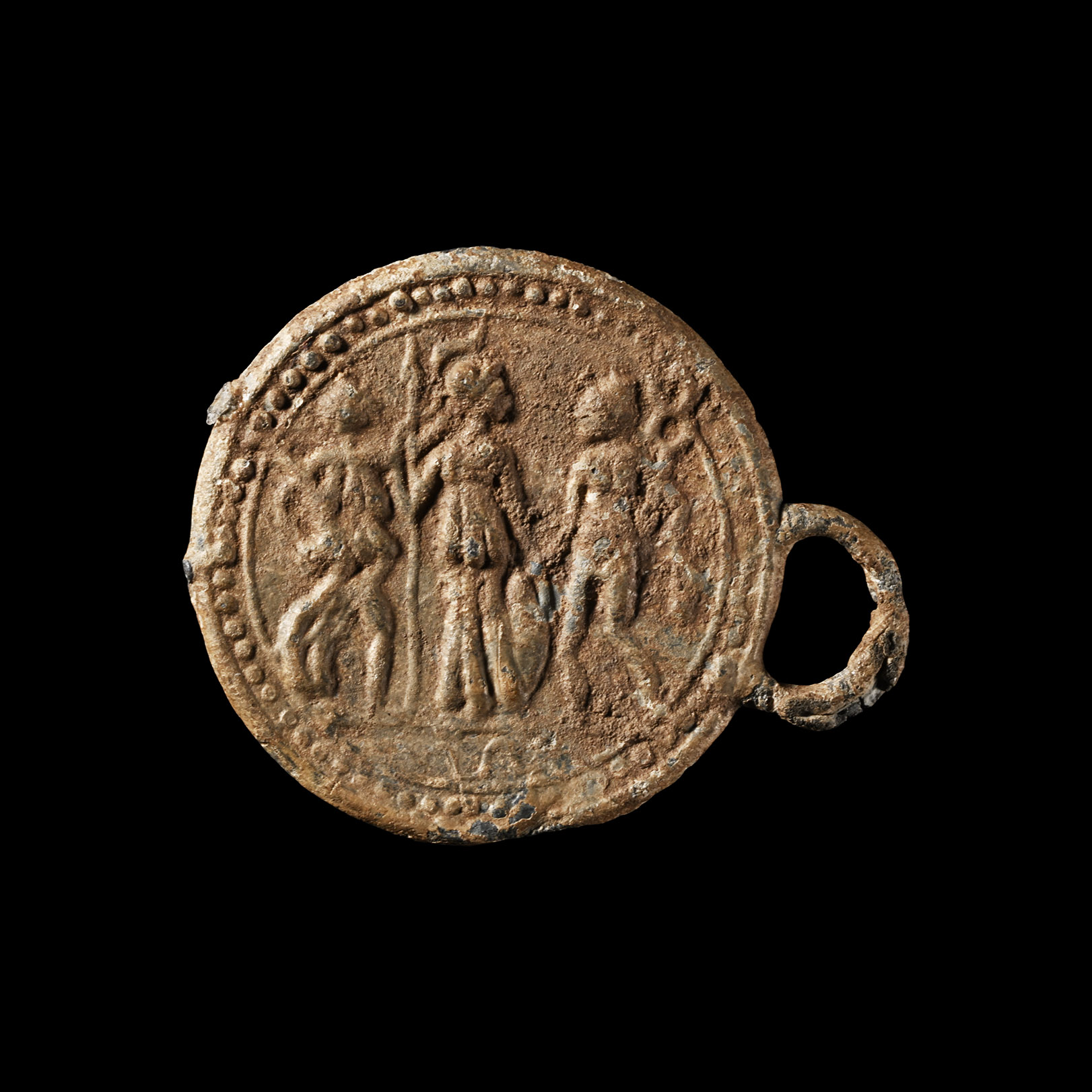
Roman Lead Plaque with Figures
2ND CENTURY A.D.
1 1/2 in. (11.1 grams, 40 mm).
Obverse with a beaded border and one loop enclosing an image of three figures: at the centre Minerva wearing a crested helmet and with a shield at her feet, on the left Abundantia with a frond in her bent arm, on the right Mercury with cap and caduceus; reverse with concentric rings. [No Reserve]
ProvenancePrivate collection, 1980s.
From the collection of a London antiquarian.
Cf. for votive or commemorative medallions in lead of the same typology (but with the image of the winged Victory and other divinities) Beutler, F. et al., Der Adler Roms. Carnuntum und die Armee der Cäsaren, Bad-Deutsch-Altenburg, 2017, items 101-103, and 625-630, for type.
FootnotesThe lead medallions were worn as elements of protection from the gods represented on them, but also used by soldiers as seals. Several lead medallions with images of emperors, male deities (Mars), military heads and imperial initials were found in the military chancellery of Carnuntum. The presence of loops on our specimen points to its use as a prophylactic medallion.
CONDITIONTimeLine Auctions follows a vetting process to ensure the authenticity and legality of all items, reinforcing our commitment to integrity and responsible trading. Each antiquity, antique, and coin lot undergoes thorough examination by a vetting committee of at least ten external specialists, professional trade association members, scientists, and archaeologists: Our Vetting Process
AUCTIONS:
TimeLine is a leading auction house specialising in antiquities, ancient art, collectables, natural history, coins, medals, and books. Our auctions offer museums, collectors, historians, and enthusiasts the opportunity to acquire unique and historically significant pieces.
-
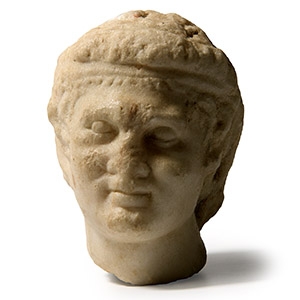
Roman Marble Head of a Satyr
1st-3rd century A.D.Sold for (Inc. bp): £3,380
Of Praxitelic type with fillet to the brow, tousled hair and rounded facial features with stern expression. 519 grams, 88 mm
Acquired early 1990s. Ex private American collection; thence by descent. Private Swiss collection since 1998. This lot has been checked against the Interpol Database of stolen works of art and is accompanied by search certificate no.11632-199025.
The head appears to be a copy of the Praxitelian type known as 'the Pouring Satyr'. The head, realised with sensitivity, but technically and stylistically academic, could be dated to the first half of the 2nd century A.D. -
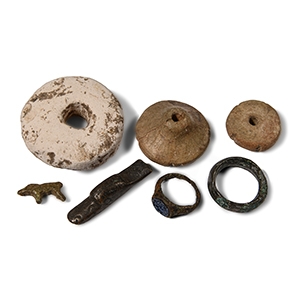
Roman and Other Artefact Collection
1st century A.D. and laterSold for (Inc. bp): £33
Comprising: a small bronze animal figure; three ceramic spindle whorls/weights; tinned ring with keeled hoop; a bronze swan-head finial; and a bronze ring with blue glass intaglio. 91 grams total, 20-45 mm
Property of a UK gentleman, acquired in the 1970s. Property of an East Sussex, UK, gentleman. -

Late Roman Geometric Floor Mosaic
Circa 6th-8th century A.D.Sold for (Inc. bp): £3,250
Comprising three full and one partial octagon, each with two concentric rhombuses distinguished by different shades of yellow, white and light red, each with a central red dot; the border above with a band of red triangles; mounted on a reinforced backing board. 59 kg, 151 cm wide including frame
Acquired 1970s-1996. Property of a North American collector. London collection, 2016. Accompanied by an academic report by Dr Raffaele D'Amato. This lot has been checked against the Interpol Database of stolen works of art and is accompanied by search certificate number no.11920-207410.
The use of abstract and geometric motifs characterises the mosaic art of the Levant under the domination of Byzantium. Close ties can be identified between these rhomboidal figures with those of some of the famous Lebanese mosaics of Beit el Dine, or the mosaics of Tiberias and Hammat, which represent the last expression of Roman art in that area before the Islamic conquest.
