
Loading, please wait...
LOT 0121
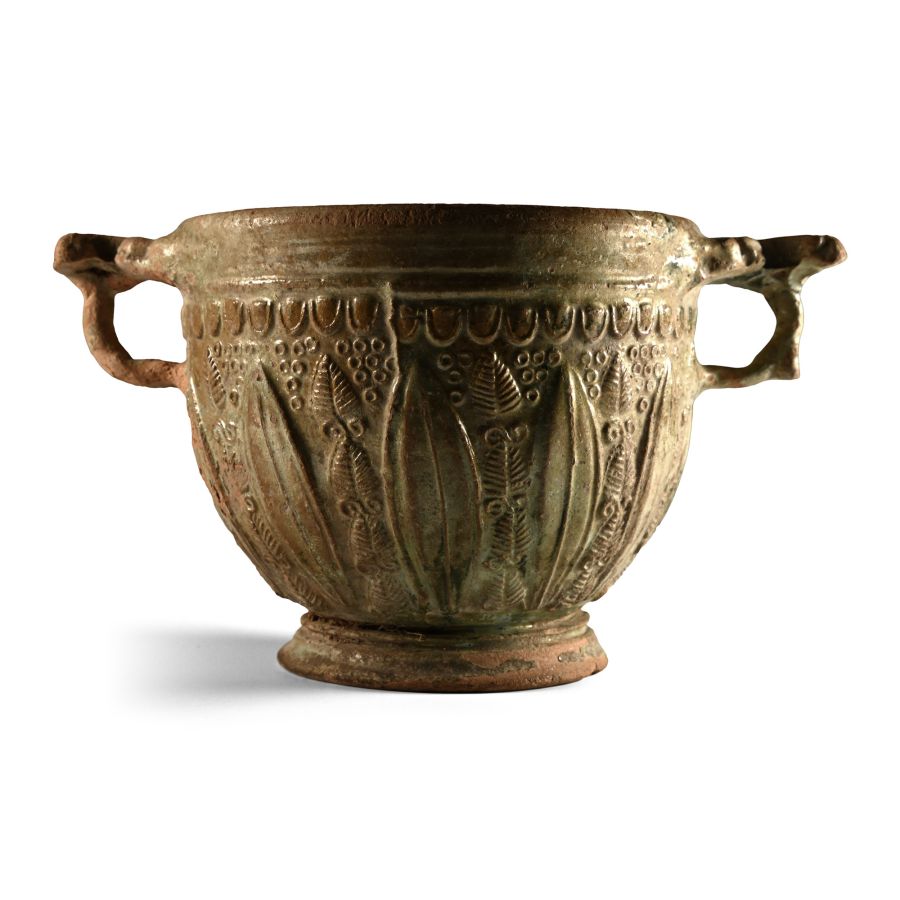
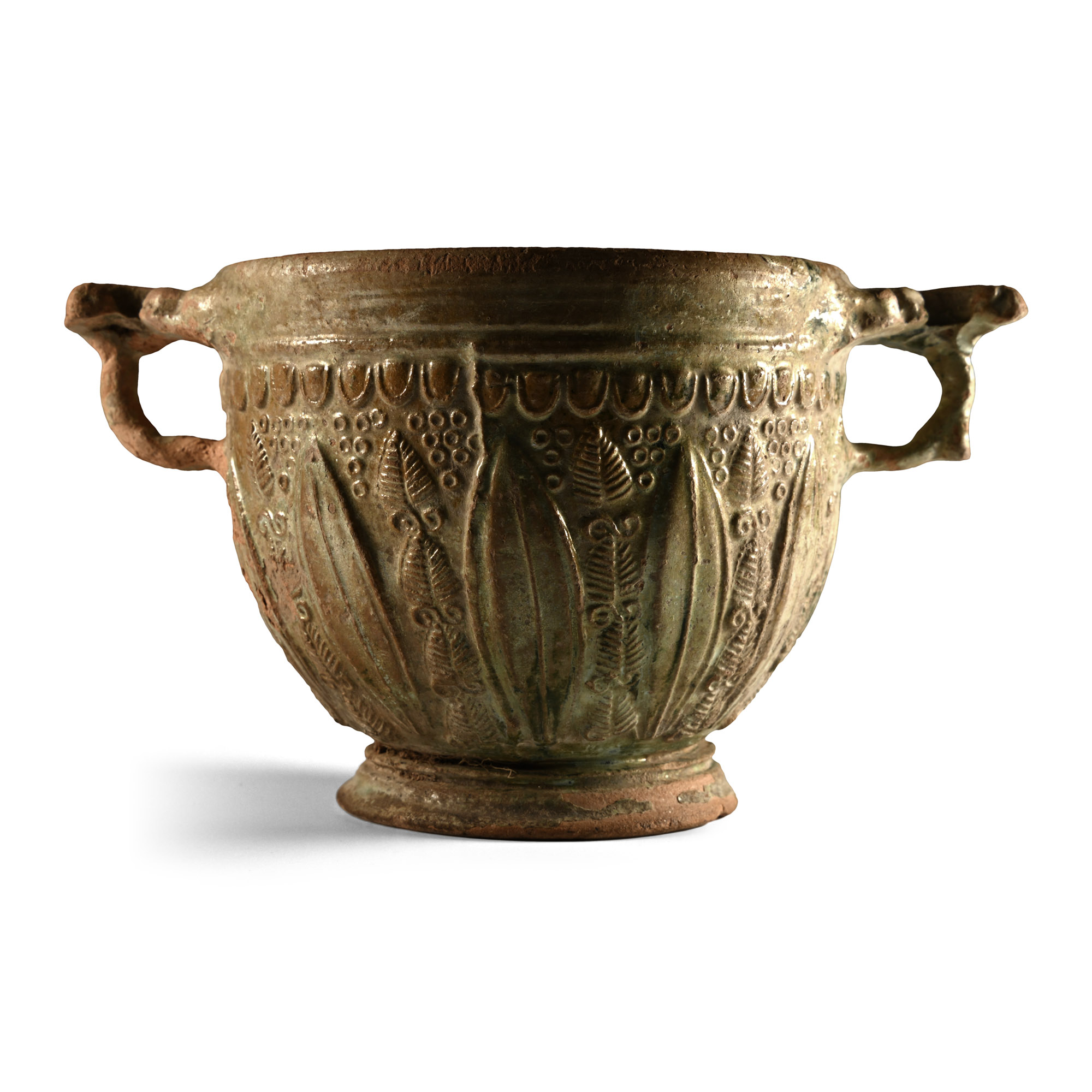
Roman Lead-Glazed Lotus Cup
1ST CENTURY B.C.
6 3/4 in. (214 grams, 17 cm wide).
With vertical leaf detailing to the bowl on a field of pellets with band of egg-and-dart below the ribbed rim, stepped foot; lateral loop handles with T-shaped scrolled panel above.
ProvenanceAcquired 1979-1999.
London collection of the late Mr S.M., thence by descent.
This lot has been checked against the Interpol Database of stolen works of art and is accompanied by search certificate number no.12510-231919.
This lot has been cleared against the Art Loss Register database, and is accompanied by an illustrated lot declaration signed by the Head of the Antiquities Department, Dr Raffaele D’Amato.
Exhibited at the Harwich Museum, Harwich, Essex, UK, 21st January-10th March 2025; accompanied by a copy of a photograph of the artefacts on display.
LiteratureCf. similar item in terracotta in the Metropolitan Museum of Art, New York, under accession no. 17.194.894.
CONDITIONTimeLine Auctions follows a vetting process to ensure the authenticity and legality of all items, reinforcing our commitment to integrity and responsible trading. Each antiquity, antique, and coin lot undergoes thorough examination by a vetting committee of at least ten external specialists, professional trade association members, scientists, and archaeologists: Our Vetting Process
AUCTIONS:
TimeLine is a leading auction house specialising in antiquities, ancient art, collectables, natural history, coins, medals, and books. Our auctions offer museums, collectors, historians, and enthusiasts the opportunity to acquire unique and historically significant pieces.
-
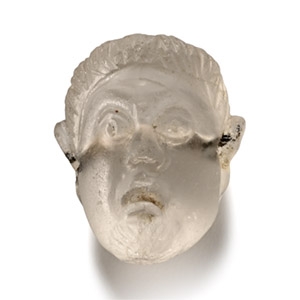
Roman Miniature Rock Crystal Bead of a Man
Circa 300 A.D.Sold for (Inc. bp): £520
Triangular in section and curved to the rear, with wide-eyed expression; pierced at the ears for suspension as a bead; small goatee beard to the chin and radiating leaf pattern to rear of head. 4.32 grams, 19 mm
Mr F.D. collection, acquired on the European art market, 1975 to present. This lot is accompanied by an illustrated lot declaration signed by the Head of the Antiquities Department, Dr Raffaele D’Amato. -
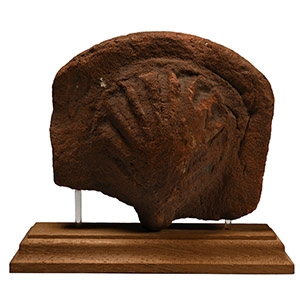
Roman 'Burgh Castle' Terracotta Antefix Shell Decoration
1st-4th century A.D.Sold for (Inc. bp): £169
The upper part of an antefix, rounded in shape and decorated with a 16-armed shell shape; mounted on a custom-made display stand. 342 grams total, 13 cm wide including stand
Found Burgh Castle, Great Yarmouth, Suffolk, UK. From the collection of a late East Anglian teacher and antiquarian who retired to the Isle of Wight in Hampshire, UK. He amassed a large collection of objects between the 1960s-1980s. This lot is accompanied by an illustrated lot declaration signed by the Head of the Antiquities Department, Dr Raffaele D’Amato.
Antefix tiles in Britain are rare and typically comprise a decorated vertical panel of triangular or pentagonal shape, though some are known to have a rounded top, and they have a lug or a semi-circular flange on the reverse designed to fit into the open end of either the lowest course of embraces on a roof, or into the gable end of the ridge tiles. Antefix tiles have sanded decorated surfaces showing that they were made in sanded moulds rather than being stamped. The majority of antefix tiles in Britain are decorated with human masks, though several other designs are known: pentagonal panels, vine leaves with grapes, gorgon heads, a female head with a stylised headdress, a second design of female head and a man fishing. -
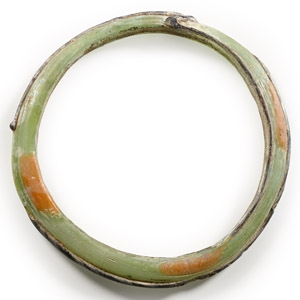
Romano-Phoenician Multicoloured Glass Bracelet
2nd century B.C.-1st century A.D.Sold for (Inc. bp): £52
D-section bangle in aqua glass with applied dark red trails to the outer face. 24 grams, 86 mm
Ex London, UK, collection, 1990s. This lot is accompanied by an illustrated lot declaration signed by the Head of the Antiquities Department, Dr Raffaele D’Amato.
