
Loading, please wait...
_900x900.jpg "Roman Lead Coffin Lid with Ivy and Floral Motifs")
_200x200.jpg "Roman Lead Coffin Lid with Ivy and Floral Motifs")
.jpg "Roman Lead Coffin Lid with Ivy and Floral Motifs")
LOT 0160
Roman Lead Coffin Lid with Ivy and Floral Motifs
2ND-3RD CENTURY A.D.
67 1/2 in. (38.5 kg, 175.5 cm).
Decorated with stamped patterns comprising dolphins, vegetal and floral patterns, motifs with ivy leaves and floral border strips with laurel leaves.
ProvenanceAcquired 1970s-early 1990s.
Property of a North American collector.
London collection, 2016.
This lot has been checked against the Interpol Database of stolen works of art and is accompanied by search certificate no.11992-209844.
See for a similar specimen in the Metropolitan Museum of Art, accession no.31.116a-i; Penn Museum, coffin panel B10280, from Lebanon (Tyre); see also Rahmani, L.Y., ‘Lead Coffins from Israel’ in Israel Exploration Journal, vol.37, no.2/3 (1987), pp.123-146, pls.10,11,14.
FootnotesAlthough the majority of people were buried without coffins, there is evidence for wooden coffins, lead-framed wooden coffins, tile burials, lead coffins and stone coffins from the Roman Empire. Our typology belongs a type diffused in the Eastern Mediterranean. The leaves refer to actual garlands and flowers used to decorate tombs and altars. The dolphin was considered to ferry the souls of the dead to the afterlife and was a common motif in this period, also used for the slide-fitting of Roman sword scabbards. Romans believed these animals carried souls to the
Fortunate Isles, perhaps because they could pass through the air-breathing terrestrial world and into the watery depths that claimed so many Roman sailors’ lives. This symbol would have had a personal significance for the deceased, who may have been a seafarer during life. Romans often ordered their lead coffins long before they died as the process of making them took a long time.
TimeLine Auctions follows a vetting process to ensure the authenticity and legality of all items, reinforcing our commitment to integrity and responsible trading. Each antiquity, antique, and coin lot undergoes thorough examination by a vetting committee of at least ten external specialists, professional trade association members, scientists, and archaeologists: Our Vetting Process
AUCTIONS:
TimeLine is a leading auction house specialising in antiquities, ancient art, collectables, natural history, coins, medals, and books. Our auctions offer museums, collectors, historians, and enthusiasts the opportunity to acquire unique and historically significant pieces.
-
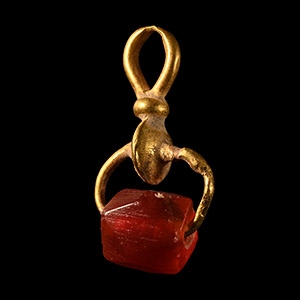
Roman Gold Pendant with Bead
1st-4th century A.D.Sold for (Inc. bp): £260
Formed as a double loop with collar, set with a facetted red carnelian bead. 1.22 grams, 19 mm
From a late Japanese specialist collector, 1970-2000s. -
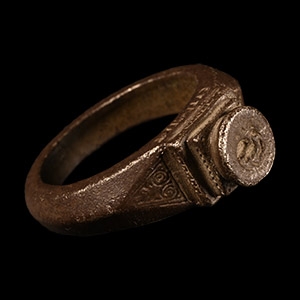
Roman Silver Ring with Inscription to the Sides
1st-4th century A.D.Sold for (Inc. bp): £169
With a keeled hoop having a Greek inscription to both sides beneath the bezel; expanding shoulders with triangular panels engraved with palmettes; tiered bezel, the lower level with incised Greek key design to the short edges, the second level with a zig-zag pattern around the perimeter, the round top part with an incised bird motif. 10.38 grams, 27.41 mm overall, 17.36 mm internal diameter (approximate size British N, USA 6 1/2, Europe 13.72, Japan 13)
Ex London art market, 1990s. -
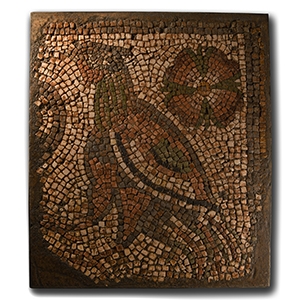
Eastern Roman Mosaic Depicting a Bird
4th-6th century A.D.Sold for (Inc. bp): £2,860
In a rectangular matrix; cream, olive, pink and other tesserae depicting a perching bird with rosette above. 15.4 kg, 43.5 x 50.4 cm
Former collection of Mr Pierre Bart (1889-1964), official of the French mandate in Syria and Lebanon (1919-1936) and delegate to the Lebanese government until 1946. Transmitted by descent.
