
Loading, please wait...
_900x900.jpg "Roman Key with Chain")
_200x200.jpg "Roman Key with Chain")
.jpg "Roman Key with Chain")
LOT 0753
Roman Key with Chain
2ND-3RD CENTURY A.D.
8 5/8 in. (18.8 grams, 22 cm).
A key composed of a D-section handle and integral loop, decorated with hatched geometric motifs, notched rectangular-section stem and rectangular bit with six teeth; chain composed of nine links. [No Reserve]
ProvenanceAcquired Munich, Germany, late 1990s.
Property of an East London gentleman.
TimeLine Auctions follows a vetting process to ensure the authenticity and legality of all items, reinforcing our commitment to integrity and responsible trading. Each antiquity, antique, and coin lot undergoes thorough examination by a vetting committee of at least ten external specialists, professional trade association members, scientists, and archaeologists: Our Vetting Process
AUCTIONS:
TimeLine is a leading auction house specialising in antiquities, ancient art, collectables, natural history, coins, medals, and books. Our auctions offer museums, collectors, historians, and enthusiasts the opportunity to acquire unique and historically significant pieces.
-
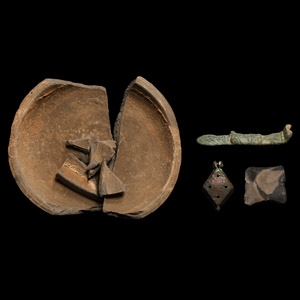
Roman and Other Artefact Group
Circa 1st century A.D. and laterSold for (Inc. bp): £5
A mixed group of artefacts comprising: fragments of a ceramic bowl; a Roman seal-box base; a zoomorphic footplate from an Anglian cruciform brooch; a gun flint. 126 grams total, 24-87 mm
Essex gallery, early 2000s. -
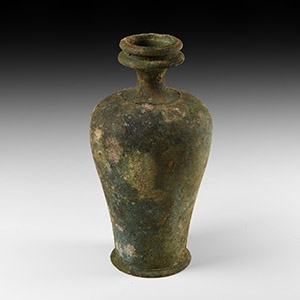
Roman Balsamarium with Spool-Type Mouth
1st-2nd century A.D.Sold for (Inc. bp): £845
A piriform bronze balsamarium with a broad rounded shoulder, slender waisted neck and squat, spool-type mouth. 207 grams, 12 cm high
From the collection of the late Dr D.G., Surrey, UK.
Such vessels, with their high-bellied body, are similar to examples from Palestine, Pompeii, Phocis, Brigetio and Salona. They are not fitted with handles, meaning that they were not part of a portable set. -
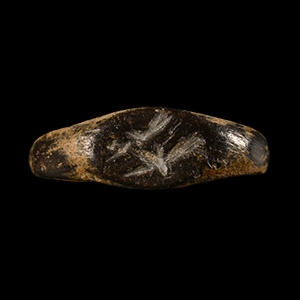
Roman Ring with Engraved Bezel
2nd-3rd century A.D.Sold for (Inc. bp): £33
A bronze ring with D-section hoop, lentoid bezel engraved with a running hare. 1.48 grams, 20.32 mm overall, 17.70 mm internal diameter (approximate size British K 1/2, USA 5 1/2, Europe 10.58, Japan 10)
Acquired in the 1970s. Important European collection.
The libidinous hare was sacred to Aphrodite and Eros (Venus and Cupid), and live hares were often presented as love gifts.
