
Loading, please wait...
_900x900.jpg "Roman Jupiter Holding Victory Gemstone in Gold Ring")
_200x200.jpg "Roman Jupiter Holding Victory Gemstone in Gold Ring")
.jpg "Roman Jupiter Holding Victory Gemstone in Gold Ring")
LOT 0089
Roman Jupiter Holding Victory Gemstone in Gold Ring
2ND CENTURY A.D.
1 in. (4.05 grams, 24.06 mm overall, 18.78 mm internal diameter (approximate size British R 1/2, USA 8 3/4, Europe 19.38, Japan 18)).
An onyx cabochon with intaglio image of Jupiter holding a miniature icon of Victory, set into a later gold ring.
ProvenanceEnglish private collection.
CONDITIONTimeLine Auctions follows a vetting process to ensure the authenticity and legality of all items, reinforcing our commitment to integrity and responsible trading. Each antiquity, antique, and coin lot undergoes thorough examination by a vetting committee of at least ten external specialists, professional trade association members, scientists, and archaeologists: Our Vetting Process
AUCTIONS:
TimeLine is a leading auction house specialising in antiquities, ancient art, collectables, natural history, coins, medals, and books. Our auctions offer museums, collectors, historians, and enthusiasts the opportunity to acquire unique and historically significant pieces.
-
.jpg)
Roman Opaque White Glass Vessel
1st-2nd century A.D.Estimate: £450 - 650 (+bp*)
Opening Bid: £250
An opaque white glass cup or other vessel with trumpet-style neck and rim, slightly convex body and everted foot. 32.5 grams, 65 mm wide
Fine condition, repaired.
Acquired 1969-1999. London collection of the late Mr S.M., thence by descent. -
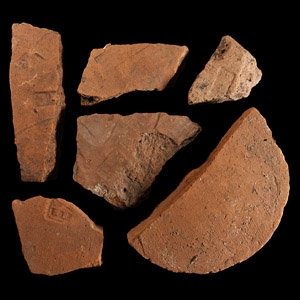
Roman Tile Fragment Group with Military Stamps
1st-4th century A.D.Sold for (Inc. bp): £59
A group of six ceramic tile fragments, each bearing a stamp. 3.3 kg total, 10.5-22.2 cm
Previously in a private collection since the 1990s. Property of a Sussex, UK, teacher. -
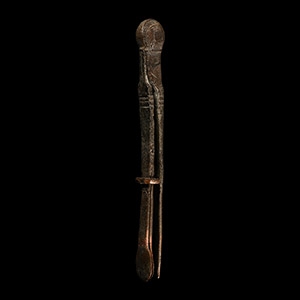
Roman Military Compass and Tweezers Multi-Tool
Circa late 2nd-4th century A.D.Sold for (Inc. bp): £260
A bronze multi-tool featuring a compass and tweezers, free-moving collar to one arm, one arm with two oval terminals and one tapering to a point. 19 grams, 90 mm
Acquired before 2000. From the collection of a European gentleman living in the UK.
This instrument, a type of circinus formed of two flat-section arms, was widely used by masons and carpenters, as well as for making wall decorations for the preparation of repetitive elements such as spirals or circles. It was widely used by the agrimensores of the army, as is proven by a very similar specimen found in Carnuntum, the camp of the Legio XIIII Gemina.
