
Loading, please wait...
_900x900.jpg "Roman Julius Caesar Sling Shot from the Battle of Munda")
_200x200.jpg "Roman Julius Caesar Sling Shot from the Battle of Munda")
.jpg "Roman Julius Caesar Sling Shot from the Battle of Munda")
LOT 0234
Roman Julius Caesar Sling Shot from the Battle of Munda
45 B.C.
1 3/8 in. (62.67 grams, 37 mm).
A biconical facetted lentoid-section lead sling shot (glans), the inscription monogram a combination of letters 'C', 'A' and 'E', for 'C A E S' referring to Julius Caesar.
ProvenanceFound near to an important village site, close to Seville, 1960-1970.
From an old Spanish collection.
Swiss private collection.
Accompanied by a copy of the Spanish export licence.
Accompanied by an academic paper by military specialist Dr Raffaele D'Amato, dated 4th May 2022 and titled 'Roman Res Publica - Lead Slingshots (glandes) of Caesarian Age - 45 B.C circa'.
Cf. D'Amato, R. and Sumner, G., Arms and Armour of the Imperial Roman Soldier: From Marius to Commodus, 112 BC-AD 192, London, 2009, fig.32, p.45, for similar glandes from Zaragoza Museum, one with the name of Pompey inscribed also coming from Munda battlefield; Schinco, G., Small, A.M., 'A previously unknown siege of Botromagno/Silvium: the evidence of slingshots from Gravina in Puglia (Provincia di Bari, Puglia)' in Papers of the British School at Rome, 2019, pp.1-52, figs.31, 37.
FootnotesThe shot (type IIb of the Völling classification) is marked with the abbreviated name of Julius Caesar; it was used in quantity at the Battle of Monda (or Munda) against the last fellows of Pompey, the leaders of the Optimates, on the 17th March 45 BC. Similar shots were used in the civil war among Pompey and Caesar, and in all of Caesar's wars. The funditores of Caesar's age were part of the light infantry. Caesar speaks of his Balearic slingers during the conquest of Gaul. They wore a short tunic, with leather or rope sandals to the feet, and a warm overcoat which could also have been used to store projectiles. They also used a satchel to carry very deadly lead-like stones or bullets.
CONDITIONTimeLine Auctions follows a vetting process to ensure the authenticity and legality of all items, reinforcing our commitment to integrity and responsible trading. Each antiquity, antique, and coin lot undergoes thorough examination by a vetting committee of at least ten external specialists, professional trade association members, scientists, and archaeologists: Our Vetting Process
AUCTIONS:
TimeLine is a leading auction house specialising in antiquities, ancient art, collectables, natural history, coins, medals, and books. Our auctions offer museums, collectors, historians, and enthusiasts the opportunity to acquire unique and historically significant pieces.
LOT 0234
Roman Julius Caesar Sling Shot from the Battle of Munda
Sold for (Inc. bp): £715
-
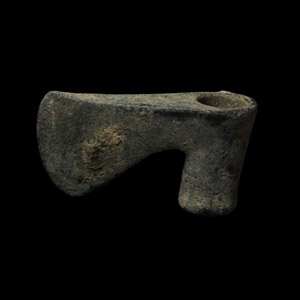
Luristan Socketted Axehead
13th-7th century B.C.Sold for (Inc. bp): £89
A small, heavy socketted bronze axehead with convex cutting edge. 243 grams, 86 mm
Fine condition.
English collection formed in the 1990s. UK art market. Property of an Essex gentleman.
Unadorned weapons, especially axes, adzes and picks, were made by Luristan craftsmen using simple clay or stone bivalve moulds, into which was inserted a core to form the socket for the shaft. Typically, the metallic composition consisted of a combination of arsenical bronze and copper, together with a small percentage of lead. -
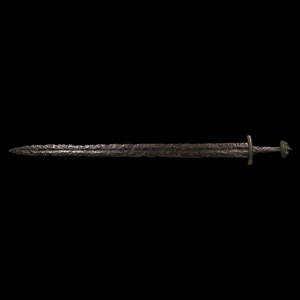
Viking Age Sword with Five-Lobed Pommel
10th century A.D.Sold for (Inc. bp): £12,350
A double-edged sword of Petersen Type L or S variant with straight tapering blade, light traces of pattern-welding and battle-nicks along the blade, tapering fullers and a sturdy long tang; boat-shaped lower guard curving gently towards the blade, decorated with punched ring-and-dot ornament along the edges; the upper guard with Trewhiddle Style ornament, surmounted by an elegant five-lobed pommel decorated with geometric patterns in the same style; cleaned and conserved. 755 grams, 89 cm
Acquired 1971-1972. From the collection of the vendor's father. Property of a London, UK, collector. Accompanied by an academic report by Dr Raffaele D’Amato. This lot has been checked against the Interpol Database of stolen works of art and is accompanied by searcher certificate no.11574-198855. -
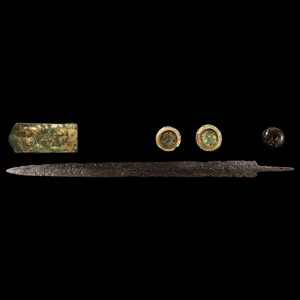
Migration Period Spatha Sword Blade with Fittings
Circa 4th-5th century A.D.Sold for (Inc. bp): £1,950
A military assemblage comprising: a double-edged spatha with a lentoid parallel-sided iron blade and pointed tip, battle nicks to both cutting edges; long tang with a bronze fastening rivet in situ; oblate chalcedony pommel; gilt copper-alloy chape scabbard fitting with fastening holes and a pair of round scabbard or baldric fittings. 937 grams total, 5-81.3 cm
Fine condition
Acquired 1971-1972. From the collection of the vendor's father. Property of a London, UK, collector. Accompanied by an academic report by Dr Raffaele D’Amato. This lot has been checked against the Interpol Database of stolen works of art and is accompanied by a search certificate number no.11587-198852.
Prestigious swords with richly trimmed sheaths, guards and hilts of the Great Migration Period on the Cimmerian Bosphorus are very few, although some specimens have been excavated from Kerch, Phanagoria, Hermonassa and Dzhurga-Oba. They were either custom-made or received as war booty. This sword belongs to a group of spathae of late Roman typology spread among the Germanic and Nomad foederati, and garrison troops of the Northern Black Sea and Bosphorus.
