
Loading, please wait...
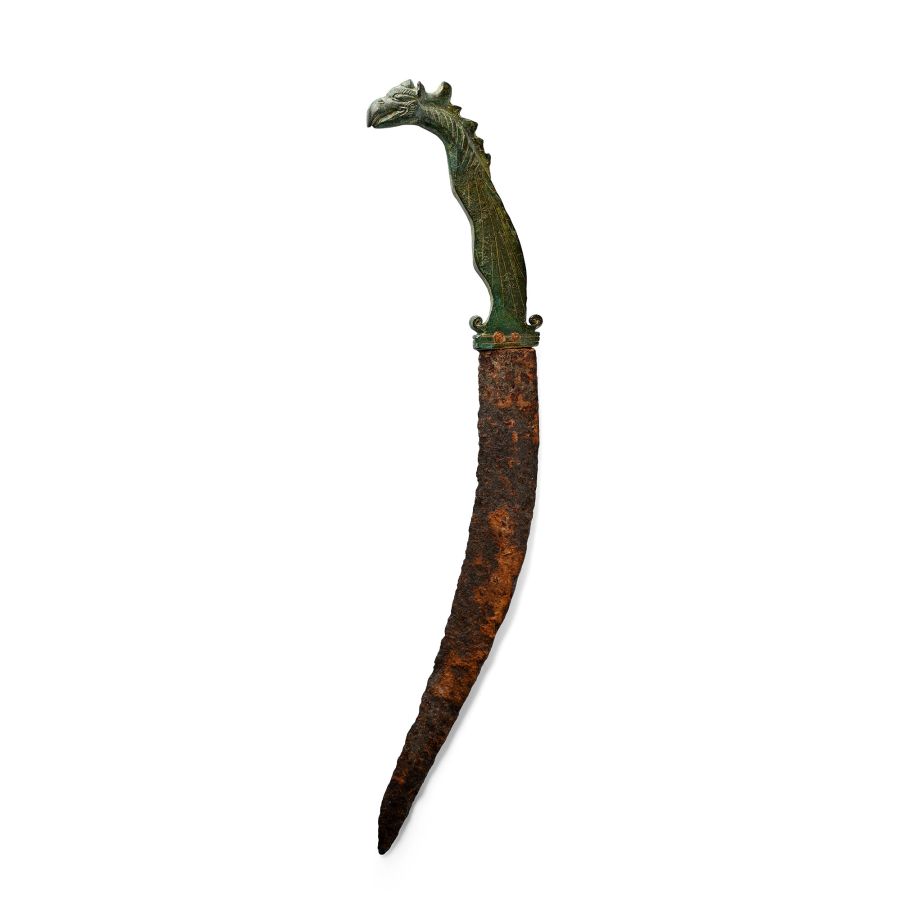
_900x900.jpg "Roman Iron Sickle-Dagger with Bronze Handle")
_200x200.jpg "Roman Iron Sickle-Dagger with Bronze Handle")
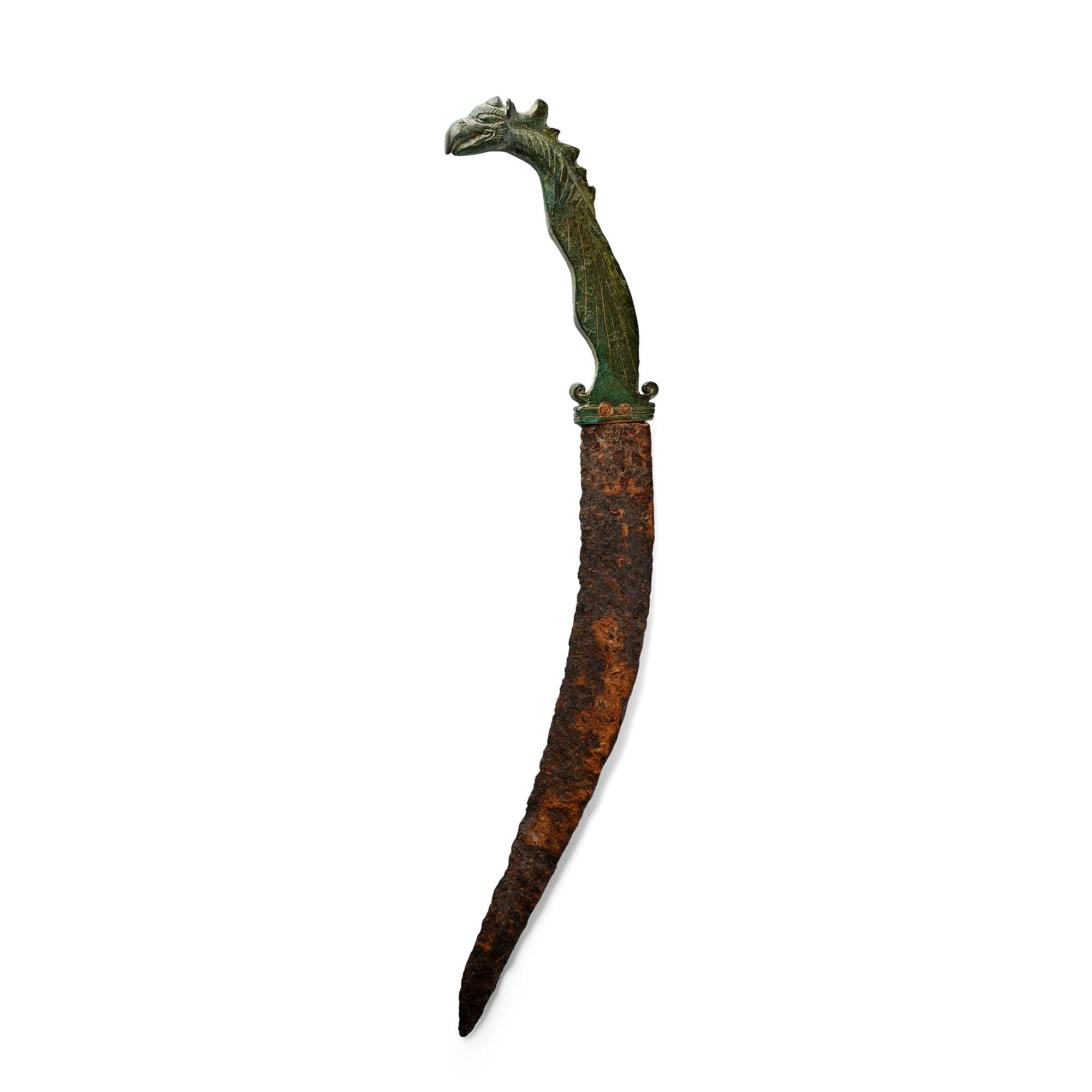
.jpg "Roman Iron Sickle-Dagger with Bronze Handle")
LOT 0715
Roman Iron Sickle-Dagger with Bronze Handle
1ST-2ND CENTURY A.D.
12 5/8 in. (210 grams, 32 cm).
Comprising: a curved blade with single cutting edge to the inside of the curve (Latin sica); bronze transverse bolster pierced to accept two mounting rivets for the blade; curved grip with lateral scrolls at the base, undulating inner face, pommel formed as the head of a gryphon with beak and raised lentoid eyes.
ProvenanceEx German art market, 2000s.
Acquired from an EU collector living in London.
From the collection of a Surrey, UK, gentleman.
This lot is accompanied by an illustrated lot declaration signed by the Head of the Antiquities Department, Dr Raffaele D'Amato.
See Aurel Rustoiu, Thracian sica and Dacian falx. The history of a "national" weapon in Dacia Felix. Studia Michaeli Barbulescu Oblata, Cluj, 2007.
CONDITIONTimeLine Auctions follows a vetting process to ensure the authenticity and legality of all items, reinforcing our commitment to integrity and responsible trading. Each antiquity, antique, and coin lot undergoes thorough examination by a vetting committee of at least ten external specialists, professional trade association members, scientists, and archaeologists: Our Vetting Process
AUCTIONS:
TimeLine is a leading auction house specialising in antiquities, ancient art, collectables, natural history, coins, medals, and books. Our auctions offer museums, collectors, historians, and enthusiasts the opportunity to acquire unique and historically significant pieces.
-
.jpg)
Roman Iron Key with Bronze Lion Handle
2nd-3rd century A.D.Sold for (Inc. bp): £715
Formed as a lion extending from an acanthus leaf column capital, with forepaws outstretched and the head of a ram in its mouth; detailing to the full mane, ears, head and muzzle; ferrous shank with perpendicular wards. 116 grams, 12.5 cm
Ex German art market, 2000s. Acquired from an EU collector living in London. From the collection of a Surrey, UK, gentleman. This lot is accompanied by an illustrated lot declaration signed by the Head of the Antiquities Department, Dr Raffaele D'Amato. -
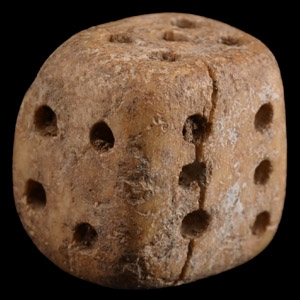
Roman Bone Gaming Die
1st-4th century A.D.Sold for (Inc. bp): £117
Irregular sub-cuboid in form with drilled spots disposed 1:6, 2:5, 3:4; cracked. 3.2 grams, 15 mm
Louis-Gabriel Bellon (1819–1899), Paris. Anonymous sale, France, 2009. Private European collection, acquired at the above sale. This lot is accompanied by an illustrated lot declaration signed by the Head of the Antiquities Department, Dr Raffaele D'Amato. -
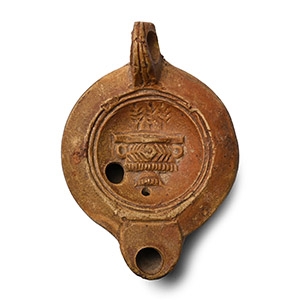
Roman Terracotta Oil Lamp with Amphora
2nd century A.D.Sold for (Inc. bp): £338
Squat in profile with small loop handle and D-shaped nozzle, discus with low-relief vessel and foliage; maker's mark to underside 'MNOVIVST'. 56 grams, 97 mm
From the private collection of a Canadian gentleman living in Essex, UK, formed since the 1920s-circa 1990. Property of an Essex lady until the late 1990s; thence by descent. From the private collection of an Essex gentleman since the late 1990s. This lot is accompanied by an illustrated lot declaration signed by the Head of the Antiquities Department, Dr Raffaele D'Amato.
The lamp belongs to the Bussière type, form D I 3, from a period between the Late Flavian era to the second half of the second century A.D. Like the types of this category, the ring handle shows two grooves on the upper part and the filling hole is in the lower part.
