
Loading, please wait...
LOT 1020
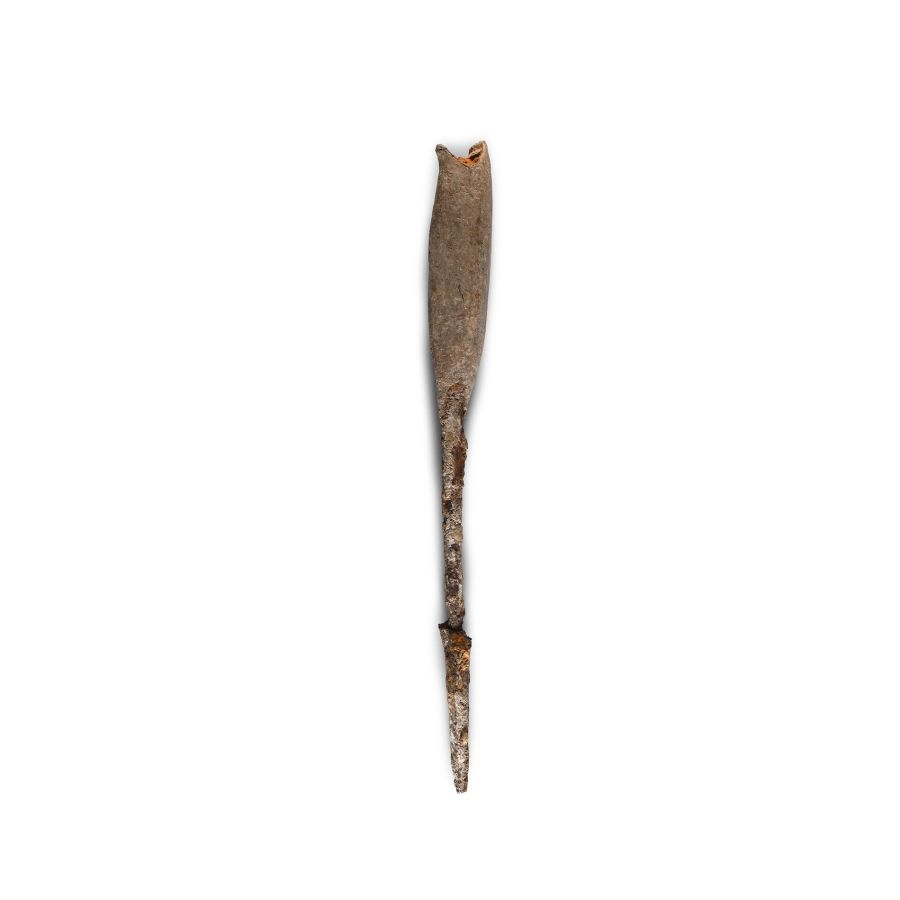
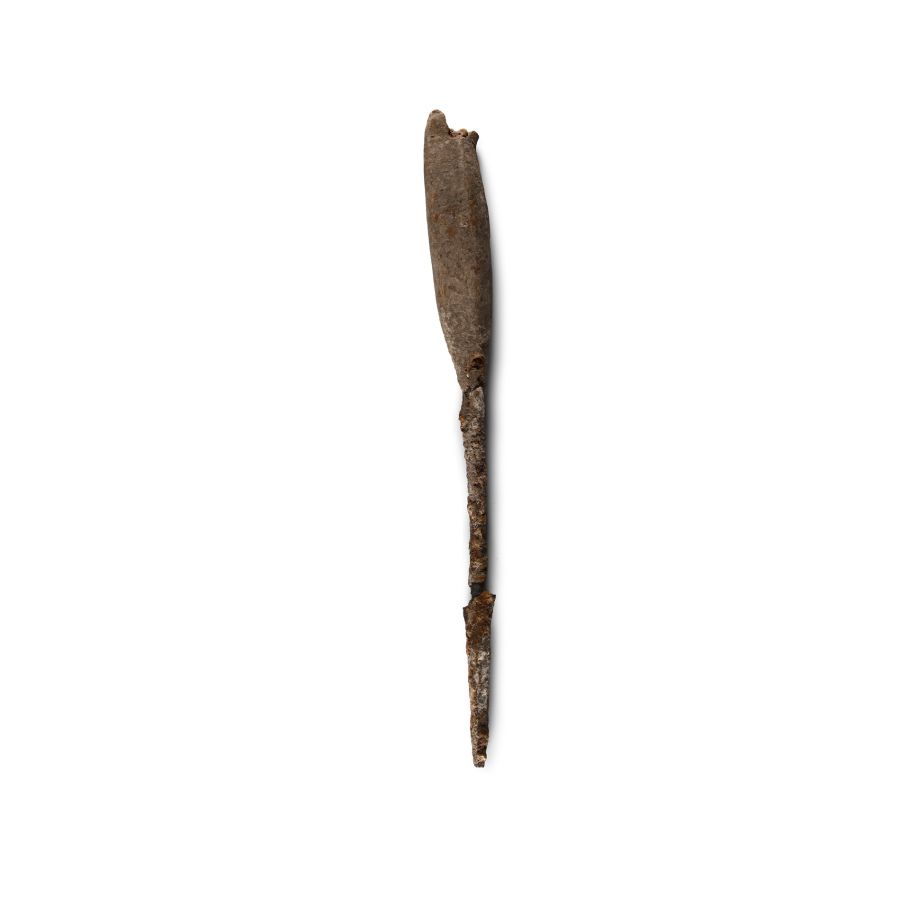
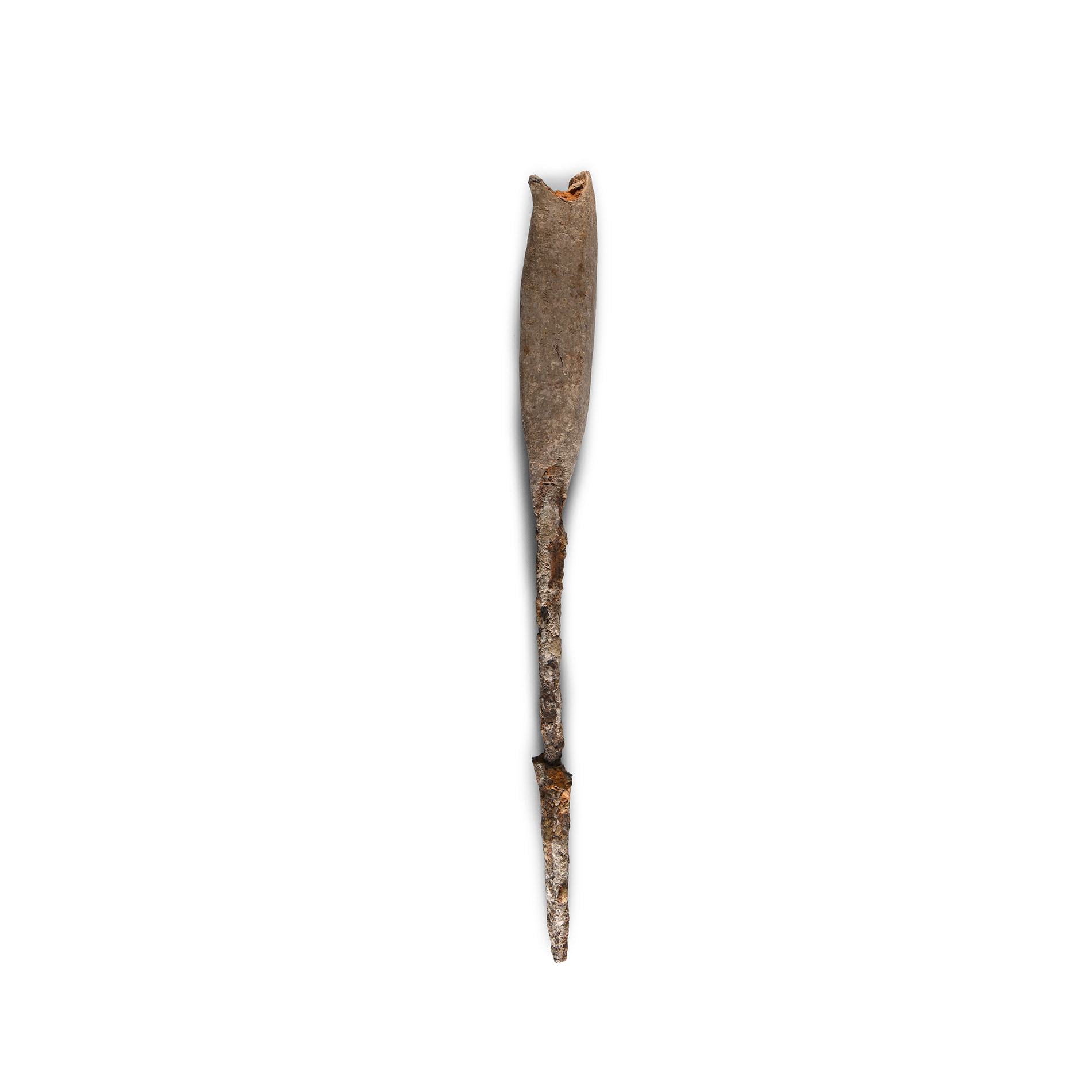
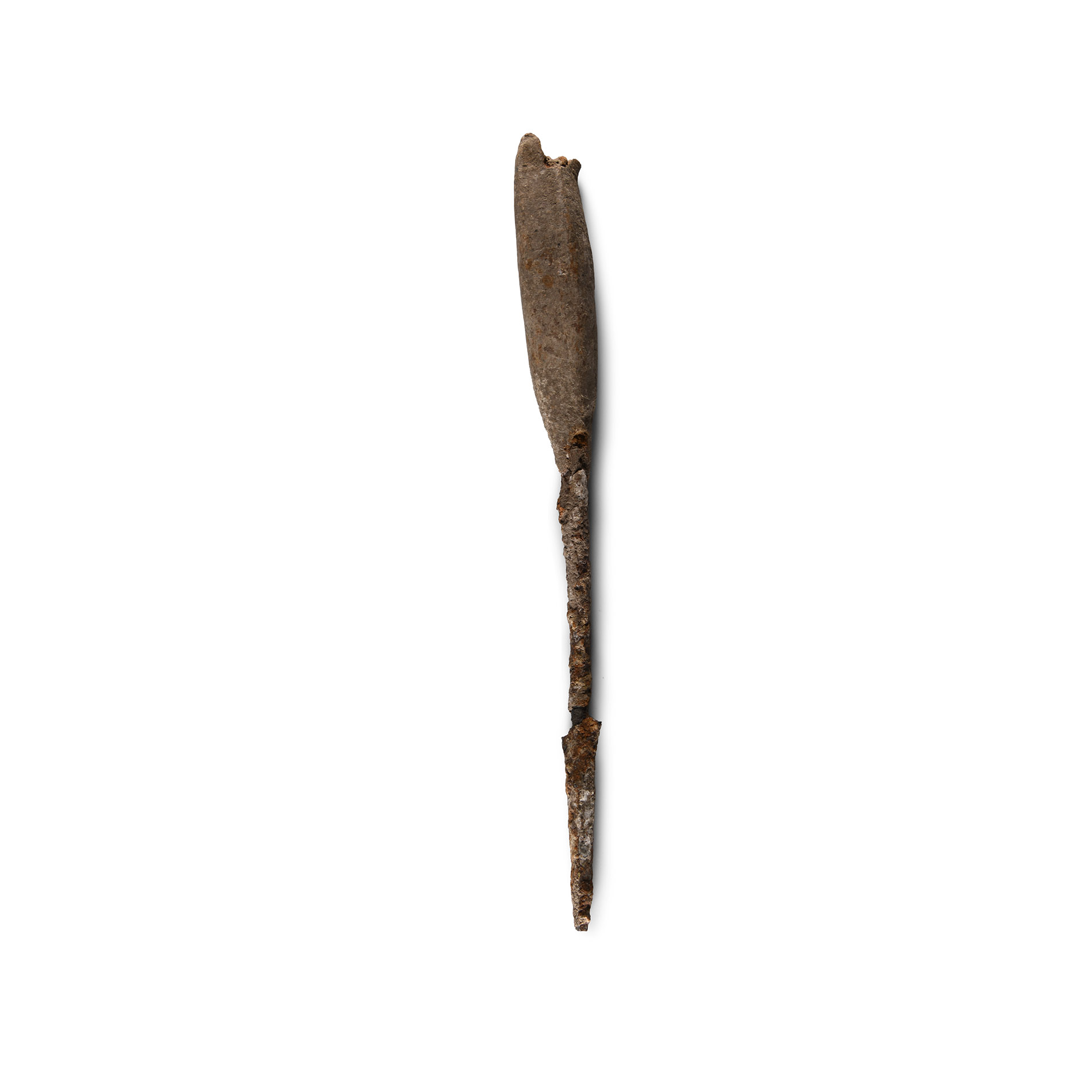
Roman Iron Military Plumbata Head
4TH-5TH CENTURY A.D.
7 1/2 in. (116 grams, 19 cm).
Missile weapon with short iron shaft and square-section barbed head, lead sleeve to the lower end of the shaft. [No Reserve]
ProvenanceFrom the collection of B. Posey, UK, 1990s.
LiteratureCf. Southern, P. & Dixon, K.R., The Late Roman Army, London, 1996, fig.46, pp.113-115; See Barker, P., The plumbatae from Wroxeter, in Hassall and Ireland, De Rebus Bellicis, BAR Int. Ser., vol. 63, Oxford, 1979.
FootnotesThe lead-weighted darts known as plumbatae mamillatae, (or breasted javelin) were short darts mounted upon a shaft, of the same shape, and thrown from a short distance. A Roman soldier would typically carry around 5-6 of these darts at any one time, fastened to the back of his shield. They could be thrown overhand or underhand, with an effective throwing range of up to 60 meters by trained soldiers. They could also be fixed upon longer shafts.
CONDITIONTimeLine Auctions follows a vetting process to ensure the authenticity and legality of all items, reinforcing our commitment to integrity and responsible trading. Each antiquity, antique, and coin lot undergoes thorough examination by a vetting committee of at least ten external specialists, professional trade association members, scientists, and archaeologists: Our Vetting Process
AUCTIONS:
TimeLine is a leading auction house specialising in antiquities, ancient art, collectables, natural history, coins, medals, and books. Our auctions offer museums, collectors, historians, and enthusiasts the opportunity to acquire unique and historically significant pieces.
-
Roman Iron Gladius
1st-2nd century A.D.Sold for (Inc. bp): £1,300
Or semi-spatha blade with parallel-sided lentoid-section body and a long rectangular-section tang; Mainz type, Wederath-Canterbury-Kopki variant; repaired and surface treated. 557 grams, 83 cm
Ex South London collection, acquired 1970-1990. The Kusmirek Collection, UK. Accompanied by an academic report by Dr Raffaele D'Amato.
In contrast to the average length of the Roman Pompeii type gladius, some Roman swords, continuing the typology of the Mainz gladius, tend to be longer and transform themselves into a semi-spatha. Both the weapon from Eich (Miks, 2001, AI43), and especially a gladius from Korytnica with approximate blade length of 548mm (total length 762mm) is very close to the length limit of a semi-spatha. The same can be said of a blade from Godmanchester (Miks, 2001, no.A824) for its dimensions and proportions, where the tip of the blade already gives a significantly shorter impression, showing a certain relationship to 'Lauriacum-Hrornöwka', 'Mainz-Canterbury' variant type spathae. -
Greek Fragmentary Bronze Pilos Helmet
5th-4th century B.C.Sold for (Inc. bp): £2,015
Conical in shape, comprising a thick hammered bowl and broad rim with carination to the upper edge; remains of crest at brow and rear; a restoration project. 951 grams total, 1-24.5 cm
Ex Axel Guttmann Collection of Ancient Arms and Armour, Germany [1944-2001]. with Hermann Historica, 13 October 2010, lot 2169 [Part].
This type of helmet (called ‘bell-helmet’ by Connolly, 1981, p.70), named pilos after the Greek felt cap (in the Laconian shape, but distinguished from the cap by the noticeable point and the shape of the rim), had a conical shape and was pointed or rounded at the top. Its introduction was linked with the streamlining of Hoplite equipment, and it soon the replaced the closed Corinthian helmet. The helmet was widespread in the Greek and Mediterranean world from the last quarter of the 5th century B.C. and was widely used by continental Greeks, South Italian Greeks and Italic people, Etruscans, and even Romans. -
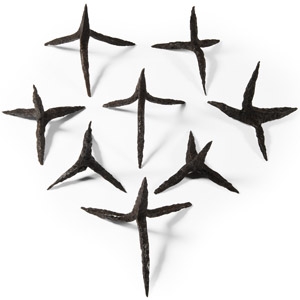
Medieval Iron Anti-Cavalry Caltrop Group
13th-15th century A.D.Sold for (Inc. bp): £221
Comprising eight caltrops, hand-forged with square-section spikes. 398 grams total, 76-95 mm
From the private collection of a London gentleman, from his grandfather's collection formed before the early 1970s.
