
Loading, please wait...
LOT 0849
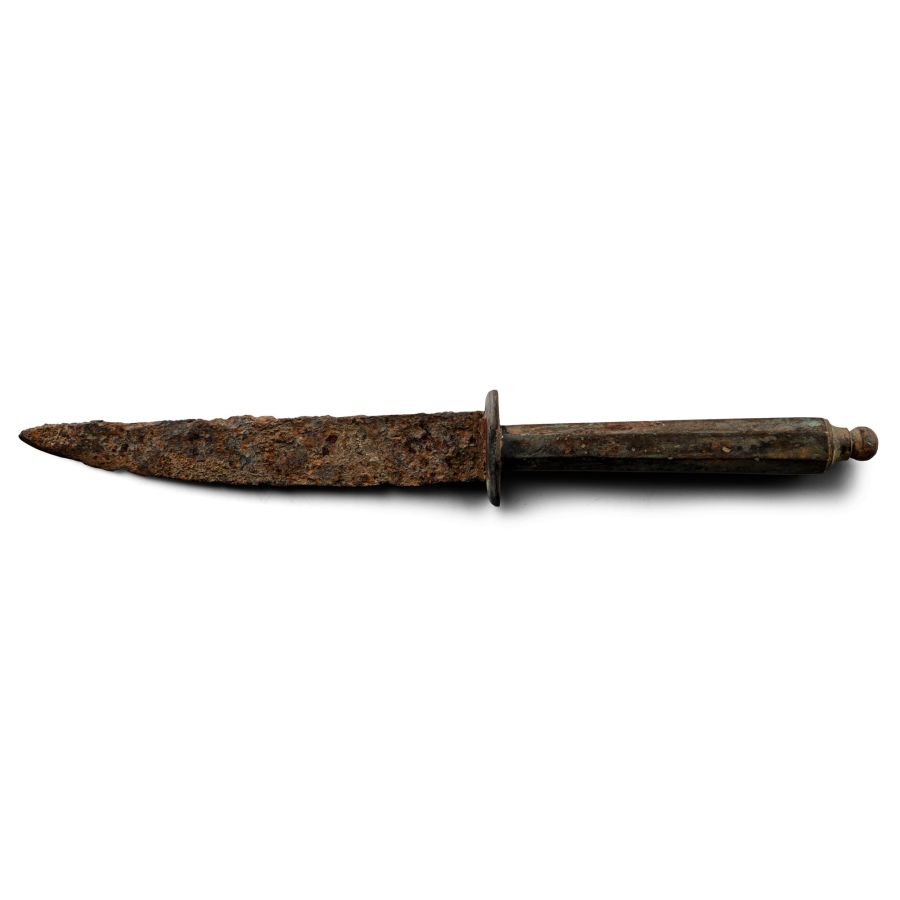
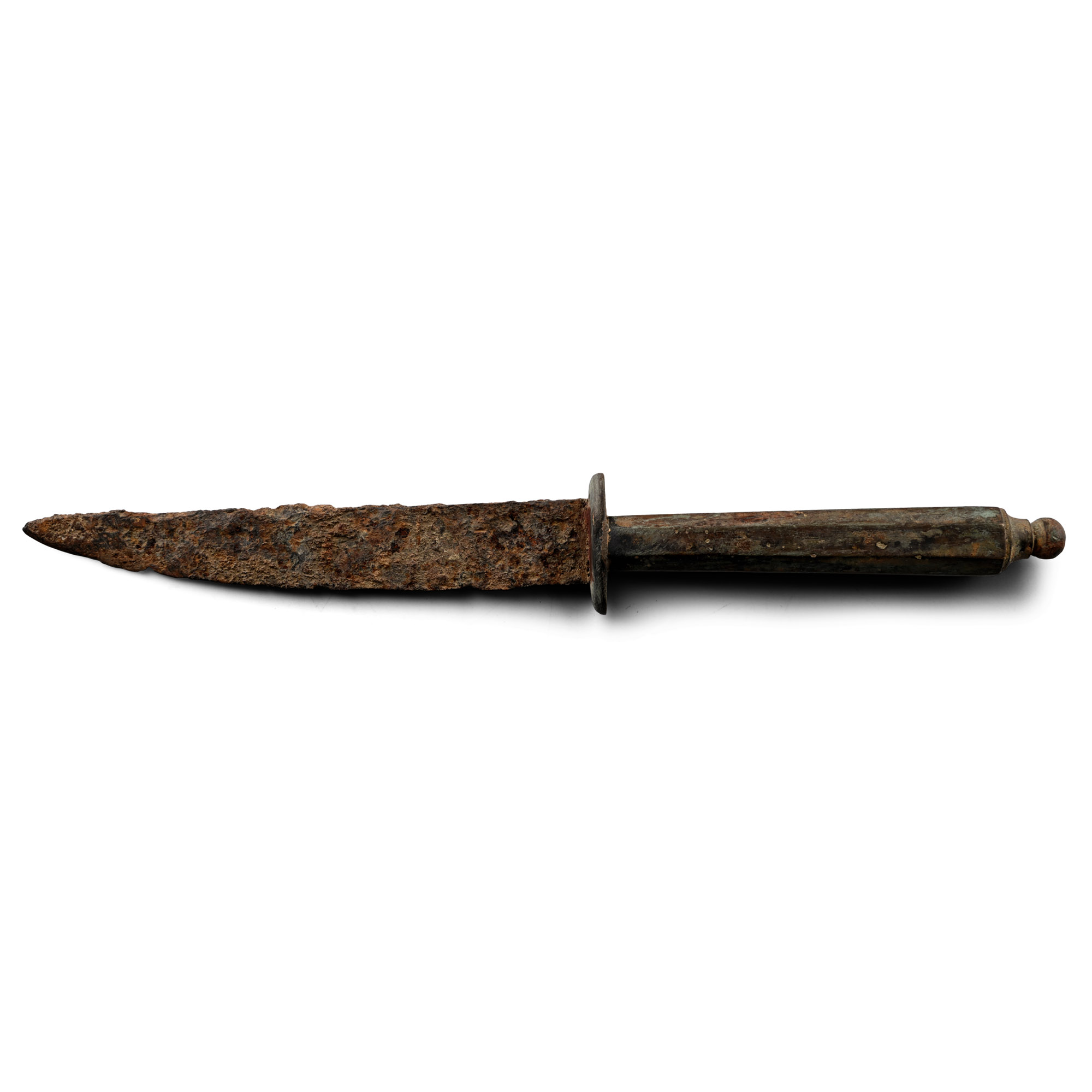
Roman Iron Knife with Bronze Handle
4TH-5TH CENTURY A.D.
8 3/8 in. (138 grams, 21.2 cm).
Single-edged ferrous blade with scooped tip, ellipsoid bolster, fluted grip with scooped finial surmounted by a spherical knop.
ProvenanceEx German art market, 2000s.
Acquired from an EU collector living in London.
From the collection of a Surrey, UK, gentleman.
This lot is accompanied by an illustrated lot declaration signed by the Head of the Antiquities Department, Dr Raffaele D'Amato.
TimeLine Auctions follows a vetting process to ensure the authenticity and legality of all items, reinforcing our commitment to integrity and responsible trading. Each antiquity, antique, and coin lot undergoes thorough examination by a vetting committee of at least ten external specialists, professional trade association members, scientists, and archaeologists: Our Vetting Process
AUCTIONS:
TimeLine is a leading auction house specialising in antiquities, ancient art, collectables, natural history, coins, medals, and books. Our auctions offer museums, collectors, historians, and enthusiasts the opportunity to acquire unique and historically significant pieces.
-
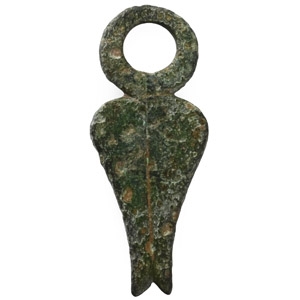
Romano-British Bronze Cosmetic Nail Cleaner
43-410 A.D.Sold for (Inc. bp): £39
Flat teardrop-shaped with round loop to the top, narrow bifurcated tip. 2.66 grams, 37 mm
Found near Bainton, East Riding of Yorkshire, UK, on Monday 23rd August 2021. Accompanied by a copy of the British Museum's Portable Antiquities Scheme (PAS) report no.NLM-7712AE. This lot is accompanied by an illustrated lot declaration signed by the Head of the Antiquities Department, Dr Raffaele D'Amato. -
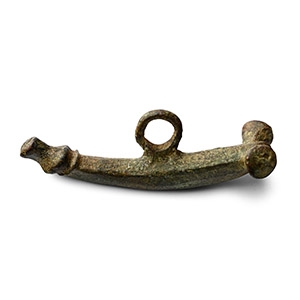
Roman Bronze Phallic Pendant
1st-4th century A.D.Sold for (Inc. bp): £124
Modelled as an elongated phallus with lateral testis and ridged glans, integral suspension loop above. 10.7 grams, 45 mm
Acquired on the UK art market during the late 20th century. From the private collection of David King (1940-2024), Hoddesdon, Hertfordshire, UK. This lot is accompanied by an illustrated lot declaration signed by the Head of the Antiquities Department, Dr Raffaele D'Amato. -
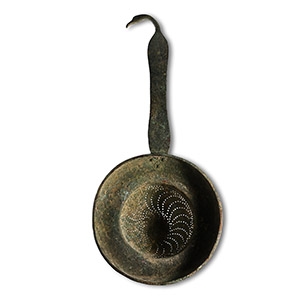
Roman Bronze Swan-Headed Wine Strainer
1st-3rd century A.D.Estimate: £2,500 - 3,500 (‡+bp*)
Opening Bid: £1,389
Cup-shaped body with flared and curved rim, flat-section handle with swan-head finial; the body with pierced rosette pattern. 159 grams, 27.4 cm
Acquired in the mid 1980s-1990s. Private collection, Switzerland, thence by descent. Private collection, since the late 1990s. This lot has been checked against the Interpol Database of stolen works of art and is accompanied by search certificate number no.12233-222331. This lot has been cleared against the Art Loss Register database, and is accompanied by an illustrated lot declaration signed by the Head of the Antiquities Department, Dr Raffaele D'Amato.
