
Loading, please wait...
LOT 0556
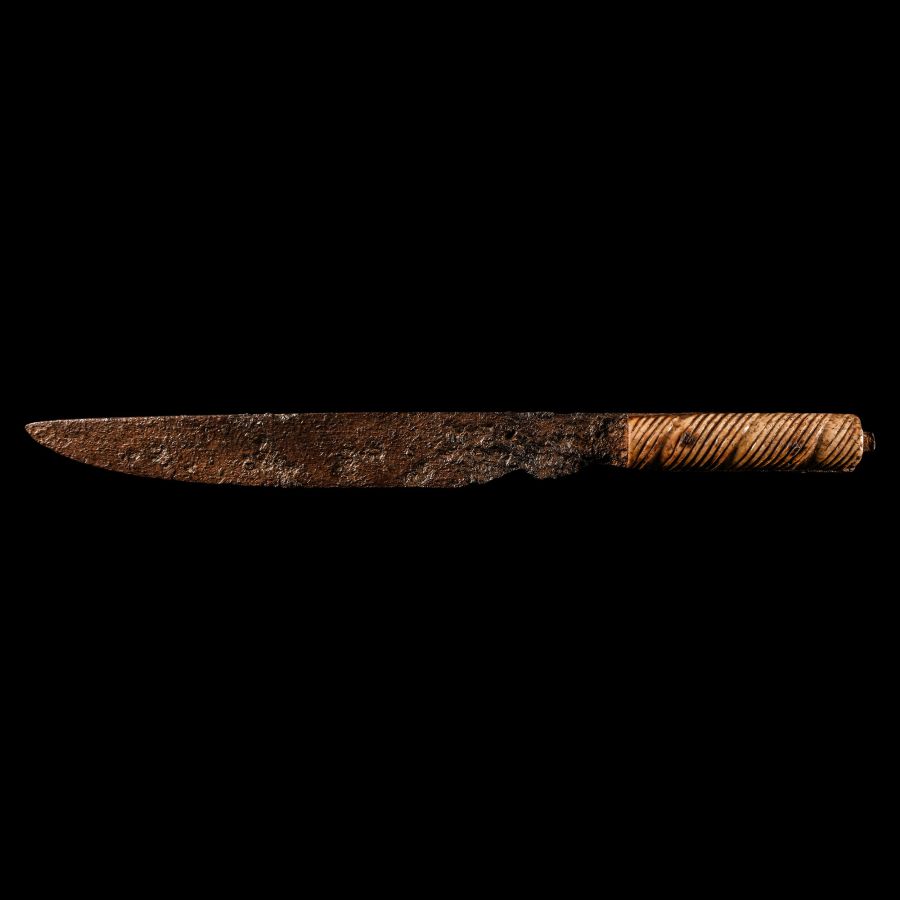
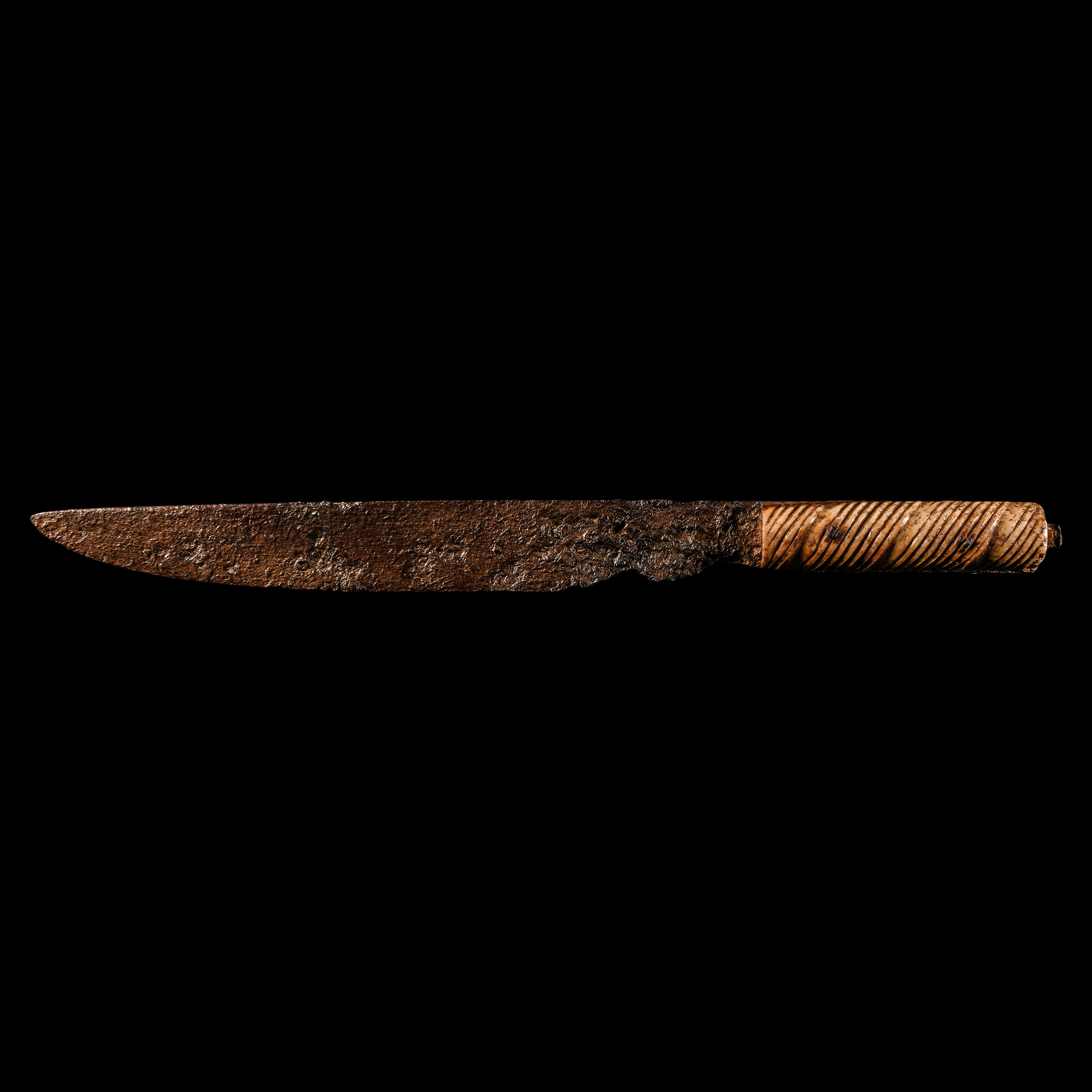
Roman Iron Knife with Bone Handle
1ST-4TH CENTURY A.D.
6 7/8 in. (38.1 grams, 17.5 cm).
With single-edged blade gently curving towards the tip; applied bone handle with diagonally striated banding. [No Reserve]
ProvenanceFound near Wetwang, East Yorkshire, UK.
Acquired from the finder in 2007.
Property of a Nottinghamshire gentleman.
Cf. Crummy, N., Greep, S., Hassall, M., Henig, M., Major, H., Webster, G., Wild, J.P., Colchester Archaeological Report 2: the Roman small finds from excavations in Colchester 1971-1979, Colchester, 1983, nos.2935 (handle) and 2974 (knife).
FootnotesTools which cannot be assigned to one of the more specific categories, such as agricultural or military equipment especially knife blades, tool handles, and hones. Three methods of attaching a handle to the tang of a knife or tool are distinguishable in the Roman culter. Rivetting was used on two-piece handles (like in our specimen). Driving the tang into the marrow-cavity of the bone, which was usually packed with wood-shavings, so that the irregularities of cancellous tissue and the wood-shavings prevented the tang from twisting or slipping out (often a collar was also used with this method). Lastly, the tang could be fixed to the handle by means of an iron clip.
CONDITIONTimeLine Auctions follows a vetting process to ensure the authenticity and legality of all items, reinforcing our commitment to integrity and responsible trading. Each antiquity, antique, and coin lot undergoes thorough examination by a vetting committee of at least ten external specialists, professional trade association members, scientists, and archaeologists: Our Vetting Process
AUCTIONS:
TimeLine is a leading auction house specialising in antiquities, ancient art, collectables, natural history, coins, medals, and books. Our auctions offer museums, collectors, historians, and enthusiasts the opportunity to acquire unique and historically significant pieces.
-
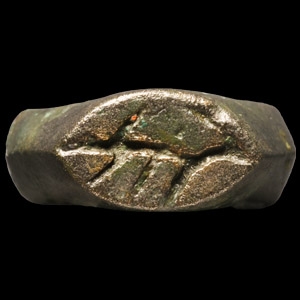
Roman Period Bronze Ring with Antelope
1st century B.C.Sold for (Inc. bp): £20
D-section hoop and tall scaphoid bezel, intaglio design of an antelope. 10.82 grams, 26.08 mm overall, 15.94 mm internal diameter (approximate size British K, USA 5 1/4, Europe 9.95, Japan 9)
Ex old English collection. London art market, pre 2000. Property of a London, UK, gentleman. -
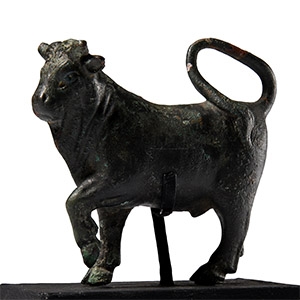
Roman Apis Bull Statuette
Circa 2nd century A.D.Sold for (Inc. bp): £624
Standing with its left foreleg raised, the head held high and turned slightly left with a full, fleshy dewlap cascading to the brisket; the tail looping over the rump, with its end adhering to the left flank; wide-open eyes and flaring nostrils; accompanied by a custom-made display stand. 106 grams, 72 mm wide (207 grams total, 91 mm high including stand)
Acquired from Charles Ede Ltd., London, UK, in 2004. From the collection of a South West London, UK, collector.
After the Roman annexation of Egypt, Egyptian cults such as that of the Apis bull were syncretised, becoming part of a distinctively Egyptian form of Roman polytheism. Representations of prancing Apis bulls, turned either left or right, have been found throughout the Roman empire. Various parallels can be found in the Cincinnati Art Museum (inv.1956.13), in Walters Art Gallery (inv.54.1565) and in the British Museum. -
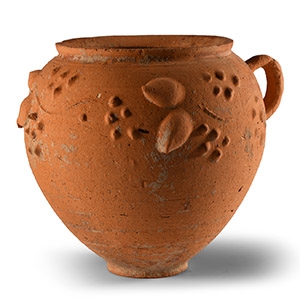
Roman Pale Red Barbotine Cup
Circa 1st century B.C.Estimate: £1,000 - 1,400 (+bp*)
Opening Bid: £500
With horizontal banding to the lower body, high-relief moulded vine and grape decoration to the shoulder, loop handle and raised rim; rare. 211 grams, 11.5 cm wide
Acquired 1980-2015. Ex Abelita family collection.
