
Loading, please wait...
LOT 1188
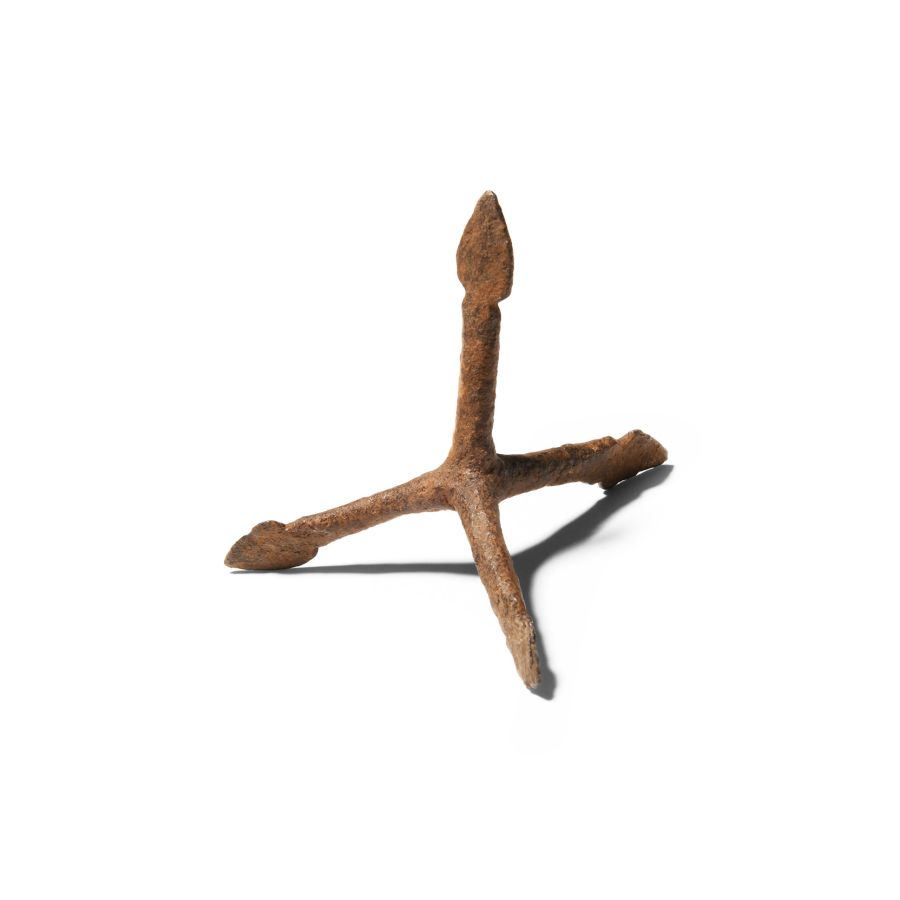
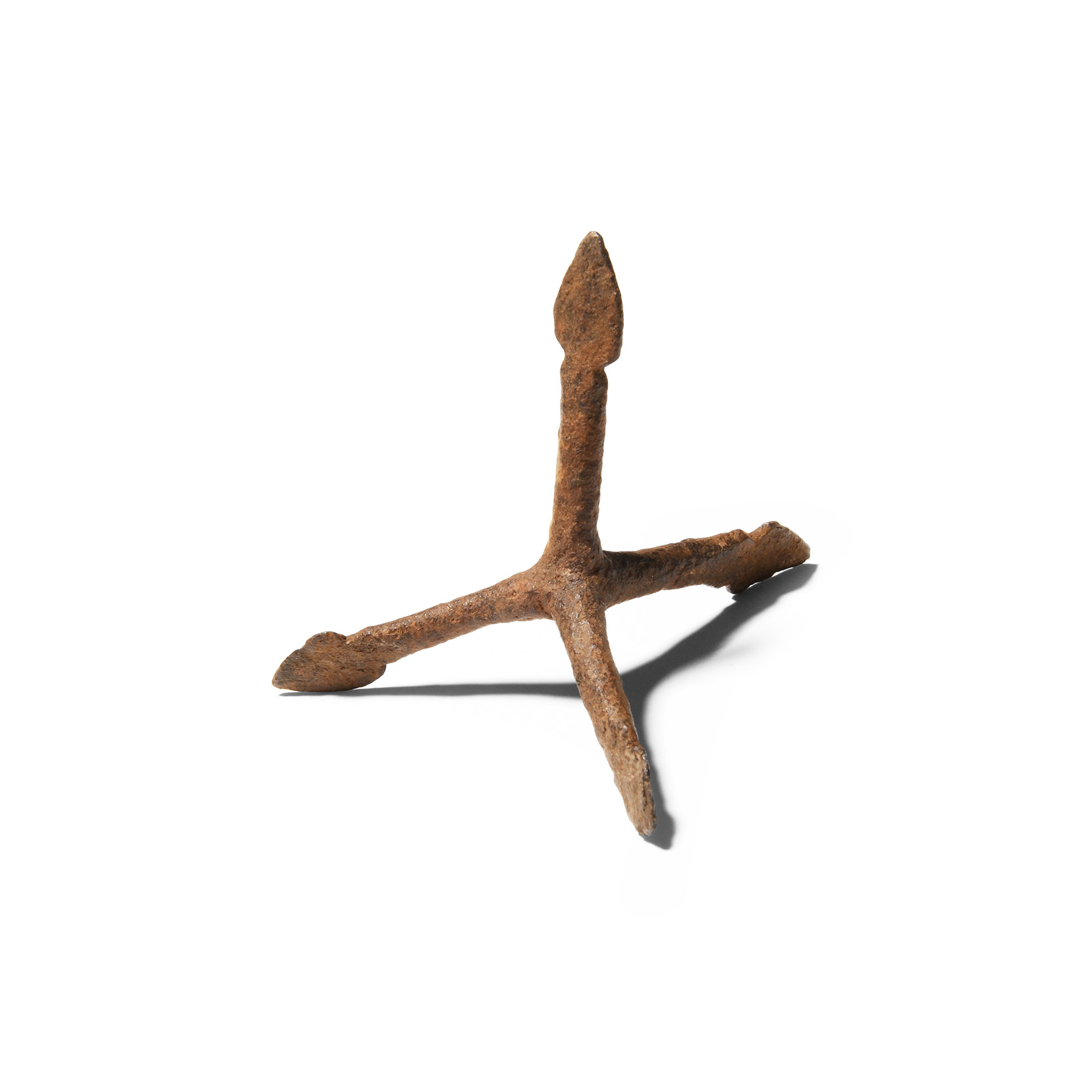
Roman Iron Anti-Cavalry Caltrop
3RD-4TH CENTURY A.D. OR LATER
2 7/8 in. (24 grams, 73 mm).
Composed of four arms tipped with triangular spikes.
ProvenanceAcquired on the German art market around 2000s.
From the collection of an EU gentleman living in the UK.
Cf. Beutler, F. et al., Der Adler Roms. Carnuntum und die Armee der Cäsaren, Bad-Deutsch-Altenburg, 2017, item 204, for type.
FootnotesCaltrops were scattered on battlefields in an effort to stop or slow advancing enemy cavalry or foot soldiers; regardless of how a caltrop lands, one spike is always facing upwards. Caesar used widely them at Alesia (Caes., BG 7.73; 82): 'Stakes a foot long, with iron hooks attached to them, were entirely sunk in the ground before these, and were planted in every place at small intervals; these they called spurs'.
CONDITIONTimeLine Auctions follows a vetting process to ensure the authenticity and legality of all items, reinforcing our commitment to integrity and responsible trading. Each antiquity, antique, and coin lot undergoes thorough examination by a vetting committee of at least ten external specialists, professional trade association members, scientists, and archaeologists: Our Vetting Process
AUCTIONS:
TimeLine is a leading auction house specialising in antiquities, ancient art, collectables, natural history, coins, medals, and books. Our auctions offer museums, collectors, historians, and enthusiasts the opportunity to acquire unique and historically significant pieces.
-
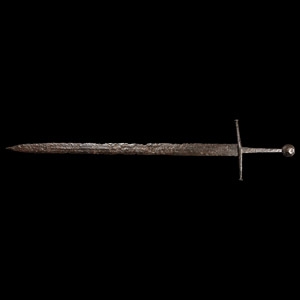
Medieval Iron Hand and Half Sword with Polyhedral Pommel
Late 14th-early 15th century A.D.Sold for (Inc. bp): £2,860
Of Oakeshott's Type XVIIIa or b, cross style 11, pommel style I1; strongly tapering pointed blade with straight edges and evident battle nicks; straight cross guard, long grip and an octagonal pommel. 1.26 kg, 1 m
From the private collection of a London gentleman, from his grandfather's collection formed before the early 1970s.
This magnificent example was well-suited to a cut-and-thrust style of fighting, a logical development of the Oakeshott XVI typology. This is mainly visible in the specimens of typology XVIIIb, typical of English effigies and brasses between 1370-1425. Because the previous types of swords were practically useless against the fully armoured man-at-arms, Western European warfare needed a sword capable of piercing the weak points of the enemy's protective equipment, leading to the development of types XV, XVI and XVII, and eventually of type XVIII. The subtypes XVIIIa and b had a longer blade, and type XVIIIb was a very long-gripped bastard sword. This word (often referred to as ‘hand-and-a-half sword’) was applied through the late Middle Ages to the long-gripped weapons. Marc de Vulson, writing on the occasion of a duel fought in 1549 before Henry II of France, stated 'Deux epées bâtardes, pouvant servir à une main ou à deux' (two bastard swords able to serve with one hand or with two). -
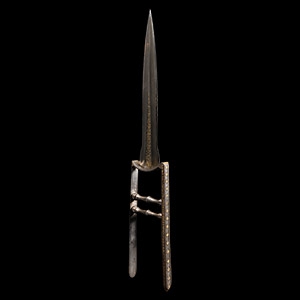
Indian Quatar Iron Dagger
18th-19th century A.D.Estimate: £900 - 1,200 (+bp*)
Opening Bid: £500
Comprising a broad blade tapering to an armour-piercing point, the steel side bars and balustered grips decorated with copper Koftgari work flowers and scrolls. 488 grams, 48 cm
General condition very good.
Property of a London gallery.
Unique to South Asia, the quatar or katar was a dagger that held at the crossbars with a clenched fist. The weapon was meant to be thrust into the opponent or prey from a close range. Rajput and Mughal royalty used this weapon to hunt tigers and even crocodiles to demonstrate their bravery and martial skill. -
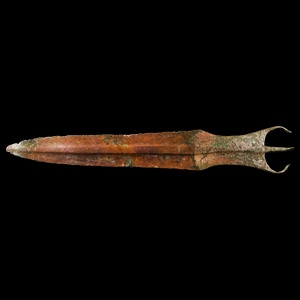
North-West Persian Bronze Dagger with Horns
Circa 1st millennium B.C.Estimate: £300 - 400 (+bp*)
Opening Bid: £150
With curved 'horns' projecting on either side at top of waisted grip, blade with flat mid-rib. 249 grams, 41.5 cm
Acquired 1980-2015. Ex Abelita family collection.
The Luristani people produced a quantity of fine metalwork, which according to Dr Khorasani, could be due to a settled period which arose as a result of the defeat of the Elamites by the Babylonians, leaving the Luristani people in relative peace for a period of time after 1200 B.C. According to Khorasani 'A culture of innovation and experimentation flourished, and the repertoire of the Luristan smiths expanded in the period between 1150-1050 BC.'
