
Loading, please wait...
LOT 0731
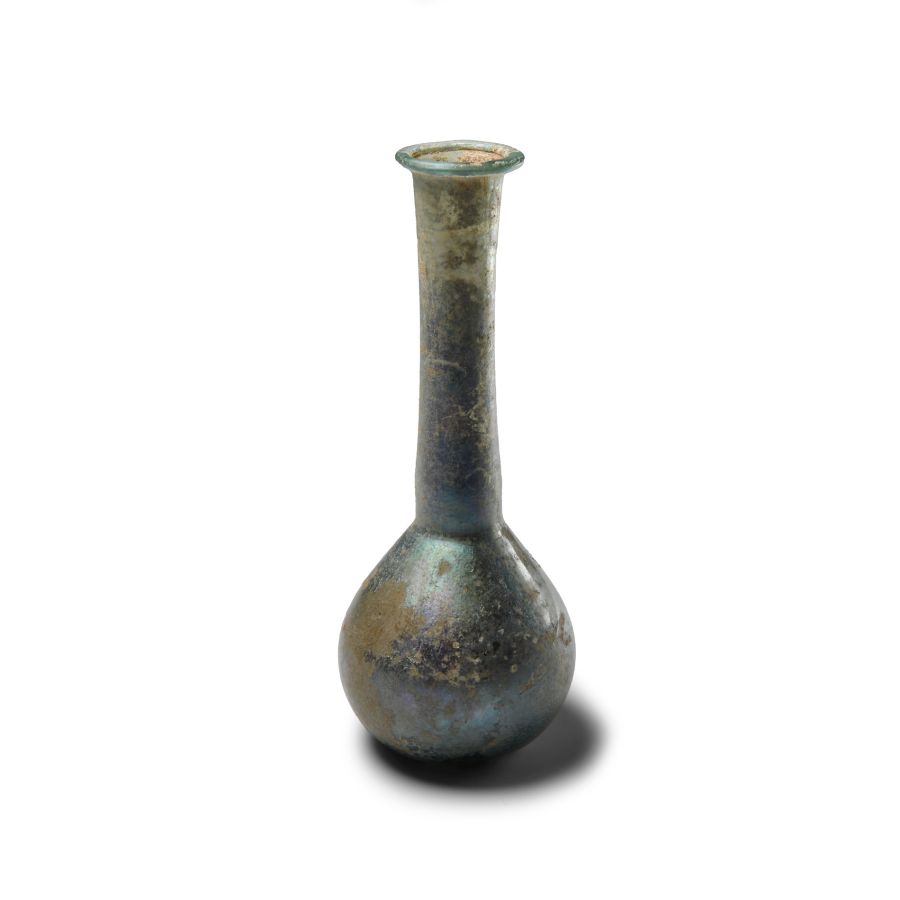
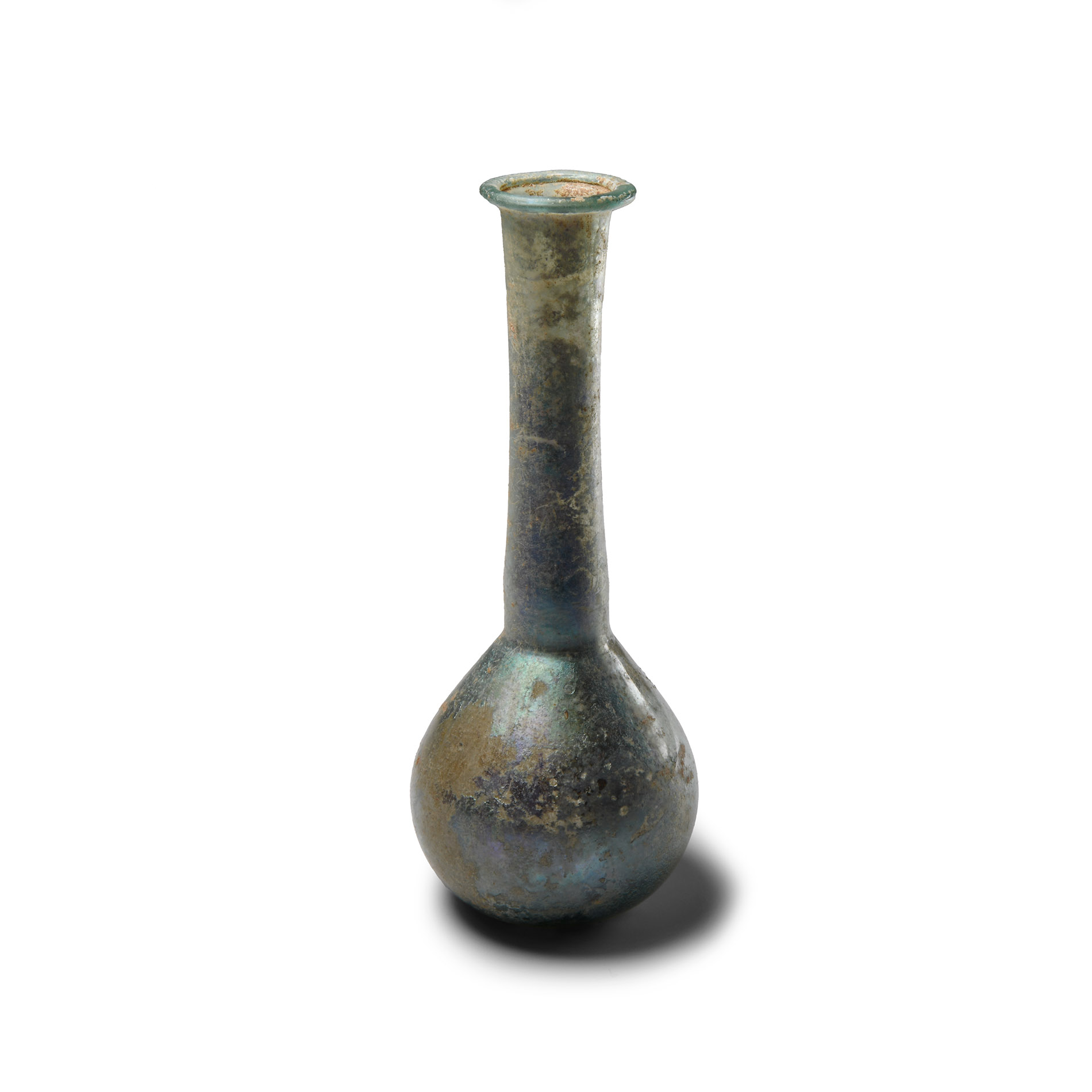
Roman Iridescent Green Glass Ampulla
1ST-3RD CENTURY A.D.
4 1/2 in. (23 grams, 11.6 cm high).
Featuring a bottle of a wide form, free blown from translucent glass of a soft turquoise hue, defined by a slightly concave base, a piriform body with a tapered shoulder, a lightly corseted neckline beneath a cylindrical neck, and a splayed rim with an in-folded lip.
ProvenanceAcquired 1980-2015.
Ex Abelita family collection.
Cf. Filarska, B., Szkla Starozytne (Ancient Glass) II vol., Warszawa, 1972, II, cat.84, pl.XVIII,1, for similar vessel.
FootnotesThe ampulla was a small round vessel, usually made of glass and used for sacred purposes. The word is used in archaeology, also for flasks that are often handle-less and much flatter. Materials include glass, ceramics and metal. The unguentarium was a term for a bottle believed to have been used to store perfume.
CONDITIONTimeLine Auctions follows a vetting process to ensure the authenticity and legality of all items, reinforcing our commitment to integrity and responsible trading. Each antiquity, antique, and coin lot undergoes thorough examination by a vetting committee of at least ten external specialists, professional trade association members, scientists, and archaeologists: Our Vetting Process
AUCTIONS:
TimeLine is a leading auction house specialising in antiquities, ancient art, collectables, natural history, coins, medals, and books. Our auctions offer museums, collectors, historians, and enthusiasts the opportunity to acquire unique and historically significant pieces.
-
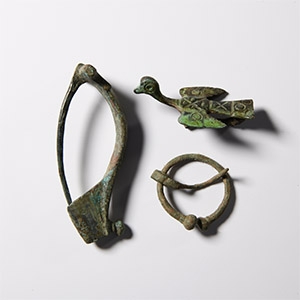
Roman Bronze Brooch Group
1st-4th century A.D.Sold for (Inc. bp): £98
Comprising: a bird-in-flight with incised annulets and X-motifs to the body, accompanied by a typed ticket 'Roman bronze brooch of bird in flight, beautifully incised decoration, iron pin intact, 2nd century AD, authenticated by British Museum, 30/5/2006'; a penannular brooch with clubbed terminals; a bow brooch with carinated bow. 31 grams total, 31-63 mm
Acquired in the 1980s-1990s. Property of a Nottinghamshire gentleman. -
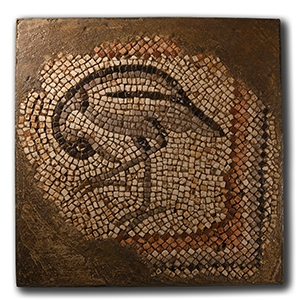
Eastern Roman Mosaic Depicting a Bird
4th century A.D.Sold for (Inc. bp): £2,860
In a rectangular matrix; cream, olive, pink and other tesserae depicting a bird advancing with head bowed, with banded frame. 10.35 kg, 40.3 x 40.3 cm
Former collection of Mr Pierre Bart (1889-1964), official of the French mandate in Syria and Lebanon (1919-1936) and delegate to the Lebanese government until 1946. Transmitted by descent. -
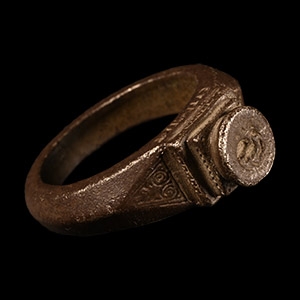
Roman Silver Ring with Inscription to the Sides
1st-4th century A.D.Sold for (Inc. bp): £169
With a keeled hoop having a Greek inscription to both sides beneath the bezel; expanding shoulders with triangular panels engraved with palmettes; tiered bezel, the lower level with incised Greek key design to the short edges, the second level with a zig-zag pattern around the perimeter, the round top part with an incised bird motif. 10.38 grams, 27.41 mm overall, 17.36 mm internal diameter (approximate size British N, USA 6 1/2, Europe 13.72, Japan 13)
Ex London art market, 1990s.
