
Loading, please wait...
LOT 0588
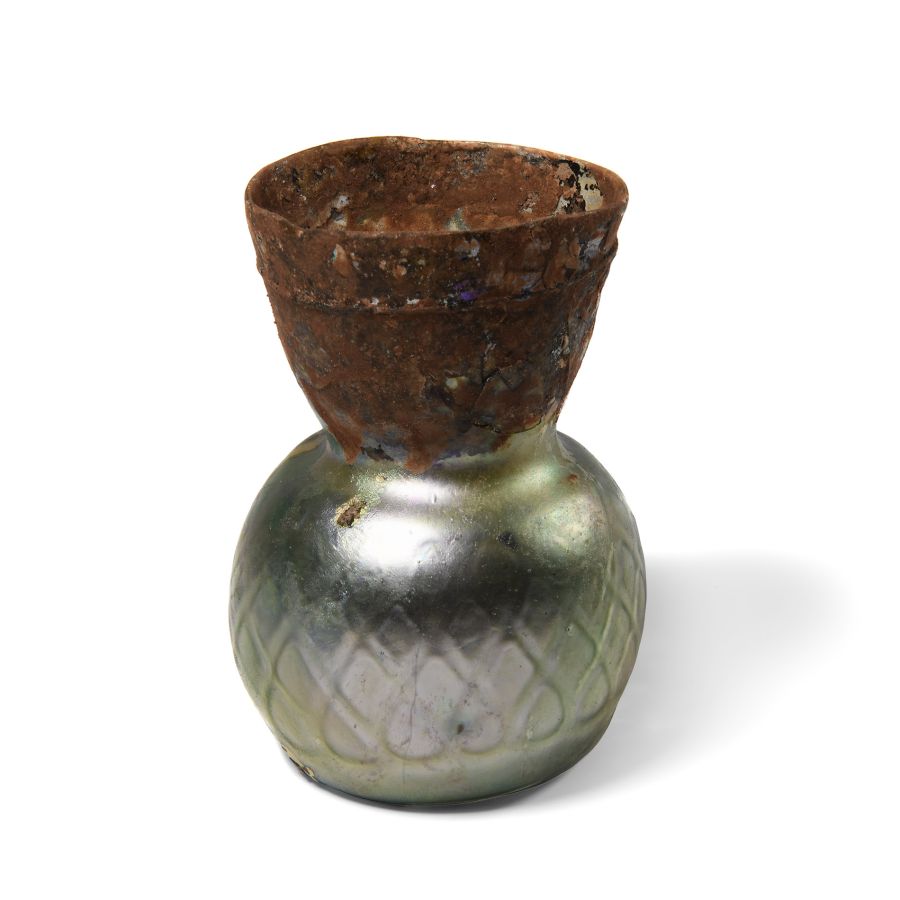
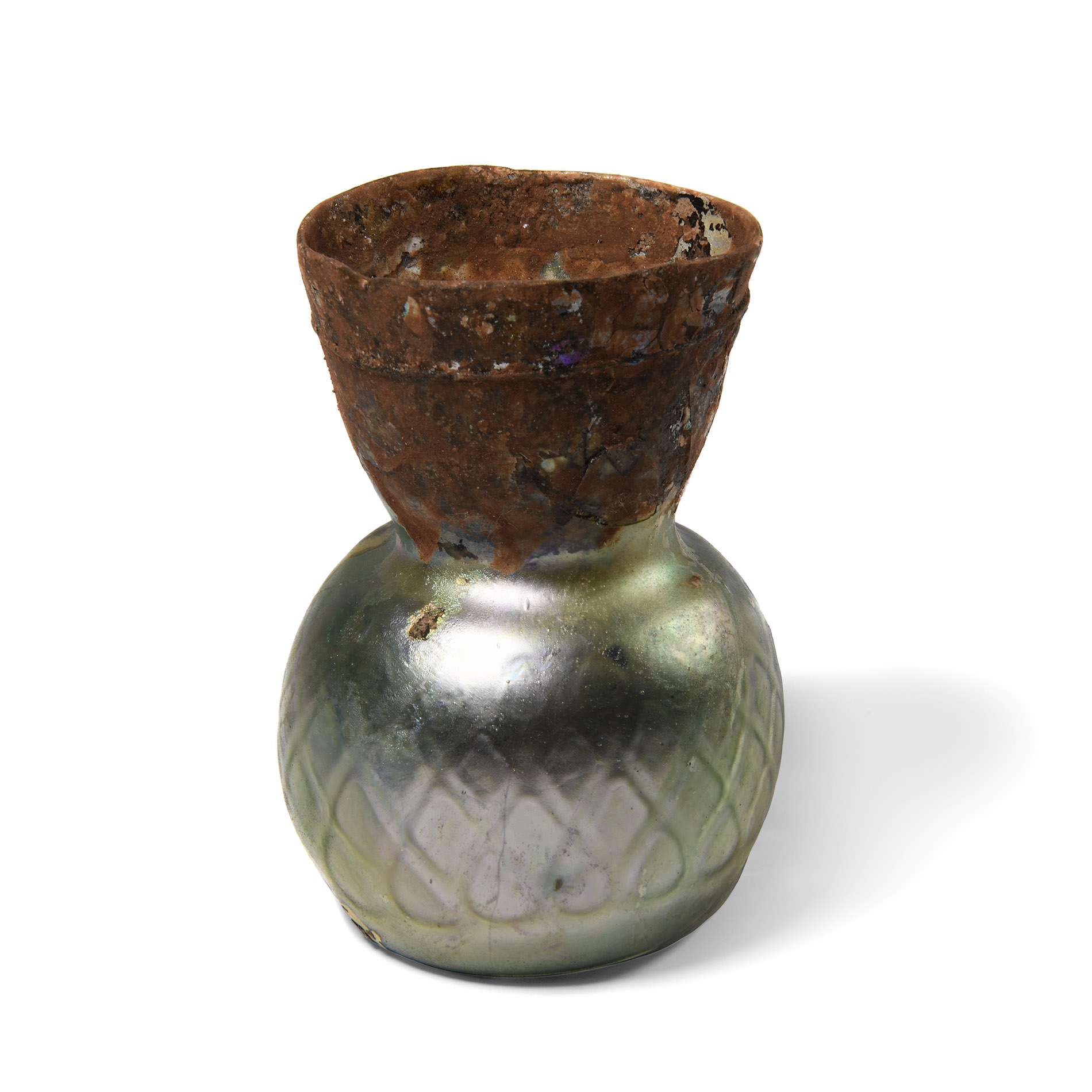
Roman Iridescent Glass Vase with Chequered Pattern
1ST-4TH CENTURY A.D.
4 1/4 in. (49 grams, 11 cm high).
A glass vase with a rounded body decorated with a lozenge 'net' motif, broad flared neck, kick-up to base; extensive iridescence, repaired.
ProvenanceAcquired early 1990s.
Ex private American collection; thence by descent.
Private collection since 1998.
TimeLine Auctions follows a vetting process to ensure the authenticity and legality of all items, reinforcing our commitment to integrity and responsible trading. Each antiquity, antique, and coin lot undergoes thorough examination by a vetting committee of at least ten external specialists, professional trade association members, scientists, and archaeologists: Our Vetting Process
AUCTIONS:
TimeLine is a leading auction house specialising in antiquities, ancient art, collectables, natural history, coins, medals, and books. Our auctions offer museums, collectors, historians, and enthusiasts the opportunity to acquire unique and historically significant pieces.
LOT 0588
Roman Iridescent Glass Vase with Chequered Pattern
Estimate £300 - 400€350 - 460 (for guidance only)$410 - 540 (for guidance only)
-
.jpg)
Roman Key with Chain
2nd-3rd century A.D.Sold for (Inc. bp): £59
A key composed of a D-section handle and integral loop, decorated with hatched geometric motifs, notched rectangular-section stem and rectangular bit with six teeth; chain composed of nine links. 18.8 grams, 22 cm
Fine condition.
Acquired Munich, Germany, late 1990s. Property of an East London gentleman. -
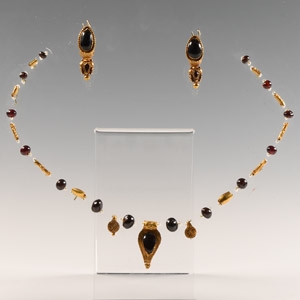
Roman Gold Necklace Element and Earring Set
2nd century A.D.Estimate: £3,000 - 4,000 (‡+bp*)
Opening Bid: £1,500
A suite of gold and garnet jewellery, comprising a matching pair of gold earrings, each composed of a hollow crescentic body tapering to slender coiled wire terminals, a suspension loop to each shoulder, large tear-shaped cell to front with granulated border, set with a polished garnet cabochon, gold bulbs below in the form of a bunch of grapes, adorned with smaller granules and three cells set with polished garnet cabochons; the necklace elements comprising graduated beads, alternating between roughly spherical polished garnets and sheet-gold beads of various types including gusseted, biconical and tubular, two floral filigree pendants flanking a central pendant ornamented with 'plaited' and plain filigree wire with granules to the outside, finial of trefoil bulbs, central corrugated cell set with a polished garnet cabochon; mounted on a custom-made perspex display base. 435 grams total, display stand: 30 x 23.5 cm (earrings: 38 mm each)
Ex private European collection, 1970s. with Genève Enchères, 14 December 2017, Lot 999. Accompanied by an academic report by Dr Raffaele D’Amato. This lot has been checked against the Interpol Database of stolen works of art and is accompanied by search certificate number no.11584-199015.
Beryls, used as small pendants, and not placed horizontally, characterised Roman necklaces of 2nd century A.D. A typical example is the necklace found in the grave of Crepereia Tryphaena. The contents of the grave are dated to the Antonine age based on the sarcophagus, the inscription and the hairstyle of the doll it contains. -
.jpg)
Roman Medical Instrument Group
1st-3rd century A.D.Sold for (Inc. bp): £25
A group of two medical instruments comprising: a probe with one thick rounded end and a triangular blade to the other; a probe with one knopped end and a flat spoon or pallette to the other. 26.9 grams total, 12.3-16 cm
Fine condition.
Ex UK art market, 1970s. Property of a London gentleman.
