
Loading, please wait...
_900x900.jpg "Roman Iridescent Glass Double Unguentarium")
_200x200.jpg "Roman Iridescent Glass Double Unguentarium")
.jpg "Roman Iridescent Glass Double Unguentarium")
LOT 0138
Roman Iridescent Glass Double Unguentarium
2ND-3RD CENTURY A.D.
6 3/4 in. (59 grams, 17 cm).
With rolled rim to each tapering tube, applied trail detailing to the body, lateral angled handles and large applied loop handle above; iridescent surface.
ProvenanceAcquired in the mid 1980s-1990s.
Private collection, Switzerland, thence by descent.
Private collection, since the late 1990s.
This lot has been checked against the Interpol Database of stolen works of art and is accompanied by search certificate number no.12237-222167.
This lot is accompanied by an illustrated lot declaration signed by the Head of the Antiquities Department, Dr Raffaele D’Amato.
This lot is accompanied by an illustrated lot declaration signed by the Head of the Antiquities Department, Dr Raffaele D'Amato.
Cf. Lightfoot, C.S., Ancient Glass in National Museums Scotland, Edinburgh, 2007, item 460.
CONDITIONTimeLine Auctions follows a vetting process to ensure the authenticity and legality of all items, reinforcing our commitment to integrity and responsible trading. Each antiquity, antique, and coin lot undergoes thorough examination by a vetting committee of at least ten external specialists, professional trade association members, scientists, and archaeologists: Our Vetting Process
AUCTIONS:
TimeLine is a leading auction house specialising in antiquities, ancient art, collectables, natural history, coins, medals, and books. Our auctions offer museums, collectors, historians, and enthusiasts the opportunity to acquire unique and historically significant pieces.
LOT 0138
Roman Iridescent Glass Double Unguentarium
Estimate £600 - 800€700 - 930 (for guidance only)$810 - 1,080 (for guidance only)
-
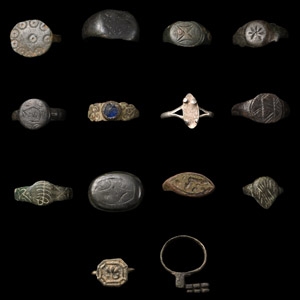
Roman and Later Bronze and Silver Ring Collection
1st-16th century A.D.Sold for (Inc. bp): £260
Comprising: a key ring, eleven rings with decorative motifs on the bezels, a ring set with blue glass, and a silver ring with lentoid claw bezel. 45 grams total, 16-24 mm
Ex German art market, 2000s. Acquired from an EU collector living in London. From the collection of a Surrey, UK, gentleman. This lot is accompanied by an illustrated lot declaration signed by the Head of the Antiquities Department, Dr Raffaele D'Amato. -
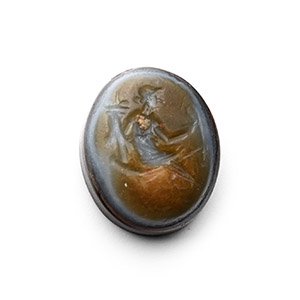
Roman Agate Gemstone with Seated Figure
2nd-3rd century A.D.Sold for (Inc. bp): £234
Plano-convex in section with incuse sitting figure of Isis holding a cornucopia with a ship's rudder beside her. 0.58 grams, 9 mm
From the Fadel family collection, London, UK, 1970s. This lot is accompanied by an illustrated lot declaration signed by the Head of the Antiquities Department, Dr Raffaele D'Amato. -
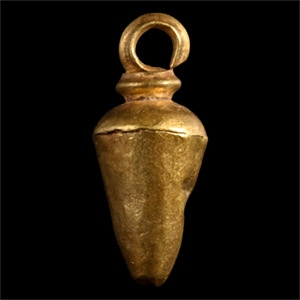
Late Roman Gold Teardrop Pendant
6th century A.D.Sold for (Inc. bp): £254
Comprising a conical body with collared suspension loop above. 0.31 grams, 11 mm
From the collection of a late Japanese collector, 1970s. This lot is accompanied by an illustrated lot declaration signed by the Head of the Antiquities Department, Dr Raffaele D'Amato.
During the Late Empire, earrings with biconical foil applications became widespread in Roman Egypt. The comparison with necklaces containing similar biconical elements used as beads or suspension elements for pendants seems to give consistency to the chronological indication of the 6th century, especially in that geographical area.
