
Loading, please wait...


LOT 0929
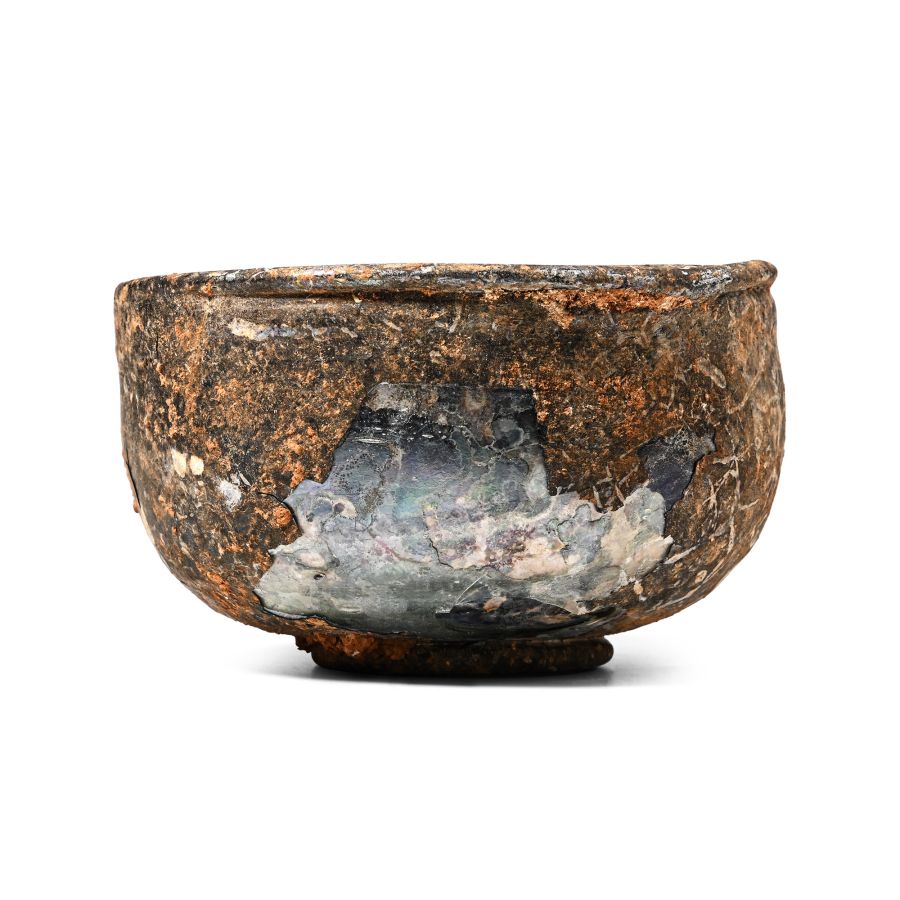
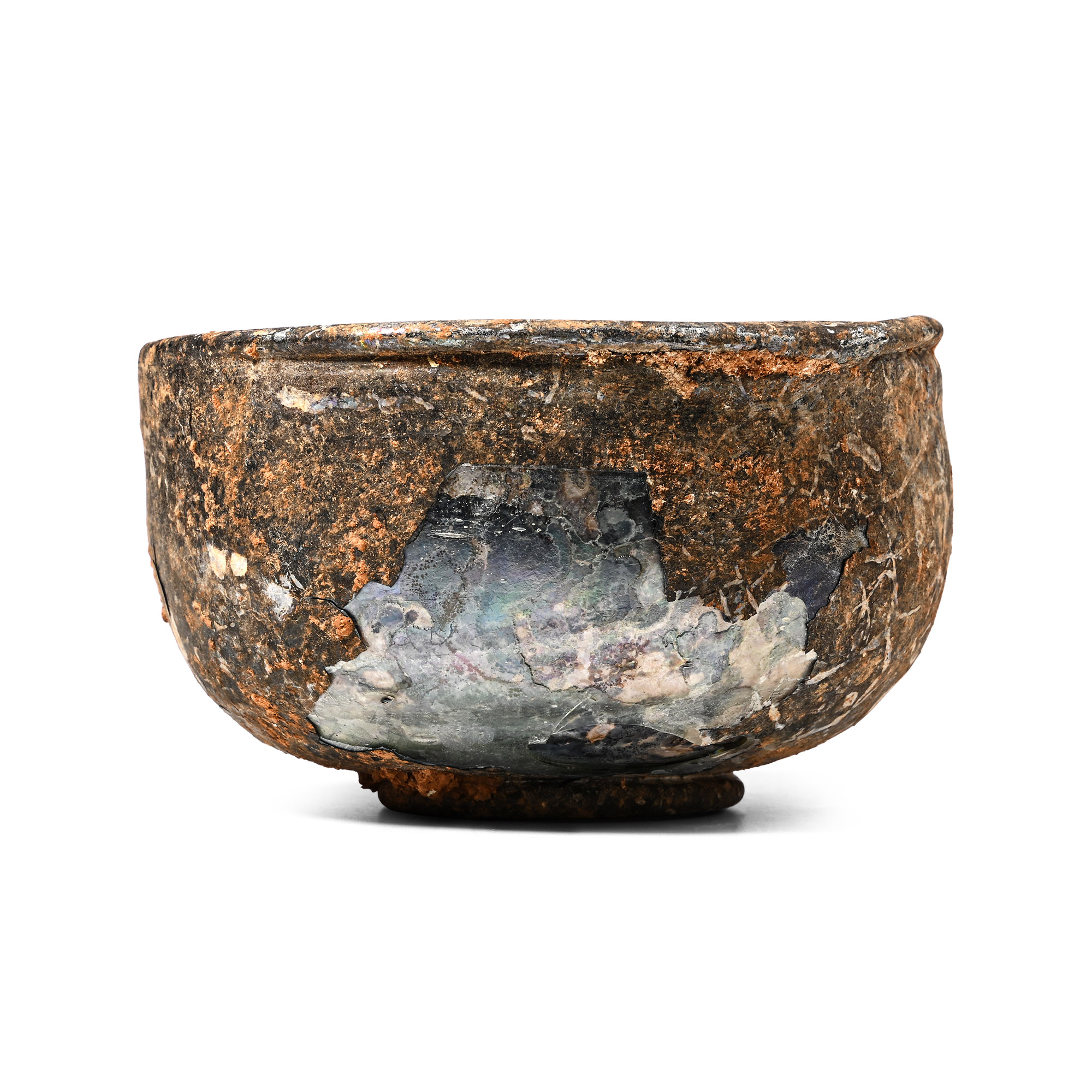
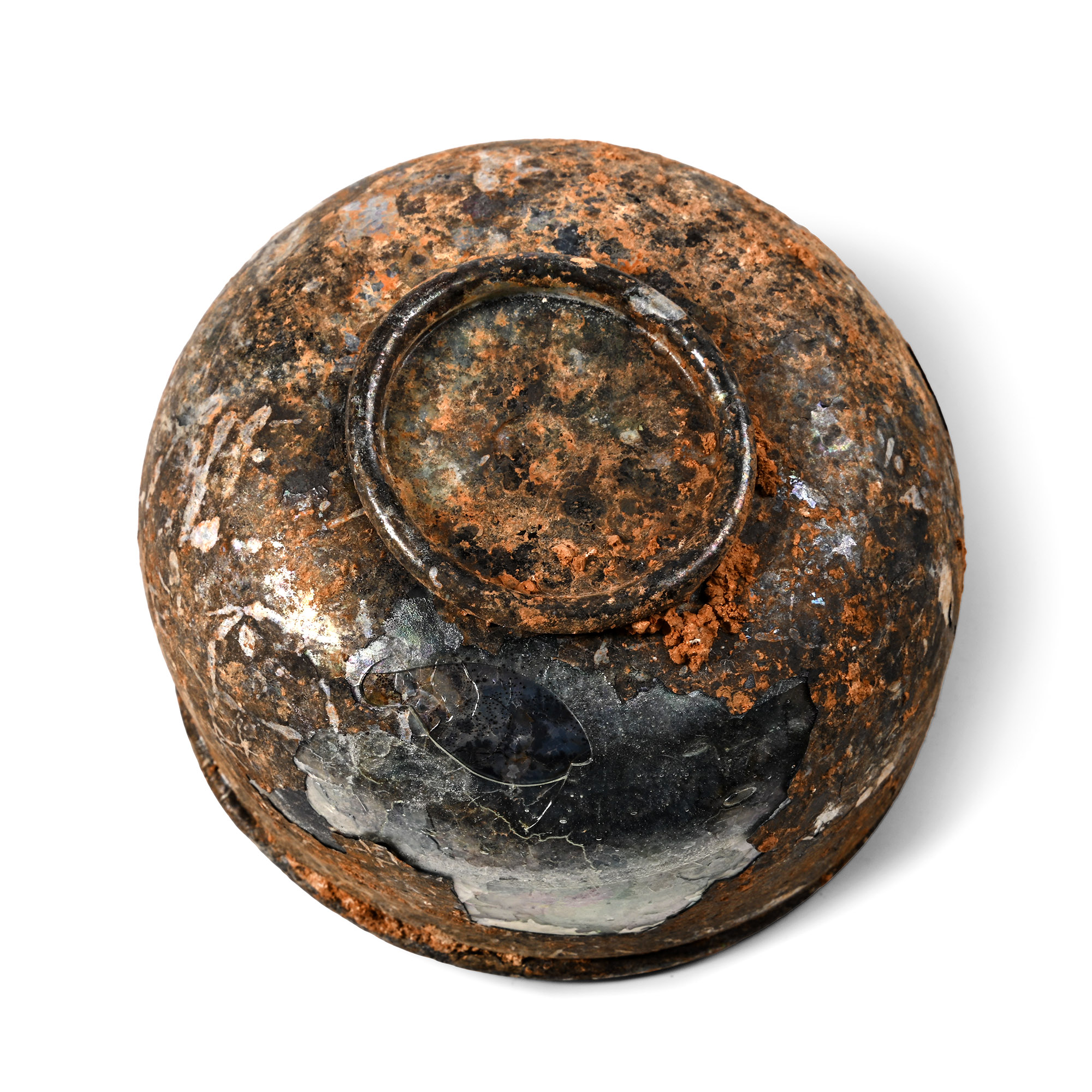
Roman Iridescent Glass Bowl
3RD-4TH CENTURY A.D.
4 1/8 in. (53 grams, 10.5 cm wide).
Wide bowl with rolled rim and an applied basal ring.
ProvenanceAcquired in the 1990s from London dealerships and auction houses.
From the Lonson collection.
Cf. for a similar example Filarska, B., Szkla Starozytne (Ancient Glass), vol.II, Warszawa, 1972, II, cat.52, pl.XII,1.
CONDITIONTimeLine Auctions follows a vetting process to ensure the authenticity and legality of all items, reinforcing our commitment to integrity and responsible trading. Each antiquity, antique, and coin lot undergoes thorough examination by a vetting committee of at least ten external specialists, professional trade association members, scientists, and archaeologists: Our Vetting Process
AUCTIONS:
TimeLine is a leading auction house specialising in antiquities, ancient art, collectables, natural history, coins, medals, and books. Our auctions offer museums, collectors, historians, and enthusiasts the opportunity to acquire unique and historically significant pieces.
LOT 0929
Roman Iridescent Glass Bowl
Estimate £300 - 400€350 - 460 (for guidance only)$410 - 540 (for guidance only)
-
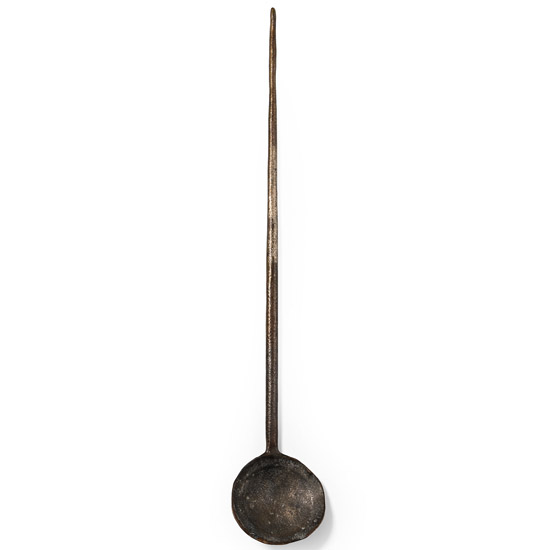
Roman Tinned Bronze Cochlear Spoon
Circa 2nd-3rd century A.D.Sold for (Inc. bp): £130
Featuring a long, pointed handle and a round bowl. 6.91 grams, 13.5 cm
From the private collection of a South London, UK, gentleman, formed since the early 1970s; thence by descent 2006. -
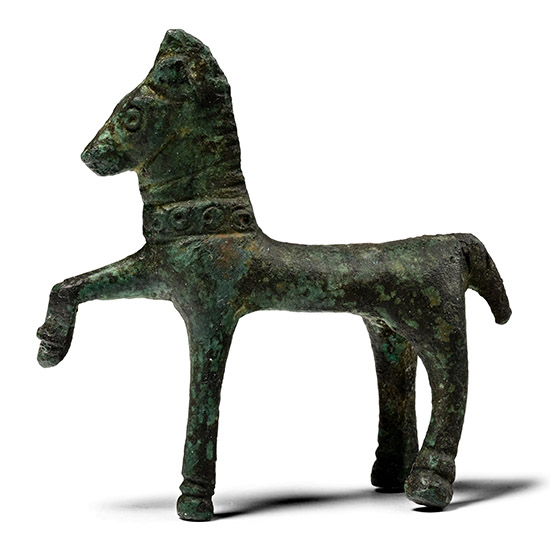
Roman Bronze Stepping Horse Statuette
100-300 A.D.Sold for (Inc. bp): £468
Modelled in the round with an elongated body and legs, right foreleg raised, head turned slightly to the right, a stamped ring-and-dot collar around the neck and eyes indicated by ring-and-dot motifs. 27.44 grams, 49 mm
From the private collection of a European gentleman (1942-2024), formed since the 1970s. -
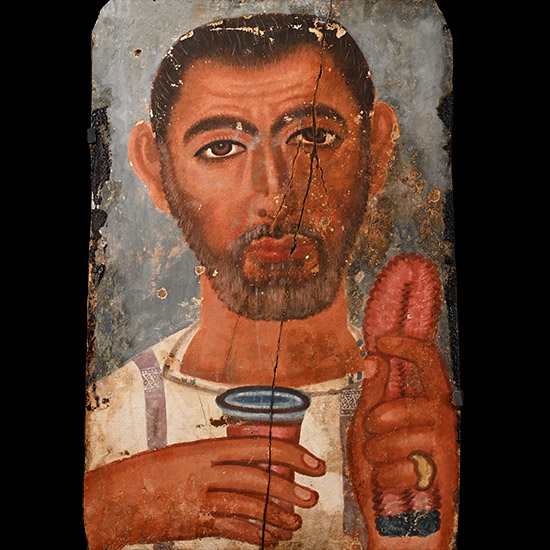
Roman Fayum Wooden Portrait of a Bearded Man
Egypt, 3rd-4th century A.D.Sold for (Inc. bp): £49,400
An intimate portrait depicting a middle-aged man with a slightly doleful expression, receding hair with grey flecks, and a furrowed brow, wearing a white tunic with lilac-coloured clavi (vertical stripes) and white stitching over a white undertunic; holding a glass vessel containing red liquid in his right hand, most probably wine, whilst his left hand cradles a garland of roses, a ring visible on the little finger of his left hand; the figure set against a pale blue background, painted in tempera on a wooden panel; set in a glazed display frame. 8.53 kg total, 50 x 37.5 cm including frame
International art market, by at least 1997. with Sotheby’s, London, 12 June 1997, Western Asiatic Antiquities and Cylinder Seals from the Erlenmeyer Collection (Part II), no.338 (£40,000-£50,000). Private collection of an Italian scholar, New York. Accompanied by a copy of an Art Loss Register certificate no.S00271547. Accompanied by copies of the relevant Sotheby's catalogue pages. This lot has been checked against the Interpol Database of stolen works of art and is accompanied by search certificate number no.13315-257736.
From the late 19th century onwards, a large number of painted wooden portraits began to appear on the European and American art market, originating from the Fayum region of Egypt, to the southwest of Cairo, where wealthy Romano-Egyptian families buried their dead. Following ancient custom, the mummified body was fitted with a painted wood portrait over its face, preserving the likeness of the deceased for eternity. In 1887, over three hundred such portraits were acquired by the Austrian dealer Theodor Graf (1840–1903) from the cemetery of Er-Rubayat, on the northeast side of the Fayum. Portraits from this area are characteristically identifiable by their clipped upper corners and the undertunics worn by the subjects, both features present in this work. During his lifetime, Graf sold ninety of these portraits, with the remainder disposed of by his heirs after his death. Examples from his collection entered many of the world's great institutions, including the Staatliche Museen zu Berlin, the National Gallery, London, and the British Museum, London. Two particularly close comparanda are of note. A portrait of a boy holding a garland and a glass vessel containing liquid, also from Er-Rubayat, is held in the Brooklyn Museum (see The Brooklyn Museum Handbook, Brooklyn, 1967, p. 100). An even closer parallel exists in the J. Paul Getty Museum, Malibu, likewise from Er-Rubayat (see E. Doxiadis, The Mysterious Fayum Portraits: Faces from Ancient Egypt, 1995, p. 221, no. 7; and S. Walker and M. Bierbrier, Ancient Faces: Mummy Portraits from Roman Egypt, exhibition catalogue, London, 1997, p. 102, no. 95). Significantly, the distinguished scholar Dr Klaus Parlasca attributed both the Brooklyn and Getty portraits to a single anonymous master he designated as the Brooklyn Painter, and some years ago suggested that the present portrait may be attributed to the same hand. Should this attribution hold, this work joins a small and distinguished group of panels recognised as the output of one of the most accomplished artists working in Roman Egypt.
