
Loading, please wait...


LOT 0954
Roman Iridescent Glass Bottle
1ST-2ND CENTURY A.D.
3 1/4 in. (13.5 grams, 84 mm).
Tubular in form with shallow rounded base, sloped shoulder and flared rim to the mouth. [No Reserve]
ProvenanceEx London, UK, art market 1990s.
LiteratureCf. British Museum reference number 899,1229.6, for a vessel of similar form.
CONDITIONTimeLine Auctions follows a vetting process to ensure the authenticity and legality of all items, reinforcing our commitment to integrity and responsible trading. Each antiquity, antique, and coin lot undergoes thorough examination by a vetting committee of at least ten external specialists, professional trade association members, scientists, and archaeologists: Our Vetting Process
AUCTIONS:
TimeLine is a leading auction house specialising in antiquities, ancient art, collectables, natural history, coins, medals, and books. Our auctions offer museums, collectors, historians, and enthusiasts the opportunity to acquire unique and historically significant pieces.
LOT 0954
Roman Iridescent Glass Bottle
Estimate £60 - 80€70 - 93 (for guidance only)$81 - 108 (for guidance only)
Opening Bid
£5 (EUR 6; USD 7) +BP*
-
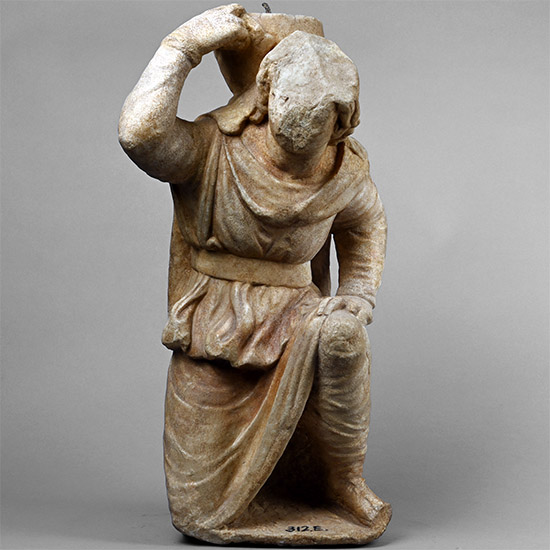
Roman Marble Figure of a Persian Water Carrier
2nd century A.D.Estimate: £40,000 - 60,000 (‡+bp*)
Opening Bid: £20,000
Depicted kneeling on his right knee, his left hand resting on his left knee, his right arm raised to support the water jar on his shoulders, shown wearing a Phrygian cap over his curling hair, dressed in a belted tunic falling in thick folds, the lower drapery stretched over the knees, and strapping on the legs, with a long cloak over the top, pinned at his right shoulder and falling down his back, set on an integral base. 39.45 kg, 59.7 cm
Ex private collection, Europe. Ex Australian collection, 1960s. On loan to La Trobe University, Melbourne, Australia, 1981-1986. Bonhams, London, 28 April 2010, no.139. Private collection, Europe. Accompanied by a printed copy of the Spanish cultural export licence no.1775-3178156. Accompanied by a copy of the Graham Geddes, Antiques & Antiquities invoice, 17 April 2007. Accompanied by a copy of an Art Loss Register certificate, no.2709AM. Accompanied by copies of the relevant Bonhams catalogue pages. Accompanied by an academic report by Dr Raffaele D’Amato. This lot has been checked against the Interpol Database of stolen works of art and is accompanied by search certificate no. 10272-168595.
The image of the subjected foreigner (‘barbarian’) became particularly prevalent in the late 1st and early 2nd centuries A.D. as a reflection of increased Roman expansion and part of an iconography of empire and triumph. The clean-shaven face of this figure indicates that it represents a so-called 'Oriental', i.e., a Persian, instead of a bearded European. -
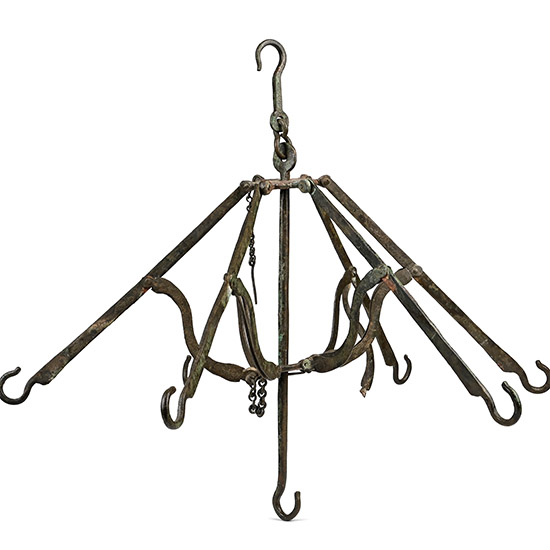
Roman Military Bronze Folding Campaign Chandelier
1st-2nd century A.D.Estimate: £4,000 - 6,000 (+bp*)
Opening Bid: £2,000
Consisting of six vertical supports with hook-shaped terminals, connected to a circular top plate via ring joints and to a circular bottom plate by paired double hooks, attached to the supports with rivets; the top circular plate linked to the bottom one by a sturdy element terminating in a hook at the lower end and a round loop at the top, where the main suspension hook for the chandelier is attached; a small chain link attached to the bottom circular plate. 1.6 kg, 54.2 cm wide
UK private collection assembled 1970s-1990s, and thence to the liquidated estate of the above. Accompanied by letter from the relevant authorities renouncing any current or future claim over this piece. This lot has been checked against the Interpol Database of stolen works of art and is accompanied by search certificate no.13446-263437.
A chandelier like this (candelabrum, λυχνίον, λαμπτήρ, φανός) was designed for easy transport and was most probably created to be used in military activities. These field chandeliers featured platforms fitted with lamp supports, which branched out into several arms from which the lamps were hung. They were highly portable and collapsible, designed to be easily dismantled and reassembled as needed. -
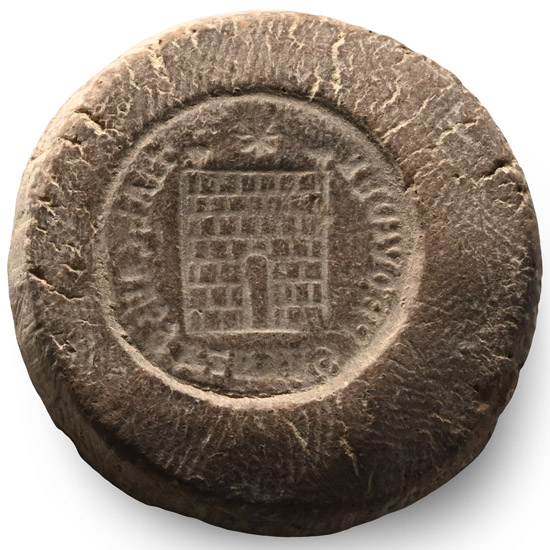
Roman Terracotta Forger's Coin Mould
Circa 3rd-4th century A.D.Estimate: £50 - 70 (+bp*)
Bids: 3 | Current Bid: £25
Discoid clay mould with an impressed design of a campgate on each face. 5.13 grams, 28 mm
London gentleman's collection, 1970-1990s, by descent.
